
Romney’s distance from past decisions helps explain potency in current criticisms
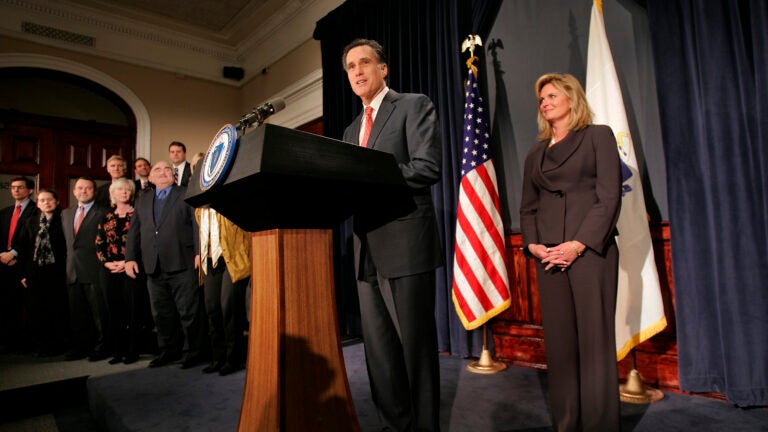
In December 2005, as reporters in Boston rushed to finish their stories before their annual State House press room Christmas party, Mitt Romney crashed the occasion by adding a whopper: He called a news conference to declare he would not seek reelection as governor of Massachusetts.
The announcement was not a complete shock, given that Romney had been laying the groundwork for a 2008 presidential campaign even before being sworn in as governor in 2003. But the spin he put on the announcement was eyebrow-raising, considering he had not yet been governor for three years.
“My decision comes down to this: In this four-year term, we can accomplish what I set out to do. In fact, we’ve already accomplished a great deal,’’ Romney said.
Standing with family members and his Cabinet against a special backdrop and at a presidential-style lectern brought in especially for the occasion, Romney declared: “Frankly there was very little to do for a second term that I could realistically accomplish.’’
Nearly six years later, one benefit from that seemingly premature departure is now clear.
Since Jan. 4, 2007, when Romney was replaced as governor by Democrat Deval Patrick, the Republican has not added a substantive achievement to his business or political records.
During the 2008 White House campaign, he had to answer for decisions made during his 25-year business career and his four-year term as governor, but ever since leaving the State House, Romney has gained increasing distance to talk about what he would do, not what he did.
In 2007 and 2008, any problematic corporate and government decisions were too new, too fresh to escape. But now, during Romney’s second presidential campaign, the sting has largely subsided.
That helps explain the confidence Romney displays today on the trail and in debates, as well as why his attacks on top rival Rick Perry have been so potent.
It also explains why Romney keeps harking back to his 2010 book, “No Apology,’’ as he seeks not only the 2012 GOP nomination, but also the presidency.
No longer at risk for fallout from management decisions, Romney has been free to create a new reality through his book, frequent op-ed columns, and speeches and television appearances at his choosing.
“I’m absolutely committed to keeping Social Security working. I put in my book that I wrote a couple of years ago a plan for how we can do that and to make sure Social Security stable not just for the next 25 years, but for the next 75,’’ Romney said during last week’s Republican debate in Orlando, Fla.
And in one of his most-quoted soundbites of the evening, Romney proclaimed: “There are a lot of reasons not to elect me, a lot of reasons not to elect other people on this stage, but one reason to elect me is that I know what I stand for, I’ve written it down. Words have meaning, and I have the experience to get this country going again.’’
Time and distance, of course, do not make Romney immune to attack.
Among the likely targets is how his venture capital firm, Bain Capital, handled American Pad & Paper Co. Bain ran up the company’s debt from $11 million to $400 million, while Romney and his partners walked away with $100 million in profits.
Ampad later went bankrupt, and the whole affair provided fodder in 1994 when Romney made an unsuccessful run for US Senate against the late Democrat Edward M. Kennedy.
“He was very, very good at making a profit for himself and his partners but not nearly as good (at) saving jobs for communities,’’ David Axelrod, the president’s chief strategist, told Politico. “His is very much the profile of what we’ve seen in the last decade on Wall Street. He was about making money. And that’s fine. But often times, he made it at the expense of jobs in communities.’’
Former Minnesota Governor Tim Pawlenty also led the charge against the universal health care law that Romney signed into law while governor of Massachusetts.
Noting how it served as the template for the federal health care law signed by President Obama, Pawlenty branded their amalgam “Obamneycare.’’
Perry himself has attacked the 2006 Massachusetts law and its mandated coverage, in part by citing a study by Suffolk University’s Beacon Hill Institute that analyzed its costs since taking effect in 2007.
“In Massachusetts, the costs have increased by more than $8 billion, that’s what that socialized individual mandated health care bill that they put in place in Massachusetts did,’’ the Texas governor said in a Sept. 6 speech at the Iowa Credit Union League in Des Moines, Iowa. “Those who had insurance are now paying the price for an individual mandate for those without insurance who must join the system.’’
Perry also has noted that Romney’s fountain of youth – “No Apology’’ – was substantively changed between its original hardcover and the paperback edition released earlier this year.
“In the original, Romney wrote that (the Obama administration’s economic stimulus package) ‘will accelerate the timing of the start of the recovery, but not as much as it could have,’’’ David Bernstein of the The Boston Phoenix wrote in an article quoted by Perry. “The paperback pronounces the stimulus ‘a failure,’ and blasts Obama’s ‘economic missteps’ with conservative red-meat language — for example: ‘This is the first time government has declared war on free enterprise.’’’
Despite the attacks, Romney has emerged largely unscathed.
Part of the reason is that he has developed stock answers for these old criticisms. Those answers, in turn, have given him confidence and allowed him to remain unflappable on stage. And that confidence has accentuated the difference between him – a veteran national candidate – and first-timers like Pawlenty and Perry.
In terms of jobs, Romney has said the good and bad of his business career have given him a real-world economic standing that can help the country recover from the Great Recession.
“Unlike career politicians who’ve never met a payroll, I know why jobs come and go,’’ Romney wrote in USA Today on Sept. 6, the day he outlined his job-creation plan during a speech in North Las Vegas, Nev.
Romney has also focused on his Bain victories. They include providing funding to help launch or grow Staples, Domino’s Pizza, and other household names.
“When I was at Bain Capital, we invested in about 100 different companies. Not all of them worked,’’ he said during a debate in August. “But I’m very proud of the fact that I learned about how you can be successful with an enterprise, why we lose jobs, how we gain jobs and overall, in those 100 businesses we invested in, tens of thousands of jobs, net-net, were created.’’
Romney even ignores his 1994 Senate campaign, his unsuccessful 2008 presidential campaign, and the three years he has spent campaigning since, as he contrasts his limited four years in office with his 25 years in the private sector.
“I spent my life not in politics; I’ve only been in politics four years. I was governor for four years. I didn’t inhale,’’ Romney joked during a Fox News Channel interview on June 2, the first day of his second campaign. “My life has been as a private-sector guy.’’
That is only because he lost two of three political campaigns.
On health care, Romney has seized on a constitutional argument popular with conservatives that casts the issue in states-rights terms.
“Our plan was a state solution to a state problem, and (Obama’s) plan is a power grab by the federal government to put a one-size-fits-all plan across the nation,’’ Romney said on May 12 as he addressed the subject during a speech at the University of Michigan Medical Center in Ann Arbor, Mich.
In the paperback edition of his book, he also blames Massachusetts Democrats for overriding some vetoes he made to the plan and Patrick – his successor as governor – for his implementation of it.
And Romney cited “No Apology’’ in countering a health care criticism leveled by Perry during last week’s debate.
“It’s fine for to you retreat from your own words in your own book, but please don’t try and make me retreat from the words that I wrote in my book,’’ Romney said. “I stand by what I wrote. I believe in what I did.’’
While the Romney team expected the Massachusetts law to be one of their key campaign vulnerabilities – as highlighted by their decision to stage the May speech in Michigan – the damage has been minimal so far.
“Those who like it, like it, those who don’t like it, don’t like it,’’ Jim Talent, a former US senator from Missouri and top Romney adviser, told the Globe’s Matt Viser. “But I think it’s sort of been assimilated into the body politic. It’s been discounted by the political market.’’
Pawlenty even endorsed Romney after becoming the first candidate to quit the campaign.
“I talked to Mitt about this at some length, and, look, for Republican primary voters, one of their main concerns is the repeal of Obamacare, and Mitt Romney is 100 percent dedicated and committed to repealing Obamacare,’’ Pawlenty said of Fox News on Sept. 12, the day he joined Romney’s campaign as a national co-chairman.
The stock answers and confidence they’ve engendered have also prompted Romney to be an aggressor against his primary opponents, especially Perry, while remaining focused on a potential general election matchup against Obama.
Romney initially attacked Perry for his Social Security views, which have included the Texas governor labeling the safety-net program a “Ponzi scheme’’ and even questioning its constitutionality.
“I want to save Social Security; it’s an essential safety net for the American people,’’ Romney said during a Sept. 8 interview with Sean Hannity of Fox News. “And number two, it’s terrible politics. If we nominate someone who the Democrats can correctly characterize as being opposed to Social Security, we will be obliterated as a party.’’
During their most recent debate last week, Romney pivoted to a fresh line of attack: illegal immigration.
He blasted the Texas governor for signing a 2001 law granting allowing the children of illegal immigrants to pay in-state tuition rates to attend public colleges and universities if they have lived in the state for three years and are seeking permanent residency.
Romney noted that at the University of Texas, the difference between the in- and out-of-state tuition rates is about $22,000 annually, or nearly $100,000 over four years.
“If you are a United States citizen from any one of the other 49 states, you have to pay $100,000 more. That doesn’t make sense to me,’’ Romney said.
Perry retorted: “If you say that we should not educate children who have come into our state for no other reason than they’ve been brought there by no fault of their own, I don’t think you have a heart. We need to be educating these children, because they will become a drag on our society.’’
Perry’s claim of heartlessness has since been widely panned within the conservative electorate and media, prompting questions about whether he can still win the nomination.
The potency in Romney’s criticism was, in part, its freshness.
Few on the national stage had ever heard that in-state tuition argument framed in such specific terms. Perry himself ended up being baited into one of his most criticized answers of the night.
The criticism also carried punch because it was related to a tangible, documentable policy decision, the kind of things that CEOs and government officials add to their record every day.
In 2008, Obama had a scant record in national and international affairs and was able to project into the future with airy talk of “hope.’’
Romney was where Perry now is, saddled with the political damage that comes from fresh scrutiny of his record.
Looking ahead to next year’s primary and, potentially, general election campaigns, Perry and Obama will have to talk about what they have done. Through his book, continued writings, debate appearances, and speeches, Romney can focus more on what he would do.
For a candidate who once joked about being unemployed, it’s had its benefits.





To comment, please create a screen name in your profile
To comment, please verify your email address
Conversation
This discussion has ended. Please join elsewhere on Boston.com