
Romney pushed to oust Bulger over brother
To outsiders, it may have seemed strange for a Republican presidential candidate to issue a statement about the arrest of a fugitive.
Mitt Romney, June 21, 2003Michael Dwyer/AP
But Mitt Romney isn’t just a presidential candidate. And James “Whitey’’ Bulger isn’t just an everyday fugitive.
As the newly inaugurated governor of Massachusetts in 2003, Romney pressured Bulger’s brother William to resign as head of the University of Massachusetts system when he admitted – under a grant of immunity – that he had spoken with his brother after he became a fugitive in 1995.
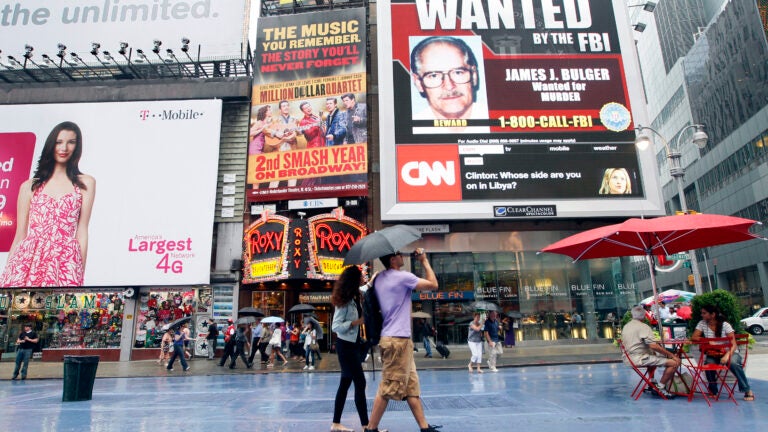
Subsequently, James Bulger joined Osama bin Laden on the FBI’s Ten Most Wanted list. Among other things, he is accused of murdering 19 people.
“I hope the capture of Whitey Bulger brings some measure of relief to the families of his numerous victims. It brings to a close a sad and sordid chapter in recent Massachusetts history,’’ Romney said in his statement today.
Left unstated was that James Bulger’s arrest is a fresh talking point for a candidate who casts himself as a non-politician, and as someone who took on the Democratic establishment when he finally entered the political arena.
And that argument could gain fresh resonance in the 2012 presidential race, as Romney pitches himself universally as a political outsider; to Democrats as someone capable of working in a bipartisan fashion, as proven with the 2006 Massachusetts universal health care law; and to Republicans as a candidate who can be trusted to challenge the Democrats who already control the US Senate and the White House.
“The entire Bulger affair established Mitt Romney as a genuine political outsider and as a person who was more interested in cleaning up government than in going along with the business-as-usual crowd,’’ said a top adviser, Eric Fehrnstrom.
Romney hadn’t even been sworn in as governor when, in December 2002, William M. Bulger appeared before Congress and refused to speak about his brother amid an investigation into the FBI’s improper dealings with informants.
James J. Bulger Jr. had cut a deal with an FBI agent to provide information about the New England mob in exchange for protection from federal prosecution. The deal spiraled out of control with allegations of murder and other crimes.
Just before William Bulger’s congressional testimony, The Boston Globe reported that in previously secret federal grand jury testimony, he acknowledged speaking with his brother shortly after he fled a federal indictment in January 1995.
“I do have an honest loyalty to my brother and I care about him,’’ Bulger told the grand jury. “I don’t feel an obligation to help everyone to catch him.’’
Before Congress, the lawyer and future academic noted the Fifth Amendment protections against self-incrimination and said it was designed to “protect innocent men who might be ensnared by ambiguous circumstances.’’
He added: “I find myself in such circumstances.’’
Romney was angered by the response, with the governor-elect saying, “I was disappointed that University of Massachusetts President Bulger could not find a way to answer the questions.’’
During the next six months, Romney tried to eliminate Bulger’s $358,000-per-year job, filing a budget that eliminated the university’s presidential office. Romney argued that with each of the five campuses having its own leader, a system president was unnecessary.
He didn’t hide the fact, though, that Bulger was his primary target.
Romney also openly clashed with university trustees, Bulger loyalists who refused to oust him. Former Governor Michael S. Dukakis defended his fellow Democrat, saying Bulger had infused cash, energy, and high standards to a system whose flagship campus in Amherst had been derided as “Zoo Mass.’’
One by one, though, Romney began to make his own appointments to the 22-person board, once threatening to name two Bulger critics: Harvard Law School professor Alan Dershowitz and Boston Herald columnist Howie Carr.
Finally, the House Government Relations Committee granted Bulger immunity and subpoenaed him to testify anew before the panel. Before doing so in June 2003, he issued a statement that provided his first expansive public comments about him and his brother.
“Let me be clear,’’ Bulger said. “For 42 years I have made choices. And my choice has always been to pursue my public responsibilities and to work for the public good – as a state representative, state senator, president of the Massachusetts Senate, and as president of the University of Massachusetts.’’
Bulger said, “Changing the course of my brother’s life is something I tried to effectuate for many years. That I was not successful is a matter of great personal pain. I have done everything one could possibly do to influence the course of another person’s life.’’
Nonetheless, Attorney General Tom Reilly, a Democrat, joined the Republican Romney in calling Bulger to step down.
When Bulger finally testified on June 19, 2003, he made a lengthy opening statement that was blunt.
“I do not know where my brother is. I do not know where he has been over the past eight years. I have not aided James Bulger in any way while he has been a fugitive. Do I possess information that could lead to my brother’s arrest? The honest answer is no.’’
He added: “Truth to tell, over the years I was unable to penetrate the secretive life of my older brother. He marched to his own drummer and traveled a path very different from mine. Jim had his own ways I could not possibly influence. The realities of the situation were such that his activities were, in fact, shrouded in secrecy.’’
He also publicly acknowledged the phone call recounted privately in his grand jury testimony.
Yet Bulger also avoided direct answers in response to many committee questions, saying frequently, “I don’t recall,’’ and responding that something was “possible.’’
Romney demanded Bulger’s resignation anew, saying he had surrendered his moral authority to lead.
On Aug. 3, 2003, after the trustees negotiated a buyout for the remaining four years of his contract, Bulger announced he would quit, effective Sept. 1, 2003.
For Romney, it proved to be an enduring political victory, one his supporters are relishing with the zeal akin to that the nation felt in May when Osama bin Laden was killed, and the city experienced last week when the Boston Bruins won the the NHL Stanley Cup.
“What was remarkable about Mitt Romney’s leadership as governor is that he arrived at State House as an outsider and he left as an outsider,’’ said Fehrnstrom. “Not many people can make that claim, and it’s a testament to the type of political figure that Mitt Romney represents: He’s not beholden to special interests, and he’s guided by a very strong sense of doing the right thing.’’





To comment, please create a screen name in your profile
To comment, please verify your email address
Conversation
This discussion has ended. Please join elsewhere on Boston.com