
Address newsletter
Get the latest news on buying, selling, renting, home design, and more.
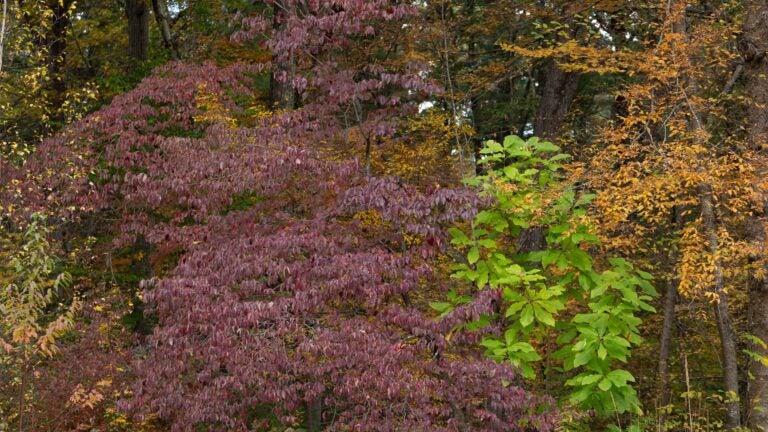
Welcome to the autumnal season, New England! This week in the garden, I have been observing the emerging foliar radiance of flowering dogwood, currently featuring a stately progression of crimson, burgundy, and purple, punctuated by fiery-red fruit. Rainfall, or rather the lack thereof, is also on my mind this week. How does a late summer drought affect the fall color of trees? Which perennials in my garden have weathered this period well, and which have not? Our region is world-famous for its autumn colors, and many foresters predict an excellent foliar season. The science of fall color is fascinating, an elegant interplay between weather conditions and the production of sugar via photosynthesis with the associated pigments the starring actors. With weather being variable, no two autumns are ever the same. However, this year, the combination of a wet spring and warm summer that has culminated in warm days but cool nights should produce a brilliant response by the trees of our forests and woodlands. For those looking for a deeper analysis of fall color, check out the US Forest Service page.
Q. Hi! My hydrangea was big and blue and beautiful this summer for the first year. Tell me, do I cut off the dead flowers right now, and should I cut back the shrub within the next month so that it will grow back just as beautiful next year?
JEANNIE GARDNER
A. Despite the dry conditions, this summer has been outstanding for hydrangeas. Here is what to do to be sure your shrubs are in good shape for next year. Hydrangeas fall into two groups when it comes to pruning. The first group encompasses oak leaf (Hydrangea quercifolia), big leaf (Hydrangea macrophylla), mountain (Hydrangea serrata), and climbing hydrangea (Hydrangea petiolaris). These all flower on old wood and should be pruned only after flowering in late summer. Pruning these in the fall, winter, or spring will remove next year’s flower buds. Typically, late-summer pruning entails deadheading, the removal of broken or dead branches, and light trimming for shape. The second group contains smooth (Hydrangea arborescens) and panicled hydrangea (Hydrangea paniculata). These shrubs flower on new wood (the current year’s growth) and should be pruned in late winter or early spring. With clean, sharp, and sanitary pruners, remove up to one-third of the branch, pruning just above the node (or bud). Favor strong-growing stems over spindly stems and consider overall shape and form.
Q. My question is about aggressive native plants. We’re all well aware of the unwelcome spread of aggressive introduced non-native plants like Norway maple, oriental bittersweet, and buckthorn, but I am curious about the appropriateness of introducing aggressive native plants into an area where that native plant doesn’t currently exist, even if it is considered native to that state. For example, I planted a white snakeroot (Ageratina altissima) a few years ago and found it self-seeding around my yard. Now I am noticing it on other properties in my neighborhood. Native plants, by design, seed around. Should I be worried about the spread of aggressive spreaders like snakeroot, great blue lobelia (Lobelia siphilitica), golden Alexander (Zizia aurea), blue mist flower (Conoclinium coelestinum), and boneset (Eupatorium perfoliatum)? What if a property is abutting open space or conservation land?
ANN DORFMAN, Newton
A. If only all plants came with a user manual! Gardeners are often surprised when a native plant exceeds their expectations regarding dispersal. Exuberant dispersal, whether via seed or rhizome, is a survival strategy many plants employ in response to disturbance or changes in conditions. Ecologically harmful plants like Norway maple and bittersweet exploit the disturbances our modern lives create without the competition or natural checks in their places of origin. Native plants and fauna also respond to disturbances, whether in a garden, public park, or state forest. The driving force behind this is known as ecological succession. Learning to work with this process will help gardeners better understand and predict how plants react to the changes in their environment. The reader’s question emphasizes that our gardens are connected to one another and to nearby natural spaces. Bittersweet was introduced into the United States as an ornamental vine based on its beauty, and it quickly escaped cultivation. Native species like white snakeroot or golden Alexander evolved here and support more kinds of wildlife, so given the choice of which to let escape from my garden, I would opt for the native species. Gardens are part of a dynamic complex ecosystem, and the choices we make for ours can have a lasting impact. Check out this synopsis of shifting plant communities from my friends at Grow Native Massachusetts.
Uli Lorimer is the director of horticulture at the Native Plant Trust in Framingham. Send your gardening questions, along with your name/initials and hometown, to [email protected] for possible publication. Some questions are edited for clarity.
Get the latest news on buying, selling, renting, home design, and more.





To comment, please create a screen name in your profile
To comment, please verify your email address
Conversation
This discussion has ended. Please join elsewhere on Boston.com