
Brace Yourself for a Crash Course in Plane Crash Survival
-

British Airways offers a $365 safety class designed to teach you how to survive a plane crash.
Brace yourself. Here’s a crash course.
The students in this class literally are bracing themselves. The brace position is key to survival, Andy Clubb, a class instructor, told the Associated Press. How do you do it? Bend forward as far as you can with your head down, keep your feet flat on the floor and slide them back. Place your dominant hand on the back of your head with your other hand over it (to protect it). What you are doing is protecting your dominant hand from breaking so you can unbuckle your seatbelt when you need to get up.
-

The class takes place in a Boeing 737 cabin simulator at the company’s training facility near Heathrow in London. Students buckle in and are soon rocking back and forth like they are taxiing. Speaking of buckling in, it’s a good idea to practice unbuckling the seatbelt to build muscle memory, say the experts.
-

Before taking off (the simulator tilts up), students are read the infamous safety information. Here’s a tip: Listen to that. In this photo, folks look like they are paying attention. But there must have been some goofing around, judging by the following description by Scott Mayerowitz, an associated press airlines writer who took the class.
“Just like on a real flight, nobody pays attention — and these are passengers who know there is going to be a crash,’’ wrote Mayerowitz.
In this photo, British Airways flight safety instructor Diane Pashley demonstrated the use of an oxygen mask .
-

Pashley gave the class life vest pointers. When is the last time you checked where your life vest was located and listened to how it works?
“In this day and age, everybody is so comfortable with flying, they get on planes and don’t consider safety,’’ Clubb told the Associated Press.
We bet the 115 passengers on US Airways Flight 1549 in 2009 didn’t think they’d ever need their vests. But then they became part of the infamous emergency water landing on the Hudson River, led by the now retired airline captain Sully Sullenberger. Did you know you should always inflate your life vest outside of the plane? This is so it won’t limit your mobility during your escape and also so it won’t stop you from swimming down to the door should the cabin become submerged in water.
-

Theatrical smoke filled the cabin during this class lesson and flight attendants told students to brace. Then it was time to exit the plane. Students are told to count the number of rows to the nearest exit and second-nearest exit before taking off. And keep in mind that the nearest exit may be behind you. They are also given this tip: Six to eight passengers can make it through a plane’s door in the time it takes just one passenger to get through the small exit over the plane’s wing.
-

Clubb shined flashlights as he walked through a cabin simulator filled with smoke. Remember to look for the red lights because they always signal an exit. The lights are red because its the color that best cuts through smoke.
-

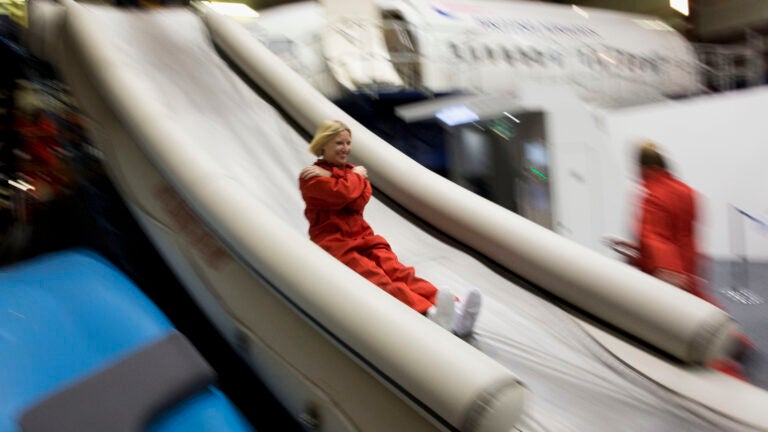
A student slid down an escape slide during class. When you are escaping a plane, every second counts. So if you hesitate at the slide, a flight attendant will likely push you out.
-

Pashley taught students how to open one of the aircraft doors.
Instructors said they hoped the more than 15,000 people who have taken the class since 2004 will act as leaders during plane emergencies. How likely are they to use their knowledge? Each day, 8.3 million people around the world board about 93,500 flights. In the past decade, there have been just 138 crashes involving fatalities worldwide, reports the Associated Press.
Therefore, experts say it is unlikely you will ever be in a plane crash. But it’s always best to be prepared.




To comment, please create a screen name in your profile
To comment, please verify your email address
Conversation
This discussion has ended. Please join elsewhere on Boston.com