
Boston’s Irish Heritage Trail
-

Explore more than 300 years of Irish-American history in Boston by following the Irish Heritage Trail. The tour consists of 20 stops along 3 miles, featuring many important historical events in the lives of those of Irish descent in the city and its surrounding area. For more, visit irishheritagetrail.com.
-
Rose Fitzgerald Kennedy Garden and Greenway

Officially dedicated in 2004 to the daughter of Boston Mayor John F. Fitzgerald and mother of President John F. Kennedy, this mile-long strip of landscaped parks and gardens stretches from the North End through the Wharf District to Chinatown. Wireless Internet is also now available on the Greenway, making it one of the largest free Wi-Fi hotspots in the state, according to the Rose Fitzgerald Kennedy Greenway Conservancy.
-
Kevin White statue

Kevin White, Boston’s 45th mayor, presided over some of the most prolific and difficult times during his 16-year tenure. In his time as mayor, White worked for the renewal of downtown Boston, including the re-opening of Quincy Market, and tackled the issues of school desegregation and busing. The statue of White, located outside Faneuil Hall, was unveiled and dedicated to the Irish politician in 2006.
-
James Curley statues

James Michael Curley served in elected office in Massachusetts for nearly half a century, from 1900-1949, including being elected to a single term as governor, two terms as a US congressman, and four terms as mayor of Boston. Curley may be most renowned for having been elected to his fourth term as mayor after being indicted on two felonies. Twin statues dedicated to the mayor/governor/congressmen were unveiled along Congress Street in 1980.
-
City Hall

The position of mayor was held by Irish-Americans for 85 years during the 1900s, including a 63-year consecutive stretch that started in 1930. The current City Hall building has seen three mayors since it was built in 1969, two of whom (Kevin White and Raymond Flynn) were of Irish heritage.
-
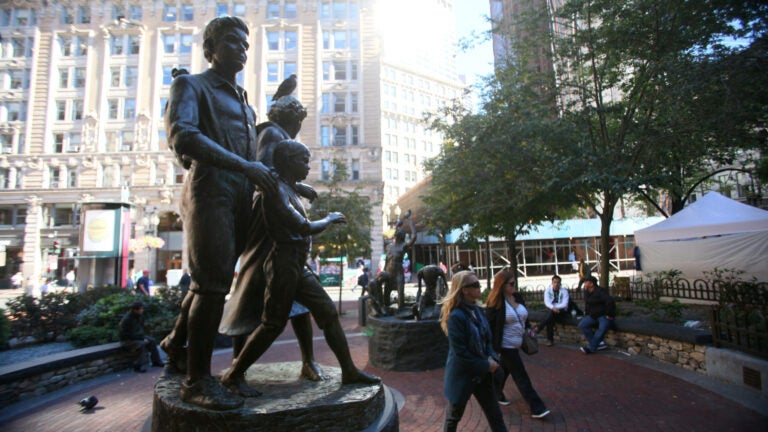
Boston Irish Famine Memorial

To commemorate the 150th anniversary of the Irish potato famine, which brought 100,000 Irish refugees to Boston between 1845 and 1849, Boston’s Irish community unveiled this $1 million memorial in 1998. Located along the Freedom Trail, the memorial includes twin sculptures as well as eight plaques that convey the history of Ireland’s infamous famine.
-
Granary Burying Ground

Among the most notable Irish residents buried here are John Hancock, Governor James Sullivan, and Boston Massacre victim Patrick Carr.
-
Robert Gould Shaw Memorial

The Shaw Memorial, which depicts the 54th Massachusetts Volunteer Infantry, a regiment of African-American soldiers that fought in the Civil War and the colonel who led them, was created by Augustus Saint-Gaudens. Saint-Gaudens was born in Dublin in 1848 and moved to America with his family later that year. The memorial, which sits on Park Street near the State House, took him 14 years to complete.
-
Massachusetts State House

Many items of Irish significance can be found in and around the Massachusetts State House. Inside are portraits of a number of former Irish-American governors and officials, including James Sullivan and Maurice Tobin, as well as a plaque to Jeremiah O’Brien, of Maine (then part of Massachusetts), who captured a British ship in the first naval battle of the Revolutionary War. Outside the State House stands a life-size statue of President John F. Kennedy, the first Irish-American Catholic president of the United States.
-
Soldiers and Sailors Monument

Unveiled on the Boston Common in 1876, this monument was erected in memory of foot soldiers and sailors who were killed during the Civil War. The monument was created by Irish-born sculptors and brothers Martin, James, and Joseph Milmore. Other Milmore statues can be found in many locations around the Boston area, including the State House and Boston Public Library.
-
Boston Massacre Memorial

This monument was created in remembrance of the five victims of the Boston Massacre, one of whom, Patrick Carr, was an Irish-American. On his deathbed, Carr, the final victim of the 1770 massacre to die, defended the British soldiers, saying they fired in self-defense. Initially, some Bostonians were against the idea of a memorial for the victims, who they considered misfits. However, John Boyle O’Reilly, an Irish-born poet and novelist who was in favor of the memorial, helped to improve public perception by reciting a poem he wrote about the victims during the memorial’s 1888 dedication.
-
Commodore John Barry plaque

Born in Ireland in 1745, Commodore John Barry is widely regarded as the father of the American Navy. Barry was best known as a naval hero for winning the first and last battles of the Revolutionary War. The original plaque, stolen in the 1970s, is located in the Charlestown Navy Yard. A granite version now resides along Tremont Street on the Boston Common.
-
Central Burying Ground

The Central Burying Ground was created in 1756 to alleviate overcrowding of the other cemeteries in the area at the time. The cemetery is said to include the remains of American patriots from the Battle of Bunker Hill, British soldiers who died during the Revolutionary War, and foreigners who died in colonial Boston. According to irishheritagetrail.com, this is the only Boston cemetery with Celtic crosses carved into headstones.
-
Colonel Thomas Cass Statue

Thomas Cass was an Irish-born businessman who was put in charge of forming the Ninth Regiment Massachusetts Infantry during the Civil War. Also known as “The Fighting Ninth,’’ the regiment was made up almost entirely of Irish-Americans, After being wounded in battle, Cass returned to Boston where he soon died from his injuries. The original granite memorial of Cass was largely criticized for its lack of artistic quality and was replaced by the current bronze statue in 1899.
-
David I. Walsh statue

Years before John F. Kennedy became the nation’s first Irish Catholic president, there was David I. Walsh, who became the first Irish Catholic governor of Massachusetts in 1914 and the first to be elected as senator from Massachusetts in 1918. The statue of Walsh can be seen at the Hatch Shell on the Esplanade.
-
Maurice Tobin Statue

Maurice Tobin is yet another ground breaking Irish-American politician in Boston’s history. Born in Boston in 1901, Tobin became Massachusetts’ youngest state congressman in 1927, at the age of 25. He went on to win two mayoral elections against James Michael Curley and later became the governor of Massachusetts in 1944. The statue of Tobin, created in 1958, can be found near the Hatch Shell on the Esplanade.
-
Patrick Collins Memorial

Patrick Collins, the city’s second Irish-born mayor, was the first candidate in Boston history to sweep an election, winning every ward. Collins’s career also included stints as a Massachusetts state senator and both Massachusetts and United States congressman. He died unexpectedly in 1905 while on an official mayoral trip to Virginia. Just days later, $26,000 had been raised for the statue in his likeness which now sits on Commonwealth Ave.
-
John Singleton Copley statue

Remembered as America’s first great portrait artist, John Singleton Copley, born in Boston in 1738, was famous for his paintings of such historic figures as George Washington, John Hancock, and Paul Revere. Copley was said to be innovative during his time for using items of personal value to his subjects in his portraits. Along with the statue in his honor, both Copley Square (where the statue was placed) and Copley Plaza are named after the colonial artist.
-
Boston Public Library

The Irish collection at the Boston Public Library, established in 1848, has grown to include 13,000 items. Items of significance include material on the Irish Free State and the Abby Theater, Irish sheet music, rare Civil War images taken by photographer Matthew Brady, and a bust of Hugh O’Brien, Boston’s first Irish mayor.
-
John Boyle O’Reilly Memorial

Before he arrived in Boston in 1870, John Boyle O’Reilly was arrested and sentenced to 20 years of servitude for his crimes against Britain as part of the Irish Republican Brotherhood. O’Reilly eventually escaped to Boston and quickly became a prominent figure in the area. As a journalist, lecturer, and poet, O’Reilly was a spokesman for Irish sentiment in Boston. A bronze statue of O’Reilly has stood on Boylston Street since its dedication in 1896.
-
Fenway Park

Fenway Park, one of Boston’s most famous landmarks, was built in 1912 by Charles E. Logue, an Irish immigrant who had moved to Boston 30 years earlier. While Logue is known to have constructed a number of Boston area schools and churches, Fenway Park stands out as his most notable contribution to the city.
-

-

-




To comment, please create a screen name in your profile
To comment, please verify your email address
Conversation
This discussion has ended. Please join elsewhere on Boston.com