
Historic downtown Plymouth walking tour
-

American history bursts from seemingly every street corner of downtown Plymouth and its waterfront, site of Plymouth Rock, the Mayflower II, and a host of other monuments and tributes dedicated to the landing of the Pilgrims in 1620, and the lives and cultures of the English colonists and the native Wampanoag tribe. Take a walking tour of this historic district, and these are among the sites you’ll encounter.
-

Part of nearby Plimoth Plantation, the Mayflower II offers visitors the chance to hop aboard and experience what life might have been like in the cramped quarters of the Mayflower. This version, which set sail from England in 1957, is a detailed replica of the original, which disappeared from maritime records in 1624.
-

On the cusp of the American Revolution, Plymouth Rock was actually split in half, as a sign of division from the British Empire. More than 100 years later (1880), the sides were re-attached, the year “1620’’ was carved into it, and the rock moved to its present location on the Plymouth waterfront, where it is housed beneath a cathedral-like canopy. Visitors can peer into the canopy from Water Street and view it at water level below.
-

William Bradford served as governor of the colony for more than 30 years. He performed the first marriage ceremony in the colony, and by many accounts, he was the forefather of Thanksgiving by instituting a “harvest festival,’’ in which the natives joined the colonists in a combined celebration of the harvesting season. As statue in his honor stands not far from Plymouth Rock.
-

The statue of Massasoit stands stoically atop a hill facing the waterfront. It was erected in 1921, during the Pilgrim tercentenary. Massasoit, which means “Great Chief,’’ was a legendary friend to Pilgrims, and a major source of long-lasting peace with the colonists, though he steadfastly did not allow any of his tribe to convert to the Pilgrims’ Christianity.
-

The Mayflower Society House, located at the corners of Winslow and Water streets, is an 18th-century mansion that serves as a society to honor the memories of the original Pilgrims who arrived in this country. Proven lineage to anyone on the Mayflower qualifies those to become a member of the General Society of Mayflower Descendants. The general public is invited to visit May-October.
-

Overlooking Leyden Street, the First Parish Church has maintained a continuous ministry since 1620. According to the plaque at the church’s base, “The Church of Scrobby Leyden and the Mayflower gathered on this hillside in 1620 has ever since preserved unbroken records.’’ The present church building was erected in 1898, and is the fifth meeting house at this same location.
-

Adjacent to the church is Burial Hill, the oldest European burial ground in New England. The earliest gravestones on the hill date back to the late 1680s, although some have suggested that some Mayflower passengers were also laid to rest here.
-

The 1749 Court House, open seasonally, is the oldest wooden court house in America. Now on the National Register of Historic Places, the interior features a 1828 fire engine, as well as panels featuring the history of the town.
-

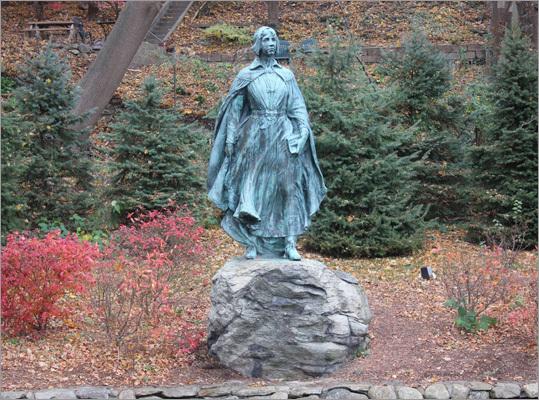
The Pilgrim Maiden statue, located in Brewster Gardens, was erected in memory “To those intrepid English women whose courage, fortitude, and devotion, brought a new nation into being.’’ The statue was dedicated in 1924.
-

Nearby stands the Immigrant Statue, erected to honor all immigrants from every nation who came after the Pilgrims’ maiden voyage.
-

The colonists’ original settlement was in the area where Leyden Street is today. All that remains of the first colony is a plaque at the base of this property which reads, “On this lot stood the first house of the Mayflower Pilgrim John Howland.’’ The inscription was added to the sidewalk by the Pilgrim John Howland Society in 1978.
-

Built in 1824, the Pilgrim Hall Museum, located on Main Street, is the oldest museum in the United States. Here, visitors can view 17th century Pilgrim items, paintings, and deep history about the Pilgrims’ journey overseas and their new lives in America.
-

The Mother Pilgrim statue was erected in 1921 as part of the tercentenary celebration. It stands on the waterfront near Plymouth Rock. Behind the woman’s likeness are listed the names of the women who arrived on the Mayflower.
-

Although it has been restored over the years, the Richard Sparrow House is Plymouth’s oldest home, built in in the years between 1636 and 1640. Today, it houses Sparrow House Pottery in the adjoining building.
-

Just around the corner, the Jenney Grist Mill is a reproduction of the 1636 mill built by John Jenney. The mill still operates the way it did in 1636, using water power to grind corn, but today it is also a museum where visitors can learn more about the Pilgrim way of life.
-

The towering Forefathers Monument, at 81 feet, is the largest granite monument in the United States, and though the Statue of Liberty predates its 1889 completion, the Plymouth monument served as the original prototype for the Ellis Island structure. The figures below the main figure depict different aspects of the Pilgrims – such as education, youth, and liberty – as well as the heritage that they left for the country.





To comment, please create a screen name in your profile
To comment, please verify your email address
Conversation
This discussion has ended. Please join elsewhere on Boston.com