
Wine country safari: camping amid exotic African animals in California’s Sonoma Valley
SANTA ROSA, Calif. — The African cape buffalo is a fixture of the Serengeti, one of the so-called Big Five animals (along with elephants, lions, leopards, and rhinos) that big-game hunters dream of bagging. Late on a Saturday afternoon, a small herd of them grazed docilely on a hilltop while my family watched from a truck a hundred yards away.
It could have been a scene out of an African safari — but it was not. We were two hours north of San Francisco, in Sonoma Valley wine country.
“There are only 50 cape buffalos in the United States,’’ said Leslie Thalman, who led our tour through the 400-acre preserve, called Safari West. “You’re looking at 13 of them.’’
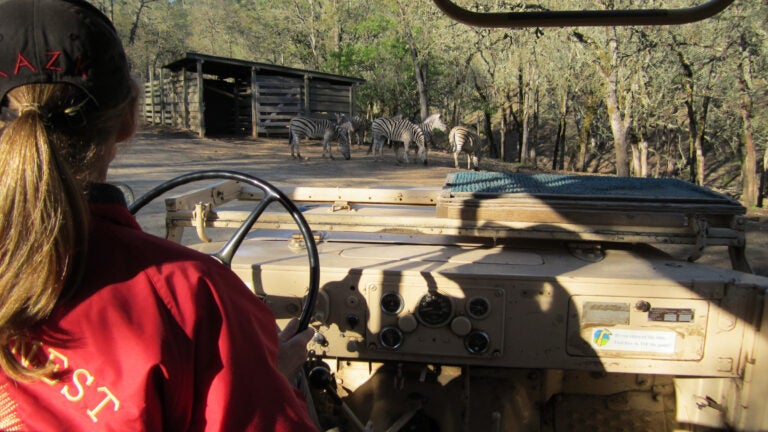
The tour provided an up-close animal adventure that went far beyond what we had experienced at zoos or Disney’s Wild Kingdom. Although we stayed safely inside the open-air tour vehicle, we came within a few yards of zebras, giraffes, and other animals we previously had seen only behind barriers.
The story of this unique resort began in the late 1970s when Peter Lang — son of Otto Lang, who directed the television series “Flipper’’ — purchased three antelope, which he housed on a property near Los Angeles. In the 1980s he began buying more animals, and in 1989 he acquired this hilly wooded property in Santa Rosa, where the grasslands and climate are similar to areas of Africa.
Lang’s wife, Nancy, holds a doctorate in biology and served as general curator at the San Francisco Zoo. Together they expanded their menagerie. Soon they began welcoming school field trips. In 1993, they started offering tours to the public, and in 1999 they added tents to accommodate overnight guests.
Our tour began on a sunny April Saturday with a 45-minute guided walk around cages containing a few of the facility’s 800 animals, including lemurs and cheetahs. Next we stepped inside an aviary. “Whatever you do, don’t open your mouth and look up,’’ joked the guide, entertaining the kids with unfortunate tales of guests assaulted by bird poop.
The walking portion of the tour was a warm-up for the main event. My family along with several other people boarded one of the ancient Dodge Power Wagons that have been converted into safari vehicles. (Passengers can take turns sitting in the four prime seats bolted to the roof.) Thalman opened a gate, and we drove up beside a giraffe. She cut the engine, told us a bit about the animal and what makes it special, then paused to let us observe it in silence for a few moments. Then we headed toward the next set of creatures.
Thalman, who has led tours at Safari West for 18 years, seemed to know everything worth knowing about African wildlife. In 2007, she traveled to Namibia and South Africa to experience
safaris there and increase her knowledge.
Much of the information she shared focused on how each animal’s physical attributes evolved to help it survive in a predatory environment. For instance, lions prefer to kill prey by biting through their spinal columns, so the manes on zebras and other animals evolved to help serve as a false target, slightly disguising the location of their spines.
Thalman also discussed how humans tend to misperceive which African animals are dangerous. While the resort’s two white rhinoceroses look fearsome, she pointed out that in Africa, hippopotamuses actually kill more humans each year than rhinos do. And neither of these mammals kill as many humans as the continent’s most lethal animal: the mosquito, which carries malaria and other diseases.
While some Safari West guests stay for only the three-hour tour, the resort offers lodging in spacious and sturdy safari tents, most of which lie in sight of the animals. Built on raised hardwood platforms, the canvas structures offer the size and basic functionality of a hotel room, with comfortable beds and separate plumbed bathrooms.
Although it is possible to drive back to Santa Rosa for a restaurant dinner, most overnight guests choose to stay on-site for a cookout. A chef grills chicken and beef on a large iron grate over a firepit the size of a hot tub. When dinner is finished, he uses a cable and ratchet system to raise the grate, then stokes the fire so guests can roast marshmallows.
It gets cold at night in this region — temperatures routinely drop into the 40s — but inside our tents, the cool air, electric blankets, and powerful space heater created an environment for a great night’s sleep.
Our one-night stay at Safari West was easily the highlight of our California trip. But it was not cheap. A Saturday night stay for a family of five cost $345 during the spring offseason. We paid an additional $68 per adult and $30 per child for the three-hour safari. The evening barbecue ran $29 per adult and $17 per child. The total tab: $773.
Sometimes it is worth putting aside frugality to enjoy something exotic.





To comment, please create a screen name in your profile
To comment, please verify your email address
Conversation
This discussion has ended. Please join elsewhere on Boston.com