
Travel may not lead to understanding
In her 1983 book-length essay, “Salvador,’’ about a country amid civil war, Joan Didion suggests that when we travel, especially to politically unstable areas, we may witness and intuit things we will never understand. Her insight is uncomfortable; it upends our assumptions about what it means to explore a people and place, and yet, Didion has a point.
I took my first trip to Northern Ireland in the early 1990s; this was no longer the peak of the Troubles, but there were still British troops on the ground. I rarely felt physically unsafe, and people were almost universally friendly to me. I scooted in and out of metal detectors and checkpoints in Belfast, and I traipsed down the hills of Derry. I snapped pictures of the famous paramilitary murals, and I took a self-guided tour of the Bogside, the site of civil rights marches in the 1960s and ’70s.
One afternoon I had lunch with a Derry family. Mrs. O’Leary was kind and generous, and her husband, a man who had once spent time in prison for being a member of the Irish Republican Army, came home as we were finishing tea. The O’Learys told me their son, 17, had recently filed a complaint against a British soldier and was being harassed as a result. Although I understood Irish history and politics, I was surprised Mrs. O’Leary was not more unsettled.
“Even if my son ends up being taken into custody, I’ll be proud of what he’s done,’’ she told me as she poured the last of the tea.
But didn’t she want to protect her son, I wondered aloud. Would she consider sending him for an extended vacation with relatives in America?
“Not at all,’’ Mrs. O’Leary tut-tutted away my silly question.
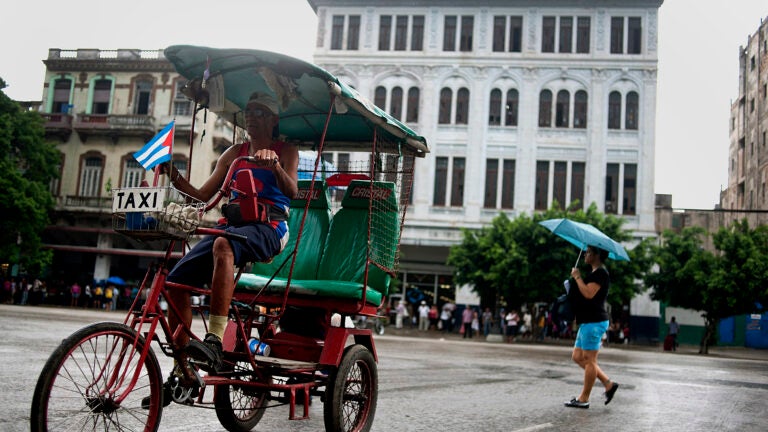
I did not feel physically unsafe in Cuba either, when I traveled there a decade later. Cubans were not as friendly as the Irish, but they were polite and generous. I took pictures of schoolgirls dancing in the streets in a small village along the coast; I posed for a man next to his 1950s Packard, so he could take my picture; and I caressed the rotted and pitted wood of a once magnificent Spanish Colonial home fallen into disrepair. Although I was denied nothing, I felt watched.
One day I took a ride on a bicycle taxi. We had gone less than a mile when we were stopped by a police officer. The officer had seen me climb onto the bike and now wanted a cut. The driver was to return with the money after he dropped me off at my hotel.
Two days later, walking alone down a busy street in Havana, I felt conspicuous. My light skin and red hair marked me as a foreigner; people were never impolite, but they noticed me. A tall, handsome, coffee-colored man smiled twice as he walked by me. The third time, he introduced himself. I bought him a lime soda, and he told me about his life in Cuba. An engineer, Ruiz was considered an intellectual and paid accordingly. He was angry that those who worked in the tourist industry made more money than he did, and he tried to explain what it felt like to be physically and psychologically trapped.
I told Ruiz what had happened with the bicycle taxi.
“It’s as though I am being watched or something, and of course I’m not. It’s crazy isn’t it,’’ I said.
Ruiz smiled, “It’s not so crazy.’’
On my last day in Cuba, I wandered the post-dawn streets. Mostly, they were quiet, but tucked into an alley I saw a wooden door propped open. It looked like a storefront, so I went to inquire about buying water. When I got closer, I saw a line of women. They were smoking and talking but became quiet when I smiled and stepped to the back of the line. I looked behind the door to see a lone woman standing at a wooden counter. There was a poster of Che Guevara behind her. In exchange for tickets, she was handing out bags of grain and powdered milk. I slipped out of line. There was no water here; only food rations.
I am glad I lived in Ireland; I am glad I traveled through Cuba; yet I do not believe I know either region the way I once thought I would. Rather, I think I realize now all that I will never know. And maybe that’s even better.





To comment, please create a screen name in your profile
To comment, please verify your email address
Conversation
This discussion has ended. Please join elsewhere on Boston.com