Can the government finally stop airline seats from shrinking?
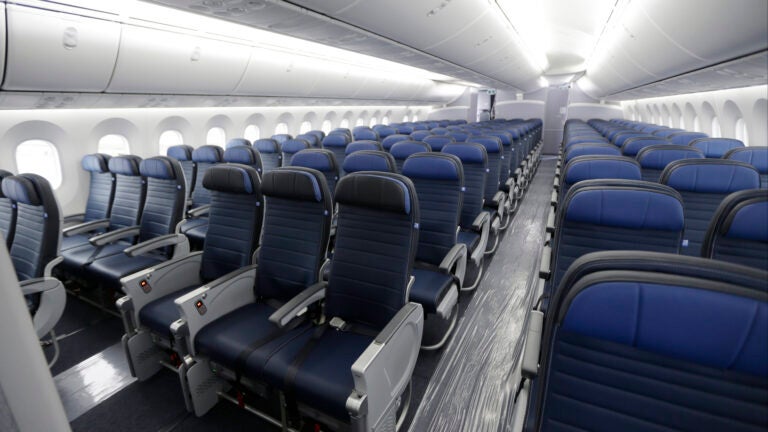
A bill mandating the Federal Aviation Administration establish minimum seat sizes and distance between rows for the health of fliers may sound like a godsend to cramped passengers, but industry experts say travelers should not assume that it will rescue them from stiff knees and aching shoulders.
The bill, which passed the Senate on Wednesday and is now headed to the president’s desk, would extend funding to the FAA for five years, but a rider attached to it, called the Seat Egress in Air Travel, or SEAT Act, requires the FAA to establish minimum seat sizes “to protect the safety and health of airline passengers.’’
“Safety must never take a back seat, much less a shrunken seat, to profits,’’ said Representative Steve Cohen, the Tennessee Democrat who first introduced the bipartisan bill in 2016 with Adam Kinzinger, a Republican from Illinois. “The safety of the public must be the airlines’ primary concern, and the bill now requires the FAA to take it seriously.’’
But while the SEAT Act will require minimum seat sizes, it does not require airlines or the FAA to establish those sizes based on comfort. The FAA has a year to work out the new requirements.
“I think the FAA will approach this from the standpoint of customer safety, not customer comfort,’’ said Henry Harteveldt, travel industry analyst with the Atmospheric Group. “No one should expect that the FAA is going to be the savior of beleaguered air travelers and mandate that the airlines offer generous legroom, or coach seats that are 10 percent or more wider than they currently are.’’
The SEAT Act does not define what passenger health and safety protections should be.
“We honestly don’t know how the FAA will evaluate standards and what criteria they will use,’’ Harteveldt said.
The FAA has long used the time it takes for passengers to evacuate a plane in an emergency as the standard for airline safety. Passengers and crew must be able to evacuate a plane in 90 seconds or fewer. Every new airplane model must receive a 90-second evacuation drill certification from the FAA before it can fly.
The 90-second standard was set by the FAA decades ago and has held to this day, despite the fact that passenger loads have dramatically increased and seats have shrunk. Seat pitch, the amount of space between one seat and the seat behind it, has dropped to just 28 inches on bargain carriers such as Spirit.
Passenger advocates contend that as seats have shrunk and adults have gotten larger, airlines are placing travelers in danger. Paul Hudson of the group Flyers Rights filed a petition with the US Court of Appeals in the District of Columbia requesting the FAA establish guidelines for seat dimensions, specifically pointing out the danger of timely evacuations and comfort of passengers.
In response to the petition, the FAA wrote it “has no evidence that a typical passenger, even a larger one, will take more than a couple of seconds to get out of his or her seat.’’
“The FAA also has no evidence that current seat sizes are a factor in evacuation speed, nor that current seat sizes create a safety issue necessitating rulemaking.’’
Hudson said it’s unlikely that the SEAT Act will make a difference unless the language of the bill is tightened.
“Unless the FAA changes its current position that any matter of comfort is none of its business, there will likely be no change,’’ he said in an e-mail. “The FAA could even set seat-size standards so low that it encourages further shrinkage.’’
Despite the uncertainty surrounding the outcome of the SEAT Act, there are positives that came out of the bill. It would bar airlines from removing passengers from overbooked flights once the passenger has boarded the plane, it would prohibit putting a live animal in an overhead bin, and it would bar passengers from making cellphone calls during airline flights.
Your flight may not be as comfortable, but at least it will be quieter.