How the travel industry exploits the class divide
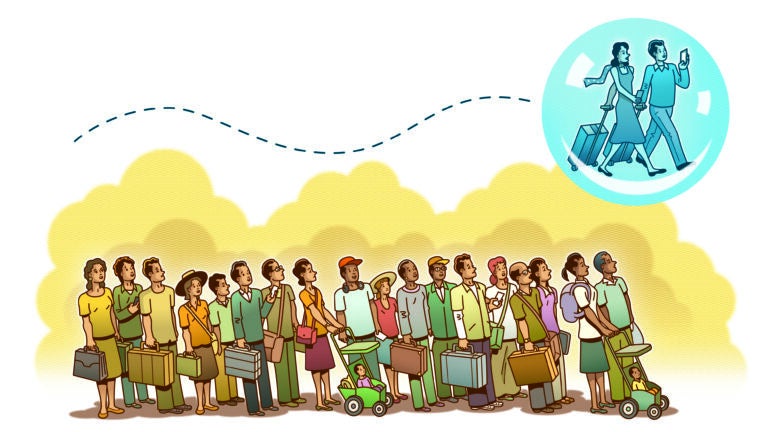
LONDON — Through the sparkling glass doors of the British Airways Galleries Club Lounge in Heathrow’s Terminal 5 is a world most travelers will never see.
There are private showers with personal sound systems, fancy soaps and fluffy towels. Watchful servers tend to a buffet of hot and cold food, from tea sandwiches to curries. There’s a vast selection of champagnes and top-label liquors for the pouring. The “sir’’s and “ma’am’’s from the neatly uniformed airline employees who staff this rarefied oasis are soft, not stern.
Just don’t try to get past them with an economy-class ticket.
The Galleries Club is open only to first- and business-class passengers, one of the increasing number of privileges reserved for the most free-spending travelers.
These are the people who glide through the fast lines at security, and don’t have to fumble with their shoes and belts. They forgo the waits for overpriced takeout fare at grubby food courts and are fed in luxurious private lounges. They go left to first class on the planes, where they are promptly served mixed drinks and gourmet cuisine on real china — not right, to fend for themselves among the screaming toddlers in steerage.
Instead of struggling with unfamiliar public transit when they land, they’re met by drivers dressed in black who flash their names as if they’re stars on a marquee. They’re ushered to their own check-in desks at hotels, past the smoldering glares of other guests who are waiting for their rooms, and get off the elevators at the concierge level.
In an era of record income inequality, when Boston-based Oxfam America calculates that just one percent of the population now holds almost half the world’s wealth, travel may be where the class divide is on display more obviously than anyplace else.
“You can extrapolate the disparity that exists in society at large, and travel is a microcosm of that,’’ said Darren Humphreys, founder of Duxbury-based Travel Sommelier, which creates — “curates,’’ as he puts it — custom trips including luxury safaris and personalized wine and food tours. “There is more wealth in fewer hands, and those hands can afford the best of everything.’’
One reason this is so apparent now, from airports to hotel lobbies, is not just that there are more travelers at the exclusive top of the income spectrum. It’s that there are more at the mass-market bottom, for whom a leisure-travel industry only the rich could once afford has added bargain-level services that suffer (literally) by comparison to the escalating comforts it provides to customers who pay the most.
It’s at that top end that the profit margin is widest, so while it’s been busy shrinking the size of the cheap seats, the industry is vying to entice the rich. “Be on Wall Street by the opening bell,’’ reads a promotion for TSA Precheck at Logan Airport, and it isn’t directed at the backpackers or families with kids who are slogging through the slow line.
Airlines in particular “have segmented their markets and are making just a ton of money off the business-class passenger versus their economy passengers,’’ said William Samenfink, dean of the School of Hospitality Management at Endicott College in Beverly. “And they will do whatever they can to keep those [higher-paying] passengers.’’
It’s harder than it sounds. Those travelers are fickle. Only one in four sticks mostly to a single preferred hotel brand, for example, a Deloitte study found. So providers keep offering them more.
“Just being a five-star hotel is not enough,’’ said Muzzo Uysal, chair of the Department of Hospitality and Tourism Management at the University of Massachusetts, Amherst’s Isenberg School of Management (it’s added a new course called Service Experience Management that covers how to deal with the most demanding customers). “They can’t compete on that basis. So they compete on the basis of unique, engaging features. We value unique experiences, engagement, indulgence. And that costs more.’’
Marriott International in June launched its Moments “master class’’ series for its most loyal customers, which includes such things as basketball lessons with Dwayne Wade, cooking classes with James Beard Award-winning chef Eric Ripert, golf tips from Hall of Fame golfer Annika Sörenstam, and surfing instruction with Laird Hamilton.
“It’s more important than ever that we really continue to build relationships with our best guests,’’ said David Flueck, senior vice president of loyalty at Marriott which also has a super-elite program for visitors who stay 100 nights or more per year; they get a personal “ambassador’’ who knows and anticipates their preferences.
“Offering an amazing experience has always been a part of hospitality,’’ Flueck said. “What we’re seeing now is that what often used to be part of just part of the luxury experience is being adopted by more and more of the loyalty programs.’’
Wealthy travelers leaving from Los Angeles International Airport don’t have to rub shoulders with the proletariat at all; in May, they got their own VIP terminal with personal suites, pre-flight massages, a private security line, and a ride in a BMW 7-Series sedan right to their planes. It costs $3,500 for three for domestic flights, $4,000 for international.
Even Amtrak has added priority boarding on Acela trains at Penn Station, holding back the masses while the upper crust in first class stroll ahead of them.
The strategy? That once people travel this way, they’ll never want go back — only encouraging an ever-wider, increasingly evident gulf between the pampered haves and the resentful have-nots.
Just ask Uysal. He once was randomly upgraded and got to use the business-class lounge at the airport in Istanbul. “I couldn’t believe how wonderful it was,’’ he said. Then his premier status expired, “and now I’m in line again and I’m stuck somewhere in the back of the plane. When that happens, you see this class division more clearly than ever before.’’
Humphreys was an investment banker and bond trader before he got into the tourism business, and traveled on an almost unlimited budget. Now he flies economy. “That was the most difficult thing, walking in and turning right rather than turning left’’ into the first- and business-class cabins on planes, he said. “And that tells you so much.’’
Among other things, it tells you that people who benefit from this growing stratification like it and want more — including the wave of retiring baby boomers who drive many of the trends in travel, and have money to spend.
“The children’s colleges are paid for, their homes are usually paid for, they have their comfortable retirement income, they invested well,’’ said Linda Terrill, CEO of the Luxury Travel Group, which specializes in this market, arranging everything from hot-air balloon rides over Tuscany to boat charters in Capri. “They have the means, and they don’t want to be standing in line. They want to be treated special.’’
Once they are, said Terrill, they cling fast to their privilege.
“I had one lady who flew business class for the first time and she called me and said, ‘I will never fly any other way again, and make sure you have that guy with the little sign waiting for me,’’’ Terrill said. “That’s the mind-set.’’
The class divide is not unique to travel, Terrill said. “There’s a divide in every aspect of life,’’ she said. “If I go to the mall, there’s a Nieman Marcus and a Saks Fifth Avenue, and I don’t shop there. Instead I’m going to go to Macy’s and hope I can get some things on sale. So is there a divide? Yes. There’s a divide everywhere.’’
But in few places is it so out in the open as in airports and hotels, starting in the security line and proceeding to the boarding process, which rewards the 13 percent of customers the industry association Airlines for America says have premier status. Then there’s the awkward avoidance of eye contact between first-class fliers and luggage-dragging passengers who have to pass them on the way to the back of the plane.
“There is that polarization,’’ said Uysal. “And it’s getting worse.’’ That’s because, he said, “There’s no end to this high end.’’