This NYC museum is putting the focus on women
With hundreds of large and small museums to choose from in New York City, visitors usually opt for the marquee names: MOMA, the Met, the Guggenheim, the American Museum of Natural History. Though it may fly below the radar, the stately but intimate New York Historical Society Museum and Library on the Upper West Side offers visitors something unique among the changing exhibits examining New York and US history. On the newly transformed fourth floor of the building is the Center for Women’s History, the first of its kind within a major American museum.
The center, which opened last spring, is home to the 1,500-square-foot Joyce B. Cowin Women’s History Gallery which hosts rotating exhibits such as the current one, “The Duchess of Carnegie Hall: Photographs by Editta Sherman,’’ running until Oct. 15. The works in the exhibit are from the archives of Sherman, a portrait photographer who died in 2013 at the age of 100 and who lived and worked in one of the artist studios above Carnegie Hall. For more than 60 years, she trained her lens on many of the luminaries of her time, including Joe DiMaggio, June Carter Cash, Yul Brynner, Lillian Hellman, and many more.
With the much-anticipated movie “Battle of the Sexes’’ opening later in September, about the history-making 1973 tennis match between Billie Jean King (played by Oscar-winner Emma Stone) and Bobby Riggs (Steve Carell), the display of artifacts from the Billie Jean King archive in the Center’s main hall is timely and fascinating.
In 2016, King donated items from her career to the museum in anticipation of the opening of the women’s history center in April of 2017. Among the items on display include a New York Daily News front page from 1973 with the headline, “Billie Jean King Outlibs the Lip’’; the Ted Tingling-designed white lace dress she wore when she won the US Open in 1971 and Wimbledon in 1972; the racket she used during her 1975 grand slam title win at Wimbledon; and the Essex Bowl she received after winning the Essex County Country Club Ladies’ Invitational Tennis Tournament a record three times.
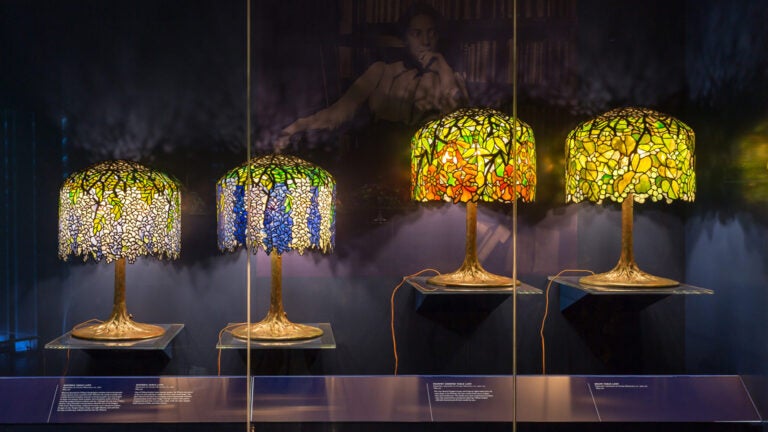
Also notable on the fourth floor is the gleaming, two-story glass gallery, designed by renowned Czech architect Eva Jiricná in her first New York museum project, showcasing the Museum’s permanent collection of more than 100 Tiffany lamps. It’s a spectacular, permanent exhibit and it boasts a little known piece of women’s history to boot.
Curated by the Museum’s Margaret K. Hofer, assisted by Rebecca Klassen, the gallery is filled with illuminated Tiffany lamps in a variety of sizes and styles — floor, hanging, desk — all with the distinctive opalescent glass shades developed by Louis Comfort Tiffany during his company’s heyday (1898 to the mid-1920s). The lamps were individually handcrafted by a team of artisans at the company facility in Corona, Queens, which is documented by period photographs.
The exhibit reveals that many of the famous glass shades are actually the work of Clara Driscoll, head of the Women’s Glass Cutting Department (nicknamed the “Tiffany Girls’’) from 1892 to 1909 at Tiffany Studios, located at 4th Avenue and 25th Street. Driscoll not only oversaw the execution of Tiffany’s famed art nouveau lampshades, she also designed many of the company’s most iconic leaded glass shades, including the peony, daffodil, and dragonfly designs, and some that are suspected of being Driscoll’s uncredited work. The historical text and photos on display throughout the extensive exhibit detail Driscoll’s contributions and importance to the company; she earned a weekly salary of $35, which was on par with that of Tiffany’s male designers. But before it’s heralded as a progressive workplace, note that Driscoll and all the “Tiffany girls’’ were prohibited from working once they married.
A dramatic glass staircase in the gallery leads to a mezzanine where there are interactive displays, such as one in which visitors can test whether they can distinguish between an authentic Tiffany lamp and a replica (not very difficult). Another displays the actual templates and tools used to make Tiffany lamps.
For more information, visit www.nyhistory.org.