The news had us looking back, so we headed South on a civil rights tour
‘The word of the day is,’’ my 7-year old daughter paused dramatically over a bowl of mac and cheese. “Segregation. Today we learned about the human race and how white people segregated black people.’’
We were sitting in a barbecue restaurant in Selma, Ala., and had just arrived in town after a full day of civil rights tourism in Birmingham, two hours away. I’d worried that my younger daughter might not understand the theme of our tour, so her summary of the day was more than I could have hoped for.
“That’s right!’’ I added, “But we also saw how people can work together to stop the bad things.’’
We can thank US Representative John Lewis — and President Trump — for our decision to take our two daughters on a civil rights tour of the South a few months ago. In January, after our new president bashed the civil rights hero on Twitter, I was among many Americans moved to buy “March,’’ Lewis’s autobiographical graphic novel. As a child of immigrants struggling with my place in America, I had found reassurance in the stories of the civil rights movement and the fact that despite intractable racial discrimination, our country usually, eventually, did the right thing. I bought the books hoping that in these uncertain times, my own kids would find similar inspiration. To my delight, my 10-year old couldn’t put the books down.
So we went to see firsthand the places in Lewis’s books. We made stops in Birmingham and Selma, traced the 50-mile 1965 Voting Rights March from Selma to Montgomery, marked the spot where Rosa Parks refused to get off the bus in Montgomery, and paid our respects to Dr. Martin Luther King Jr. at his tomb in Atlanta. It was a moving experience for the whole family.
Day 1: ‘Bombingham’
We began our tour in Birmingham for logistical reasons — flights there were cheaper. But it turned out to be a good place to start. Some of the most searing moments of the civil rights movement emerged from Birmingham in 1963: Bull Connor siccing police dogs and firehoses on demonstrators, the KKK’s bombing murder of four girls at church on a Sunday morning, Martin Luther King Jr.’s Letter from a Birmingham Jail. African Americans suffered so much violence there that the city earned the nickname “Bombingham.’’
The Birmingham Civil Rights Institute provided us with an excellent overview of the movement. As we moved through the museum, from depictions of segregated schools and water fountains to bus boycotts, drugstore sit-ins, and marches, the girls were riveted by the original TV footage sprinkled throughout the museum, particularly of the Freedom Riders testifying to the beatings they had suffered. They scoffed at the unfairness and absurdity of the questions — “How many bubbles in a bar of soap?’’ — African Americans had to answer in order to register to vote. “I think everyone should visit this museum,’’ my 7-year-old declared as we left the BRCI.
I had forgotten that appointments are required for tours of the 16th Street Baptist Church. But disaster was averted when church members allowed us a quick peek inside. I was struck most by seeing the church clock permanently stopped at 10:22 a.m., the moment when the murderous bomb went off more than 50 years ago. A docent showed where they found the bodies of the four girls killed by the KKK bomb, Addie Mae Collins, 14, Denise McNair, 11, Carole Robertson, 14, and Cynthia Wesley, 14. “We always say their names,’’ he said. Our daughters also began repeating the names to commit them to memory.
Kelly Ingram Park — where the firehose and dog attacks took place — is across the street from the church and the Birmingham Civil Rights Institute. Throughout the park, the city has placed memorials to the movement. My reaction to one sculpture — two thick metal walls with attack dogs leaping from either side – caught me by surprise. As I watched my daughters walk between the dogs, I felt my heart seize and stomach drop. I can’t imagine the terror the protestors and their parents must have felt that day in 1963. “That was scarier than I thought it would be,’’ my older daughter said.
Day 2: Selma
On the morning we visited, downtown Selma seemed all-but deserted. It was hard to imagine this now-sleepy town had caused such a mighty awakening 50 years ago. We stopped at the National Parks Service Interpretive Center at the foot of Edmund Pettus Bridge. Again, the girls were drawn to the videos. The NPS had taken care to include diverse voices in its collection of oral histories – from the organizers of the Voting Rights March, to a child marcher, to white residents who, even fifty years later, still believed that the marchers had been “paid to come’’ to Selma. Because our trip had been inspired by Lewis’ book, the girls paid particular attention to his video. My younger daughter became teary as she listened to him tell about Martin Luther King lending him his hat during the march. “That’s such a good story,’’ she said.
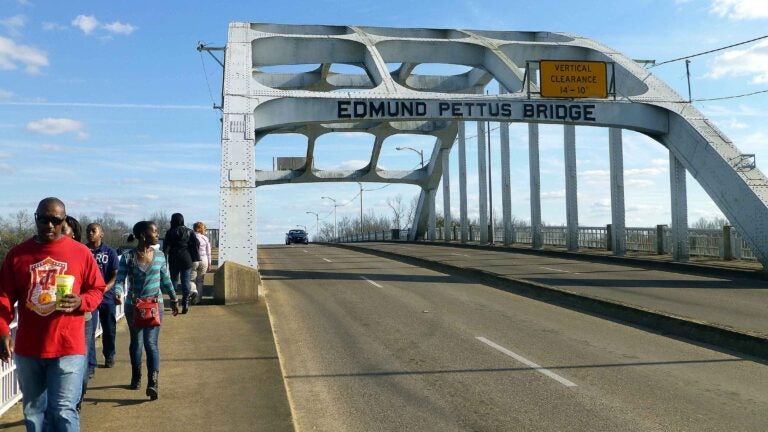
I had expected that walking across Edmund Pettus Bridge would be a holy experience – tracing the footsteps of those who marched to redeem America’s soul. But with one child afraid of heights and clinging to my waist, and cars and trucks speeding by at a good clip, crossing the bridge was more of a rushed one. Bridge crossing completed, we got in our car to follow the 50-mile Voting Rights March route to Montgomery. What now takes less than an hour to drive took the marchers five days and four nights on foot. We turned off the road to check out one of their night time campsites, but ended up driving along the massive runway of a now decommissioned airbase turned Korean auto-parts factory!
Midway through the journey is a second National Parks Service Interpretive Center. The Lowndes County Center is built on the site of the tent city that arose after white landowners expelled their black tenant farmers for participating in voter registration drives. The exhibits described how the expelled tenants were forced to live in tents for nearly two years as they secured new homes and work. It was a sobering reminder of the personal sacrifices made in the quest for justice, that the triumphant passage of the 1965 Voting Rights Act was far from the end of the story.
Parent tip: At both Centers, Rangers offer “Junior Ranger’’ workbooks. If your child completes enough pages (answers questions about the exhibits), the Rangers will swear them in as junior rangers. This exercise bought my husband and I extra time to view the exhibits as the girls hunted for the answers.
Day 3: Montgomery
We were reminded again of the personal costs of the movement the next day in Montgomery, where the paths of Rosa Parks and Dr. King crossed during the 1955-’56 Bus Boycott. As in Birmingham, Montgomery’s sites are clustered close together downtown.
Though the children’s wing of the Rosa Parks Museum was closed when we visited, the main museum was still engaging for children. The opening exhibit, for instance, consisted of a vivid multimedia re-creation of the bus ride where Mrs. Parks refused to surrender her seat for a white passenger. After a quick visit at the Freedom Riders Museum, we arrived at the Dexter Avenue Church Parsonage, where Dr. King had lived with his family during the boycott. It was a few minutes before closing time, but museum officials were kind enough to sneak us into the final stop on the day’s final tour for free.
That final stop turned out to be in the Parsonage’s kitchen, where Dr. King’s “epiphany’’ is said to have taken place. As we stood among the vintage appliances, the tour guide played a recording of Dr. King describing the experience. Just 27 years old, King had been getting telephoned death threats as many as 40 times a day. One night as he sat alone at his kitchen table while his wife and baby girl slept, King received yet another threatening call. At that moment, he was “ready to give up.’’ But then, as he prayed, he could “hear the quiet assurance of an inner voice saying: ‘Stand up for justice, stand up for truth; and God will be at your side forever.’’’
We were able to fit in quick stops at the Alabama State Capitol and the Civil Rights Memorial — the famous black granite cone table and fountain designed by architect Maya Lin. I was heartened to see my older daughter pick out the events listed on the memorial’s timeline we had learned about that day and the days before in Selma and Birmingham.
Day 4: Atlanta
After three days visiting much smaller cities, Atlanta’s lights, traffic, and ethnic and racial diversity were striking. At the National Parks Service’s MLK site in Atlanta, we paid our respects at the tombs of Dr. and Mrs. King. We celebrated the end of our trip with tacos at a Mexican restaurant. A friend who met us there said that we might just run into Lewis, since we were now in his congressional district. Seeing the bustling, diverse metropolitan area John Lewis now represented — an Atlanta that would not be possible without Parks, King, Lewis, and the movement they sacrificed for — seemed a heartening way to conclude our journey. It is an America that I hope my daughters will continue to fight for and honor.