
Newsletter Signup
Stay up to date on all the latest news from Boston.com
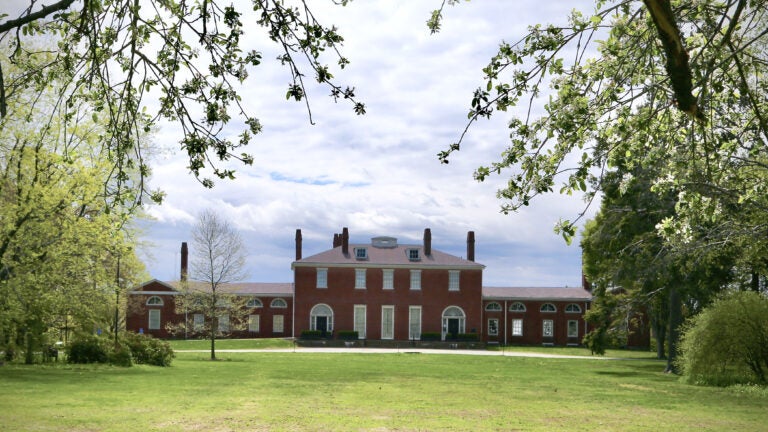
Not far from Boston sits an 1806 Federal-style country estate formerly owned by a Massachusetts governor that hosts tours and festivals and keeps rare sheep.
The 50-acre Gore Place in Waltham includes a mansion and museum, rolling grounds, and a working farm. It was the former home of Christopher Gore, who served as governor of Massachusetts from 1809-1810. Throughout his career, he also served as a U.S. Attorney, U.S. senator, and diplomat in Great Britain.
The house was “among the most beautiful, progressive, and productive in the country” in the early 19th century, according to the Gore Place Society, which has owned and operated the property since saving it from demolition in 1935.
“It’s a lovely place just to walk around,” said Thom Roach, director of interpretation for Gore Place. “People are always surprised when they get here because nine miles from Boston there’s 50 acres of park land that they sort of see as their backyard.”
Visitors step into early 19th century American life at the estate, where famous visitors once included James Monroe, John Quincy Adams, and Daniel Webster.
The picturesque property hosts many activities throughout the year, including concerts, festivals, tours, plant sales, garden parties, and holiday events. Upcoming programs include a moonlight tour on May 31, spring gala on June 5, and family time at the farm on June 8. Kids can also play on a Nature Playscape, enjoy story time in the barn, and follow a free Story Trail.
“We encourage people to use the grounds,” said Roach. “It’s free to the public from dawn to dusk. There’s lots of trees and plantings. What we’re trying to do is get the grounds back to the way the Gores would have looked at these 50 acres, which basically would have been their pleasure grounds, not for cultivating, not for the animals, just for the views.”
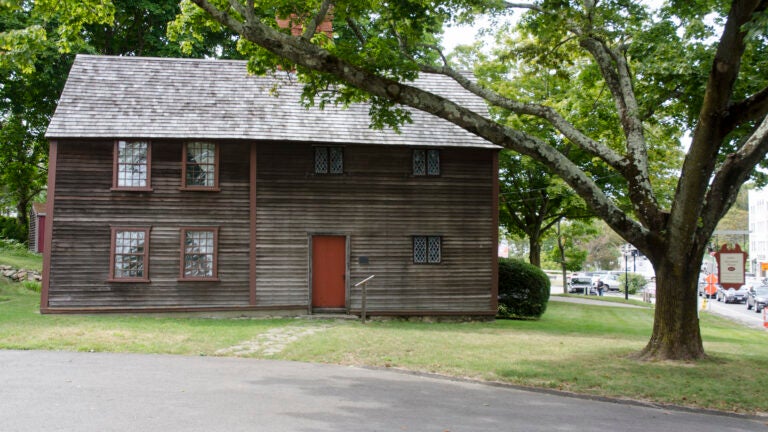
The mansion was designed by Christopher’s wife, Rebecca Gore, Roach said. The couple bought the land in 1786. The original house burned down while the couple was living in London and its accompanying carriage house still stands today.
The Gores lived in Paris for six months in 1801 and were introduced to French architect Jacques-Guillaume Legrand, who helped Rebecca Gore formalize sketches and ideas for a new home, Roach said. The structure is “a rare case of a house that was designed by a woman at the time,” he said.
“It’s as close to an English country house as you might get to see in New England,” said Roach. “So it really has a different feel about it. It’s really not what you expect from the typical historic house in this area.”
The Palladian-style mansion has five sections, Roach said.
“There’s a large central block, and then there are these gabled pavilions which look like a Greek temple in shape, and they are connected by an arcade. The interesting thing is in the Mediterranean, that arcade would be open to the air with arches. But in New England that doesn’t work. So they bricked it in, but they kept the arches. “
The home was built to impress, Roach said.
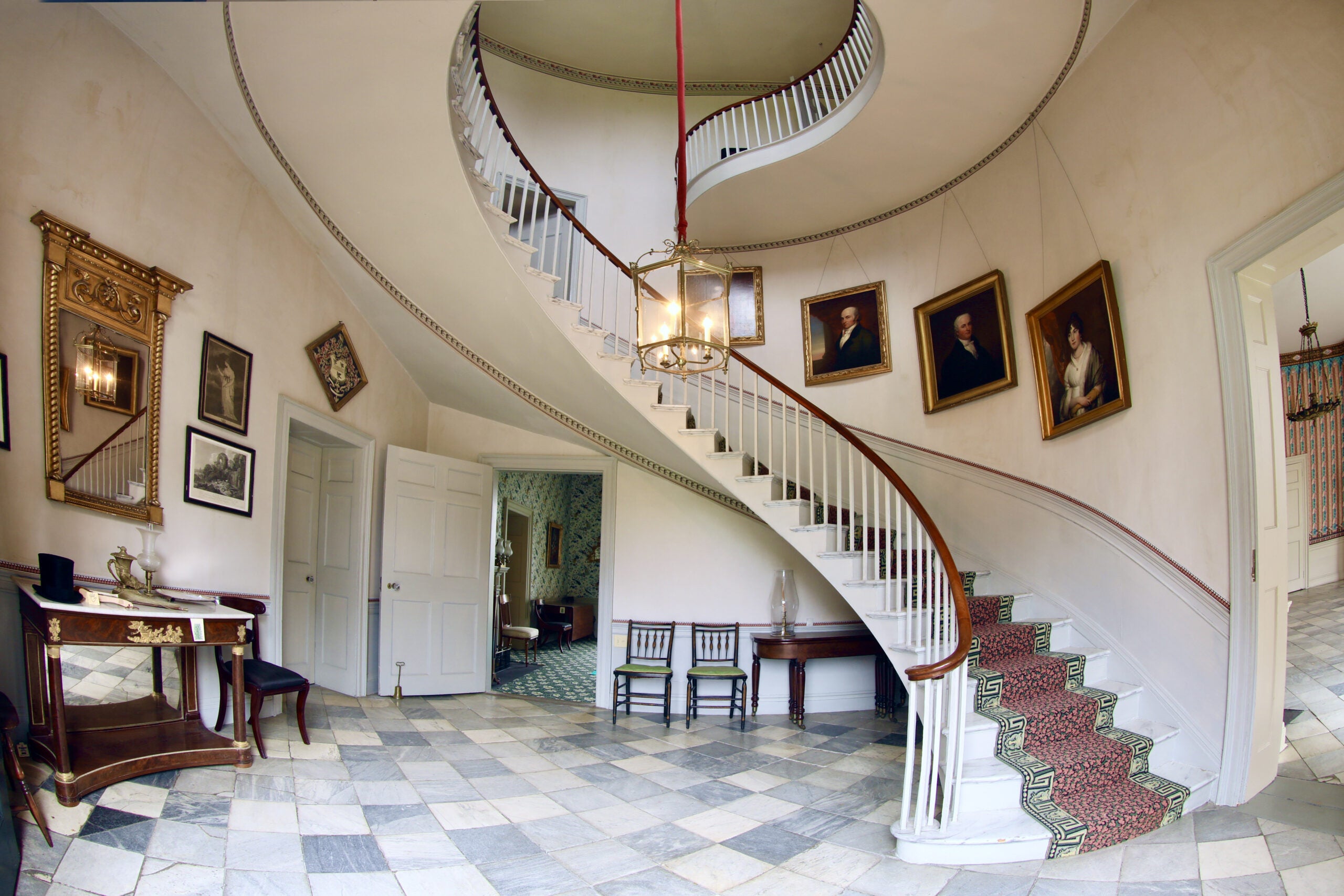
Visitors are taken through the Great Hall (with 17 foot high ceilings), Oval Parlor, library, and Gore’s office, along with dining rooms, studies, bed chambers, and the billiard room, Roach said. The large billiard table was built for Gore in Boston in 1805, he noted. Guests can view period furniture throughout the home. And, true to the time period, the walls are covered in paper, Roach said.
“We’ve reproduced a lot of the original wallpaper,” Roach said. “As you go through the rooms they look very much like they did in Gore’s time. These are some dramatic wallpapers. They weren’t shy about patterns and colors.”
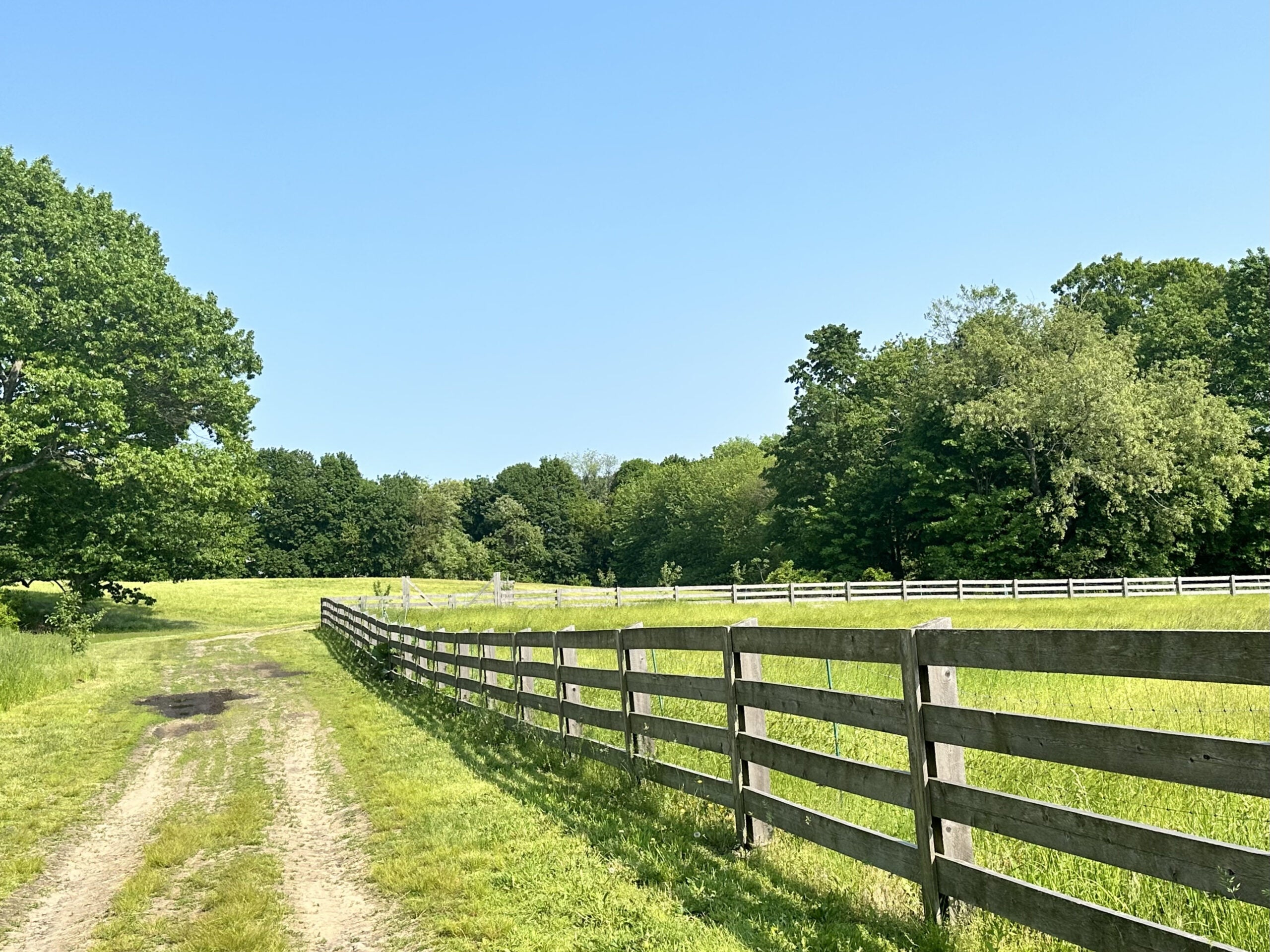
In 1800, Waltham and Watertown was a farming area and Gore had about 200 acres at one point, Roach said.
“We don’t have that today. We have his original 50 acres. But in honor of that aspect of the property, we do keep sheep and goats and chickens,” he said. “We try to maintain some of the farming element. Like there’s pasture land. We have animals. But Gore had a much bigger operation. He was running it as a commercial farm.”
Visitors can check out the Leicester Longwool sheep, a rare, heritage sheep first bred in England in the 18th century. Gore Place is one of the few farms across the nation raising Leicester Longwool sheep, according to the society.
“We chose those sheep because Gore had gone to the farm of a progressive farmer, a man who developed this breed, his name was Robert Bakewell,” Roach said. “And Gore made a point of going to Bakewell’s farm and seeing the different varieties of animals and he commented on their fine quality.”
In April, thousands of people attended Gore Place’s 38th Annual Sheepshearing Festival, Roach said.
The property also hosts Jane Austen-themed programming such as tours and tea parties, Roach said, some of which have been attended by members of the Jane Austen Society of North America.
The English novelist had never visited the property, said Roach, but “this is the type of house that she was familiar with and wrote about.”
“The Gores were there in the same period that Austen was. So Austen’s England would be familiar to the Gores,” Roach said. “The Gores were great Anglophiles, so they’re emulating that England country lifestyle.”
Editor’s note: In the coming months, Boston.com will be featuring historical sites around Greater Boston as chosen by staff and suggested by readers. Enter your suggestion in the form below.

Stay up to date on all the latest news from Boston.com




To comment, please create a screen name in your profile
To comment, please verify your email address
Conversation
This discussion has ended. Please join elsewhere on Boston.com