
Need weekend plans?
The best events in the city, delivered to your inbox
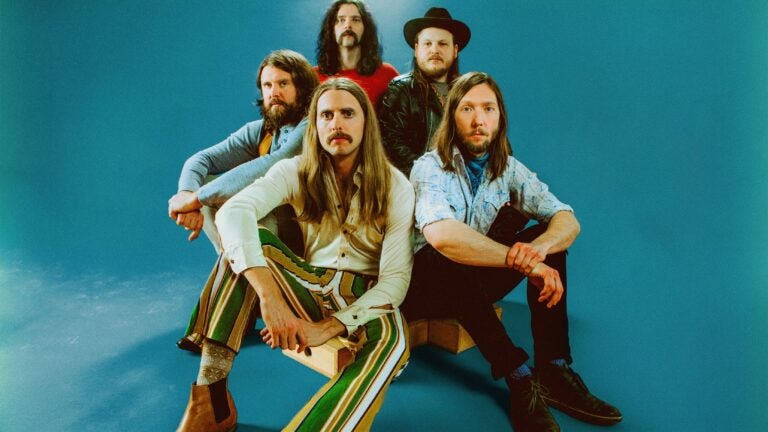
The Sheepdogs is a rock band that originated in Saskatoon, Saskatchewan, Canada in the early 2000s, originally made up of three high school friends, that has since shifted and expanded into a five-person group. They’re heading off on a major North American tour that includes over 70 show dates, one of which is Boston: they’ll be at the Sinclair in Cambridge on October 17.
Members Ryan Gullen and Ewan Currie went to high school together, and knew Sam Corbett, who went to a different high school, from mutual friends. They were the original three, with Gullen on bass, Currie on guitar and lead vocals, and Corbett on drums. Currie’s brother, Shamus, joined the band in 2012 on keys, and for this tour, Ricky Paquette is joining them on guitar.
Gullen reflected on the band’s origin, calling them “a couple friends who wanted to do something different.”
“We were at that weird age when you’re 19 and in college and trying to figure out what you want to do, and we just decided to start playing music,” Gullen said. “We didn’t set out with grandiose ambitions, but it sort of just went that way and now this is our full time job.”
Even without those ambitions, they ended up achieving a lot, including being the first unsigned band on the cover of Rolling Stone.
“In 2010, we were approached by Atlantic Records to be part of a competition to be the first unsigned band on the cover of Rolling Stone, which is a big thing. We were also the only Canadian band in that, and we ended up winning,” Gullen said.
The Sheepdogs’ sound is very classic blues-rock style, and influences include Led Zeppelin, The Beatles, Creedence Clearwater Revival, The Allman Brothers Band, and Crosby, Stills & Nash. They aim to make music that sounds like music they enjoy.
“We were lovers of old school rock ‘n’ roll, so that’s what we do. That’s how we’ve always done it and how we continue to do it,” Gullen said.
Ahead of their show, Boston.com asked Gullen some questions about their origin and the way the changes their band has gone through over the past almost two decades.
Boston.com: You’ve been making music as a band since 2004 — nearly 20 years ago. What has changed and what has stayed the same over the years?
Gullen: The funny thing is the biggest change would be how much technology has changed and how people consume music — 2004, there was maybe MySpace, but like the early version of MySpace, so things have changed a lot in terms of streaming and TikTok and all those kinds of things. That’s the way that all of our lives have changed in the last 20 years, and at an incredibly rapid pace.
But I think our whole thing is we haven’t really changed the way that we’ve done things. We’ve never really been a band who chased trends or tried to do something different. There have been a lot of times in our career where people have said, ‘Oh, if you sound more like this, or you’re more like this…,’ but we never really wanted to do that and we’ve been fortunate that we’ve still had success doing what we do. What’s true now is what was true 20 years ago: We just make music that we want to listen to. We want to make music that we love and hope that other people like it.
How do you think your music has developed over the band’s lifetime?
Gullen: When you go back and listen to music you made when you were like 20 years old, it’s obviously very different than stuff you’re doing now, and so many things can influence the music you write and perform. It’s things like life circumstances and experiences, but even as a musician, you develop and you get better. When we started the band, we literally didn’t really know how to play our instruments, so obviously that’s evolved.
The biggest thing is that we try not to do the same thing over and over again. We definitely do try to challenge ourselves to change, to try different things, to be experimental. Each record you make is like a slice of time, I think, and things naturally change over time. And, we’ve had different members who’ve had different influences on different things. But at the heart of it, we’re essentially the same band as back then, just 20 years older.
Why “The Sheepdogs”?
Gullen: I wish there was a good story. Every band name we settled on was either taken or we thought it was really hard. There was a band that was really cool at the time called Mando Diao, and that band had a song called “Sheepdog” and we literally just saw that and we were like ‘That’s not a bad idea.’ It’s funny because we did meet the lead singer of Mando Diao years later in New York and he said, ‘You know we have a song called that,’ and we were like ‘Oh, we know.’”
What’s next for the band?
Gullen: So much of what we do is tour, not just make records, and the pandemic obviously prevented that. It’s something that we’ve never stopped doing since the beginning of the band; as much as we can make records, we think that the experience of everyone being in a room together is a big part of what rock ‘n’ roll is. That experience is something we really missed with the pandemic and we’re just so excited to be touring for the foreseeable future, so happy to be back to that.
Beyond that, I think one of the things we learned during the pandemic is that even though so much of music is planning these long things ahead, we can’t always rely on that. So we’re just taking it step by step. We always want to make new music, we always want to put things out there, but for right now we’re taking it step by step. Right now, that looks like play a bunch of shows; think about the next show and play it, have it be a good time.
The best events in the city, delivered to your inbox


Be civil. Be kind.
Read our full community guidelines.To comment, please create a screen name in your profile
To comment, please verify your email address