
Get the latest Boston sports news
Receive updates on your favorite Boston teams, straight from our newsroom to your inbox.
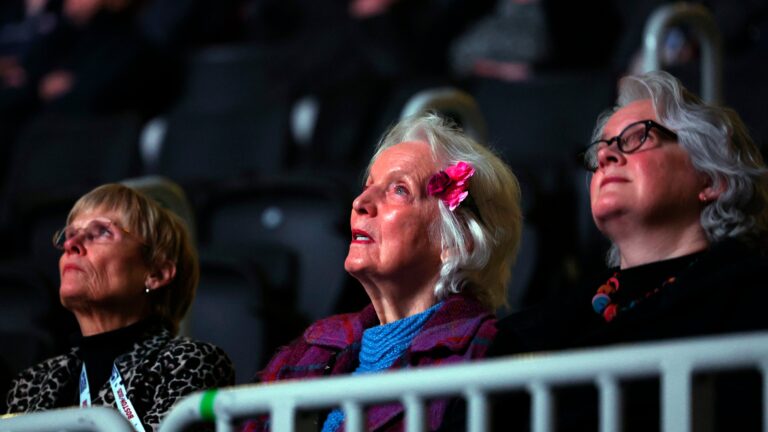
Seventy years ago, Tenley Albright was in Cortina d’Ampezzo, Italy, wondering if she would even get the chance to skate for the Olympic gold medal.
“When I flew in from the United States and found her in bed she could hardly walk,” wrote her father, Dr. Hollis Albright, to the Globe during the 1956 Olympics. Albright had suffered an injury in an early practice: a slash in her leg and a bone bruise that physicians worried at one point was becoming phlebitis.
Despite the dim prognosis, Albright did skate, and she won the first Olympic gold medal in women’s figure skating, showing a tenacity she continues to show at 90 years old.
Albright will be in Milan and Cortina, celebrating the 70th anniversary of her gold medal with a trip back to the region where she won it. Being a nonagenarian won’t stop her.
Nothing ever has.
“You’ll probably be able to hear me cheering all the way back here,” Albright laughed while talking about her 10-day trip.
In an era where women athletes are applauded more than ever, Albright’s achievements fly under the radar.
The first US woman to win a world championship, which she did, twice. The first US woman to win an Olympic gold medal in figure skating. One of just five women in her Harvard Medical School class of 1961. The first woman on the surgical staff at New England Baptist Hospital. The first woman officer of the US Olympic Committee.
Breaking new ground for women was part of Albright’s every day.
“I had seven interviews [for Harvard Medical School],” recalled Albright in a 2024 interview. “In two of the different interviews, they said, ‘Do you realize that if we accepted you, you’d be taking the place of a well-deserving young man?’
“I said, ‘Yes.’ Then they asked what I would do if I wasn’t accepted. I said I would apply again next year.”
Tenley’s trademark tenacity was possibly most on display during the 1956 Games. During a practice session on the outdoor ice (Cortina was the last Olympics with figure skating held outdoors), the blade of her left skate cut her upper right ankle and calf area. It was a deep cut, and there was a bruise where the heel of the boot struck the skin.
“I was going fast backwards, and I hit one of the big ruts in the outdoor ice and went flying,” said Albright. “I didn’t want anybody to know I was hurt. I think it’s just part of our experience when we’re skating and preparing for competitions.”
The wound was a problem, but the bruise and its pain proved to be the bigger issue. Albright was off the ice just days before the biggest competition of her life.
The Olympic team had a sparse medical staff compared with the one the United States sends now to Games. What helped Albright tremendously was that her own father, a surgeon, flew overseas to assist.
Six days after she was allowed back on the ice, the pain got worse, extending up a vein in her leg, explained Albright’s father to the Globe at the time, which could have been a sign of phlebitis or a blood clot. Luckily for Albright, it wasn’t.
The injury did limit her training. She participated in practice sparingly, and by the time she took the ice for her free skating program, she had not practiced it for more than two weeks.
What would have been daunting to many was just another chance for Albright to shine. In pain and coming off a difficult warm-up, she was nearly perfect. The supportive Italian crowd hummed along to her music, and she won the gold medal.
“I’ve always thought that, no matter what, there’s always something that comes up, and usually we are all facing the same challenges, and I just hoped I could manage the challenges better,” said Albright.
Another challenge she mastered: studying while being the world’s best figure skater. In order to balance the two, she had to find any open ice she could to practice. She remembers carrying her skates, records, and Victrola into the back of Boston Arena, while St. Botolph Street was still dark, in order to practice.
“The Boston Arena would let me call up after 10 p.m., and if they hadn’t sold the ice at 4 a.m., 5 a.m. or 6 a.m.,” said Albright, “they would let me come in and skate the next morning. I just loved that. I didn’t get much sleep, but I was thrilled.”

She also won’t be getting much sleep in Milan. Albright is excited for what she deems a “wonderful and strong” US figure skating team, especially the women: reigning world champion Alysa Liu, reigning three-time US champion Amber Glenn, and 2024 world silver medalist Isabeau Levito.
The three have a close bond and seem more friends than rivals, different from in Albright’s era. During her competitive years, Albright had a rivalry with fellow American Carol Heiss, who captured silver in 1956. No evidence of it remains: The two sat together at the recent US championships and chatted away.
Liu, Glenn, and Levito already have that camaraderie.
“They are just fantastic and are very good friends supporting each other, and that is so nice to see,” said Albright.
For 10 days in Italy, Albright will be cheering them on, hoping that one or more will join her in an elite club, as an Olympic gold medal. She will literally be on the edge of her seat.
“I can’t help feeling that I’m skating every edge with the skaters as they’re competing because the memories just flood your brain,” said Albright.
Receive updates on your favorite Boston teams, straight from our newsroom to your inbox.




To comment, please create a screen name in your profile
To comment, please verify your email address
Conversation
This discussion has ended. Please join elsewhere on Boston.com