
One Endless Moment: NCAA Tournament Games Finishing With Nonstart Action
I was a guest at a dinner party in Jamaica Plain Saturday night, about a 35-or-40-minute drive from my home in the western suburbs. I turned on the radio as I got in the car for the trip home and tuned into the Villanova-North Carolina State game. The announcer said there was a timeout with seven minutes and fifty something seconds to play.
When the final buzzer sounded on N.C. State’s upset win, I was on Route 128, two exits and five minutes from home. My interest in what was a first-degree bracket buster had waned in a blizzard of ads, despite the valiant-but-vain efforts of the broadcast crew to turn free throws into gripping entertainment. No game in any sport can be enjoyable when it ends with a half hour played in a 4-to-1 real time to clock time ratio.

North Carolina State put up an upset win over Villanova during the Round of 32.
Any one game in any sport can take on an odd life of its own. It would be nice to report that the grinding tedium of the endgame of Villanova-N.C. State was an anomaly, its effects magnified by the impact of radio on its captive audience of one. Unfortunately, to say that would also be false.
The next day, back home by the TV, I was able to indulge in remote clicking. I was both amused and horrified to see that I could watch the leaders of the PGA Tour event in Florida play an entire hole while a minute or less of the competing NCAA tourney games went off the clock. When a sport is going slower than golf, it’s barely moving.
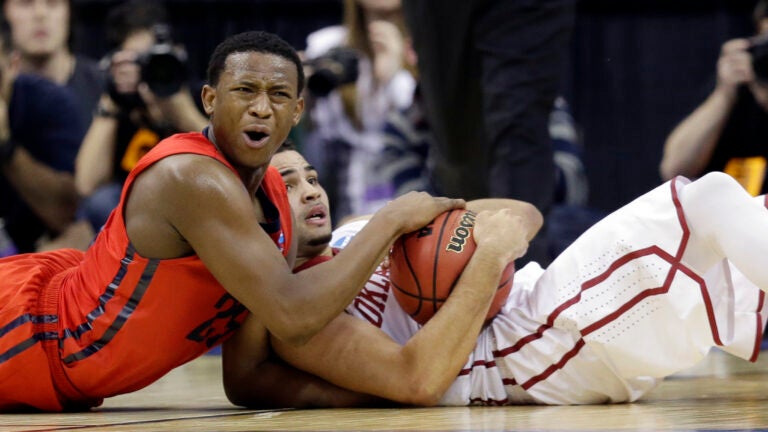
These impressions have been validated by someone else’s in depth-reporting. On Tuesday, the Wall Street Journal published its results of a stopwatch study of all 52 tournament games played to that date. The paper found that the average real time of the final two minutes for the games was nine minutes, nine seconds. For games with one team leading by less than 10 points at the two-minute mark, it was a snappy 10:34. The slow play trophy was won by Oklahoma and Dayton, who took over 16 minutes in the fourth dimension to run two minutes off the game clock.
Pauses in live action can build dramatic tension. Continual pauses destroy it. One thing I noticed in watching maybe a dozen tournament endgames last week was that the announcers felt the need to update the foul, timeout and possession arrow situation every time they returned from commercials. My guess is they feared their audience had lost the plot due to incessant interruptions.
The NCAA tournament remains a great event. But it’s in danger of losing neutral fans – the vast bulk of its television audience, by emphasizing the worst elements of college basketball rather than its best. A sport whose appeal rests on its combination of skills and raw athletic ability is providing dramas that end with neither.
What fills up the dead time of tournament finishes? Basically, it’s the rules, which allow the losing team what seems like an infinite number of opportunities to stop the clock to try and reverse its fortunes. Specifically, it’s too many timeouts and many, many, many too many personal fouls.
An ancient joke has it that when tapped upon the shoulder by the Grim Reaper, a basketball coach responded, “but I’ve got one timeout left.’’ College teams get five timeouts per half. In the first half, coaches use them to break opposition momentum. In the second half of competitive games, timeouts are hoarded for coaches to come up with tactics for every change of possession down the stretch.

#7 Michigan State upheld Coach Izzo’s reputation as the best Round of 32 coach in history, upsetting #2 Virginia 60-54.
On offense, increasingly a lost art in college hoops (the halftime score of the Michigan State-Virginia game between two of the nation’s stronger teams was 23-18, which would be OK for middle school JV squads) tactics have devolved to two basic plays, neither with much aesthetic appeal. Either the team passes the ball around until someone feels lucky about trying a three-point shot or the shot clock winds to less than five seconds and a guard drives the lane hoping to get fouled.
Odds are he will be, since the primary defensive plan for each losing team is to foul the other guys as quickly as possible. That stops the clock and makes the winning team shoot for its supper. Even the best free throw shooters in college make no more than around 80 percent of their tries.
These tactics are completely logical from the point of view of coaches and teams for whom losing means elimination. They are, however, disastrous from the point of view of a major spectator sport trying to keep said spectators entertained enough to come back for more.
College basketball, where regular attendance and TV ratings have declined in recent years, cannot afford to have people turned off by its premier event. The NCAA itself cannot afford it. The tournament’s revenue is what pays the freight for all the other NCAA tournaments in other sports, from the biggest schools to the Division III smallest ones. The organization’s fraudulent investigations of its members cost money, too.
Better to light a candle than to curse another timeout. There are simple rules changes which could get those last two minutes down to no more than five minutes of real time. The number of timeouts could be reduced. A team that’s fouled in the final two minutes could get its choice of foul shots or continued possession of the ball.
And if that didn’t work, I have a simpler solution. At the last mandatory TV timeout at the four-minute mark of the second half of a tournament game, the coaching staffs of both teams will be escorted from the arena and made to wait in parking lot until the clock hits 0:00.



To comment, please create a screen name in your profile
To comment, please verify your email address
Conversation
This discussion has ended. Please join elsewhere on Boston.com