
Revolution Version 2.0 Looks More Fit and Ready to Win
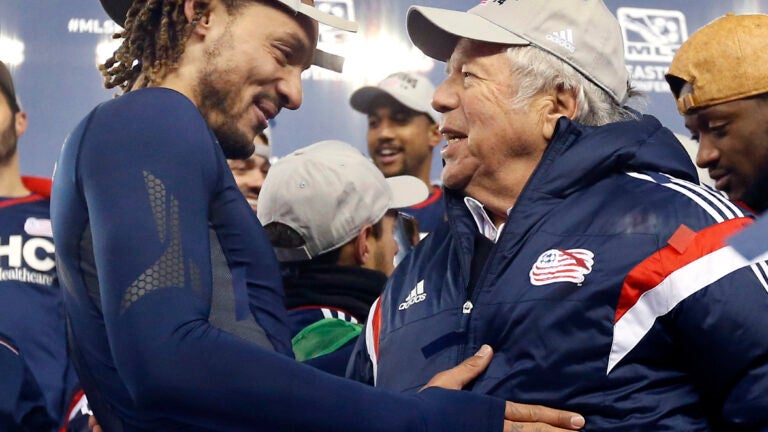
When the Revolution arrived in Dallas for the 2005 MLS Cup, they discovered much of their luggage had been left behind. The bags made it to the team hotel the following day, and nobody pointed to the mixup as an excuse for a loss to the Los Angeles Galaxy.
The Kraft family is not taking chances with commercial air travel these days. The Revolution chartered into Los Angeles Thursday in preparation for Sunday’s match with the Galaxy. This will be the Revolution’s fifth appearance in the final, and there is a concerted effort to have everything in place.
There might have been attention to detail and a management-going-the-extra-mile mindset in previous years, but those have been racheted up recently. Soon after Jay Heaps replaced Steve Nicol as Revolution head coach on Nov. 14, 2011, the organization began modernizing the operation.
A weight room was added next to the Revolution locker room. A video room was set up for the coaches. Former Revolution defender Nick Downing was hired as strength and conditioning coach. A statistical analyst is being used. This year, the Adidas miCoach performance monitoring system is being used during practices. Travel has been streamlined with charters, even for a short hop to Columbus in the playoffs.
The changes seem to have paid off. The Revolution scored seven goals (two more than the MLS record in a two-game series) in eliminating the Columbus Crew in the first round of the playoffs. After knocking out the New York Red Bulls, this appears to be the freshest, healthiest version of the Revolution to get to an MLS Cup.
“I think in some regards it’s a direct result,’’ Revolution general manager Michael Burns said. “We certainly monitor players a lot more closely than maybe at times in the past, in terms of fitness levels and through coaches and the miCoach system. I also think the medical staff and strength and conditioning coaches – and you also need a little luck. We haven’t had the number and length of time with injuries. A critical thing is strength of depth, so we’re not forced to bring guys back (from injury) sooner, if at all.’’
So now the Revolution have joined the 2.0 version of MLS as they go for their first league title win in five tries.
“I think the league has changed,’’ Burns said. “It is still a very young league. You look back to the last time we were in this position, analysts, strength and conditioning, and even scouting departments, administration. I think the league just evolved. In order to keep up and stay ahead as much as possible it is necessary to stay level and ahead of the curve a little bit.’’
When the Revolution met the Houston Dynamo in the 2006 final, star players Clint Dempsey and Steve Ralston were limping so badly there were questions whether they should have been playing. By the time the game went to penalty kicks, they were unable to take shots and the Revolution lost.
Now, when a Revolution player is injured, a more than adequate replacement is usually available. There was so much depth at forward this season, the team could trade away Saer Sene (2012 leading scorer), bench Diego Fagundez (2013 leading scorer) and expensive signing Geoffrey Castillion, loan designated player Jerry Bengtson to Belgrano in Argentina, and move opening day starter Teal Bunbury to the right wing. Charlie Davies, low on the depth chart (partly because he was injured) early in the season, emerged as the starter, setting a team playoff record with four playoff goals.
“Look, Jay (Heaps) agrees, you can never have too many forwards,’’ Burns said. “It’s arguably the most difficult position to find. The way we play, with one target guy, it’s not an easy position to play.
“Last year and this year guys have done a good job. We made a conscious effort to create as much depth and competition at every position on the field. One reason for our success in the last couple years, we’ve created a deeper roster and have guys capable of playing. And that’s the case at the forward position. It is more challenging for our forwards, it’s one position and a lot of guys are fighting to play.’’
The infrastructure and technical improvements had to be funded. But there might not have been a more important investment than Jermaine Jones, who will earn $3.25 million, the highest salary every for a Revolution player, joining the team on a free transfer in August after a 14-year career in England, Germany and Turkey.
“Ultimately, it comes down to the quality of players you have on the field and the level of professionalism each player brings on and off the field,’’ Burns said. “We’ve changed and evolved off the field. And Jermaine’s addition impacted on the field.’’




To comment, please create a screen name in your profile
To comment, please verify your email address
Conversation
This discussion has ended. Please join elsewhere on Boston.com