
From Cape Cod to the Himalayas, Jeremy Jones’ Local Roots Helped Create a Snowboarding Legend

Jeremy Jones appears suddenly out of the darkness along Boston Harbor, the skateboard upon which he’s riding rattling the boardwalk planks like a car driving over a series of railroad tracks.
He stops and speaks with a couple surprised to recognize the snowboarding legend outside the New England Aquarium’s Simon IMAX Theater, where the first of back-to-back sellout showings of his new adventure film, “Higher,” which a number of his friends and family are seeing for the first time on the big screen.
Inside, Jones’ larger-than-life projection plays on in a film that takes him from his East Coast roots to the Sierra Mountains, Eastern Alaska, and the Himalayas, tackling vertical lines in the backcountry snow that most will only experience through films like the latest effort from Teton Gravity Research.
As one of the world’s most notable big mountain freeriders, Jones’ prowess on a snowboard has made him an adventure sports icon, one that his brother, Todd, puts on par with skateboarding’s Tony Hawk or surfing’s Kelly Slater, pioneers of their sports not only because of their athletic skills, but also because of the passion each has spread from his specific craft.
But in the realm of a cool October evening on the Boston waterfront, he’s just a kid from the Cape riding a skateboard. Hanging out.
In “Higher,” Jones reflects in great part on how his past laid the groundwork for whom he has become, leaning heavily on the nuance that one of the world’s most popular backcountry snowboarders was raised in an area where the dunes at Cahoon Hollow may represent the steepest vertical offering. It’s the third of a Jones-focused trilogy from TGR, founded by older brothers Todd and Steve in 1996. “Deeper,” released in 2010, featured Jones and other top free riders explored untouched snowboarding boundaries, while 2012’s “Further” explored that backcountry mission to a new degree.
But unlike so many high-testosterone extreme sports films highlighted by dangerous stunts eminently foreign to their audiences, there’s a genuine human element to the Jones movies, one that becomes a focus in “Higher,” which is not only a story about origins, but also the human nature element involved in what Jones does for a living. We watch him struggle with his feats on the mountain, as well as the inner turmoil that lingers within over the need to be extra careful in the elements for the ultimate sake of his children.
“With these films, I hope that I inspire people to get out there,” Jones says at the conclusion of the latest film. “I hope to challenge themselves – not in the challenge of like ‘You’ve got to go hit the biggest cliff of your life.’ I mean challenge in like, ‘Go on that great adventure, and just really follow your passion.’ And that’s a scary thing and a challenging thing because that means making some tough choices along the way at times. That’s just such an exciting part of life is to go, ‘You know what, I know this is this far-out dream, but I am all in on it, and it’s the only way I know how to live my life.’”

It’s 268 miles from Centerville to Stowe, Vt., but that’s only the beginning of the journey.
Across the Cape Cod Canal, through the Hookset tolls, past the Green Mountain Inn and up Mountain Road, with the majestic backdrop of the Mt. Mansfield winter playground awaiting; it’s a trip that the Jones family would make nearly ever weekend during the New England winter months. Pack up the boys and ski gear on Friday, ski Saturday, Sunday, and drive home for the week that merely interrupted the process from repeating. It was ritual for the Jones family, a passion for skiing that developed in parents Linda and Steve later in life, but quickly trickled down to the Jones brothers.
“For me, coming from the Cape, I might as well have been going to Alaska,” Jones said, now seated at a table along the Harborwalk, fiddling with his board as he answers questions about his new movie, growing up in Massachusetts, and his role as an ambassador for the growth of snowboarding. His grandfather had moved to Stowe, where he would greet his grandchildren on a snowmobile in the rural darkness of a wintry Friday night. “Coming from the Cape, that was radical stuff.
“My parents, out of their love for the mountains, we would do the drive on Friday and on Sunday, and a drive that, now that I have kids,” Jones laughs, “I would never have done.”
That’s not to deny the attraction of Stowe, but it does admit the distance the Jones family committed to every weekend, a 536-mile roundtrip that sounds like a foreign undertaking to Jones these days, living 10 minutes from Squaw Valley in Truckee, Calif.
It was also a decision that the family didn’t take lightly, especially considering how deep the kids were into playing other team sports. “We’d do tons of hockey,” Todd Jones said. “It’s what our family was all about.” That is, of course, until, their parents put them to a choice. Hockey on weekends, and the early morning practices and long bus trips that came with the sport. Or the long family car rides to see grandpa every weekend and the ability to ski one of the Northeast’s best destinations for Alpine activities every week. It was a no-brainer, even considering the boys’ love for hockey.
“They asked us all,” Todd recalls when his parents delivered the ultimatum. “They told us, ‘You’re all going to be a big part of this decision.’ We wanted to go skiing every weekend we could.”
For Jeremy, that meant surrendering a sport that had kept him busy 11 months every year through about the sixth grade when he surrendered the skates for skis. “My first love for sure was hockey,” said Jones, who grew up playing with Eric Nickulas, who was a fourth-round draft pick of the Boston Bruins in 1994. Maybe that too could have been the same path for the Jones brothers.
Then their dad bought the snowboards at Shaw’s General Store in Stowe village and everything changed.

“I went to Shaw’s the day before Christmas and there were three of these boards in there,” Steve Jones recalled in “Higher.” “I didn’t know what it was, but I bought three of them.”
It was in 1982 when Jeremy saw his first snowboard in the pages of Thrasher Skateboard Magazine, and a light bulb went off. For a kid who enjoyed skiing, but envisioned a new way down the mountain, one in which he could surf the trails, this was what he was looking for. Perhaps without knowing it, he instantly joined a movement of snowboarders in the 80’s that would be remembered as parts tribal, revolutionary, and yes, naturally, the enemy.
“I can remember the first day ever that this mountain that I’ve skied forever allowed snowboarding and I was there and I was struggling to get on and off the lift,” Jones said. “Yeah, people were throwing a little attitude for sure.”
When Stowe first allowed snowboarding in 1988, Jeremy was among the first in line to receive a permit, which snowboarders needed in addition to a pass. Up until that point, most of the boarding the Jones brothers would accomplish would be in the backyard of their grandfather’s home in Stowe, where they would wear headlamps and fool around on their boards until being called in for dinner.
By comparison, hopping on a chairlift and navigating much steeper terrain was something entirety different for everybody.
“I remember when Stowe first allowed it. We got our asses kicked those first days,” Jones said. “I think the first day it was allowed at Stowe, I was with my brothers and we got worked. Some skiers got frustrated at us.
“But in general it wasn’t that whole snowboard vs. skiing thing, that was overblown in what I saw. That was never a big deal. But the very first day? Yeah…there was a little edge.
“I remember where I made my first proper toe-turn heel-turn on hard snow. But it took forever for me to learn how to snowboard. We had never seen anyone snowboard, so we had no idea how to turn. We didn’t know that you were supposed to turn the board on edge and track. We made every mistake you could have made. It took forever for us to be comfortable in hard snow.”

Jeremy had a solution for that. While his older brothers were away at college, he brought all three of the boards that his father had bought them that Christmas back to Shaw’s, where he traded them for a new board with edges.
“We weren’t super stoked,” Todd said. “We beat him up a little bit. But looking back now, we’re psyched he took that path.”
Of course, it was a decision that would begin to mold Jones’ talent for snowboarding during an era when the sport was just emerging from the zygote stages of its existence. Particularly in Vermont, where Jake Burton helped push the movement significantly, Jones was at just the right intersection of time and place for an aspiring boarder.
“That was a really special time and one that I’m really grateful that I got to see snowboarding in its infancy,” he said. “It was one of those deals where you’d start out the day by yourself or your own other buddy and not know any other snowboarders and by the end of the day you’d all be riding together. That went on for a long time where snowboarders just became snowboarders.
“When I started competing, like basically every weekend I was going to a snowboarding contest. I knew no one there and we’d make sure we got there Friday afternoon to ride the halfpipe. We knew that we would meet people there that would then let us surf their couch for the weekend. It never failed. It always worked.
“It was a brotherhood.”

By the late 80’s, the degree of Jones’ talent on a snowboard became apparent and leaving his family looking for ways to maximize his skills. That’s when Carrabassett Valley Academy, the private skiing and snowboard academy in Maine that has produced Olympians such as Bode Miller, Kirsten Clark, and Emily Cook, became part of the discussion.
“That was one of those things where snowboarding just took over my life and my parents recognized,” Jones said. “I was really into hockey, but then snowboarding came along and it was a whole other level of commitment and my dad’s friend from college, was running Sugarloaf. They had been talking about my obsession with snowboarding, and they had this ski academy that was just starting up. One thing led to another and I was on a bus to Sugarloaf.”
It was at CVA that Jones learned to excel in racing disciplines. He was one of the first snowboarders to ever attend the institution, which was also the first of its kind to offer snowboarding. But when the races ended, Jones felt something missing, a relationship with the mountain that had gone, if not cold, then at least tepid.

“From Day One, through racing and Sugarloaf and everywhere, it was always about riding the whole mountain,” he said. “Contests were totally part of it and I took it serious, but it was…I don’t know.”
For sure, most snowboarders during that particular period had a little rebellion in them, bred both upon the infancy of their sport, not to mention the backlash some felt from the skiing side, unwilling to yield the mountain and lifts to a whole new aspect of winter sports. In Jones’ case, he took his disciplines seriously, almost making the U.S. Olympic Team in 1998. But there was also a realization that came upon him during those years; how much fun was this really going to be in say, 20 years?
“At CVA, a lot of people that I went to school with that were super top-level skiers don’t ski anymore,” Jones said. “Now that I’m in Truckee and seeing kids growing up, not all kids that grow up in Truckee are ripping around with their dad at 25. Or climbing, surfing. I just want my kids to love those sports so I can do it with them.”
It was also at that time that Jones knew he wanted to be a professional snowboarder and that college was not in his future. Still, he promised his parents he would give it two years, but he knew. Everybody probably did by that point.
“My truck was loaded up with [cousin and fellow CVA Class of ’93 graduate] Adam Hostetter and we drove from graduation to the west,” Jones said. “When you say that you’re going to be a pro snowboarder and blow off the SATs, and that college means nothing thing to you, then yeah, there’s pushback from a lot of people along the way for sure. In all facets. And justifiably. If my kid told me that I’d be like, let’s talk about that.”
It was, indeed, but the beginning of the next journey, one that continues as he approaches 40.

“I would not be the snowboarder I am today without my time on the East Coast,” Jones tells the sellout crowd at the Simon IMAX Theater as he’s introducing his latest film. “The story is true; people come from the East and they hold their own coming out West because the mountains are real out here.”
Jones still holds an affinity for East Coast skiing, snowboarding, and mountaineering, despite the worlds that were open to him upon joining his brothers out west in Jackson Hole, Wyo., where Todd and Steve had founded Teton Gravity Research by 1996 with its first release, “The Continuum.” What followed over the years were some of the best-received “ski porn” films in the industry, including titles such as “The Tangerine Dream,” “Soul Purpose,” “Mind the Addiction,” and their latest, “Almost Ablaze,” which screens locally at Boston’s House of Blues on Nov. 14. (“Higher” will screen again in the area at Wachusett Mountain Resort on Nov. 21 (or you can purchase either movie online digitally at iTunes or on DVD at shop.tetongravity.com.)
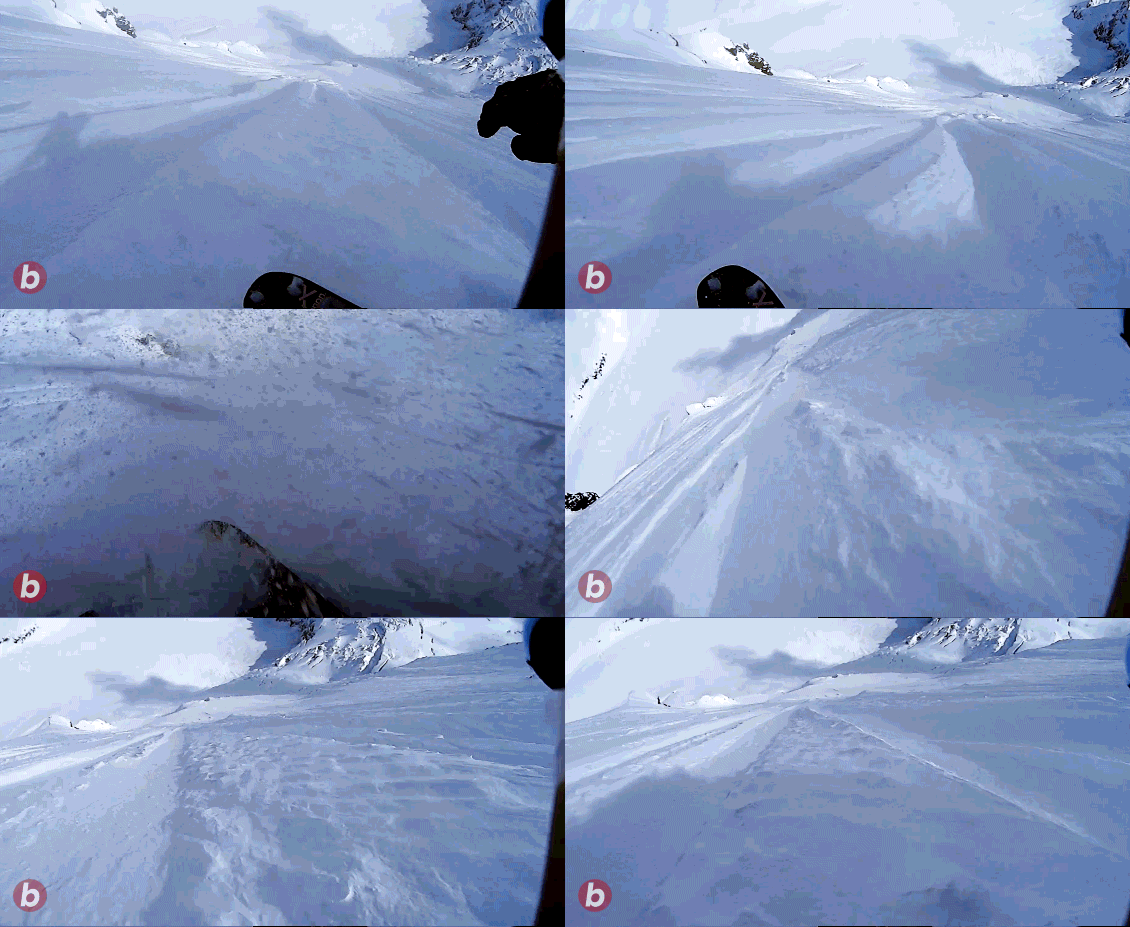
If it was in the East where Jones learned the basics of his craft and sparked his passion for not only snowboarding, but exploring, it was his move out west that gave him a workable canvas with which to develop his artistry.
“Once I started going out west, to me it was I was always really obsessed with general top to bottom snowboarding,” Jones said, as the crowd awaiting the second showing of “Higher” begins to grow outside the theater. Some linger close by the picnic table trying to catch a glimpse of Jones, attempting to eavesdrop on the conversation that Snowboard Magazine’s 10-time Big Mountain Rider of the Year is having.
Jones is talking about what’s next on the horizon. There is, of course, his popular snowboard company, Jones Snowboards, which has helped revolutionize the snowboard market with its collection of splitboards. There is furthering the mission of Protect Our Winters, the 2007 initiative that Jones founded in order to fight climate change. Jones was even honored at the White House last year along with other “Champions of Change,” in recognition of “ordinary Americans doing extraordinary things in their communities to out-innovate, out-educate, and out-build the rest of the world.”

But there are still more mountains to discover, more boundaries to explore. While it doesn’t seem that another trip to the Himalayas is in Jones’ future anytime soon, he described a recent moment on a peak in Montana, when he looked around at the horizon of unexplored territory surrounding him, and found himself already pondering a return trip to see what else the area had in store for him.
“The list just continues to get bigger and bigger,” he said.
On that to-do list, believe it or not, is New Hampshire’s Tuckerman Ravine, the New England backcountry mecca that Jones still has yet to tackle. “I’m hoping to cash that check in the next couple years,” he said.
In the meantime, there are existing productions with TGR to work on, and maintaining his fervency for the local Boston sports teams, the same he followed as a child, hoping the Patriots can make it back to the Super Bowl.
“We run a heavy Boston sports household,” Jones said. “My kids are Patriots, Red Sox, Bruins, Celtics all the way. I tell them they can be Oakland and Niners fans, but they won’t buy it.”
He’s also making sure that his two children hone their passions for winter sports the way he has, maintaining that love for skiing and riding in a town breeding Olympians, a place where competition can ultimately get in the way of ardor.
“Compared to that level, we’re pretty causal mountain people,” Jones said. “My goal with my kids with snow is to have them still love it when they’re 25. Because I want to be out there with them. And if I screwed that up, I’d be bummed.”
There’s no pressure or hope that they’ll build their lives around skiing and snowboarding, at least not like their dad and uncles have already done. Just the hope that they’ll still want to rip up the mountain with their old man a few years down the line.
“[My parents] are like, ‘I just don’t know how that happened; That you guys all ended up doing what you’re doing.’ And it’s like, well, we were up there because of you to start,” Jones said.
One of the lingering film-goers approaches the picnic table to interrupt the interview and introduce himself to Jones, thanking the snowboarder for his inspiring film work. The line outside the theater is growing for the late showing of “Higher.” We finish the interview, and Jones is off into the darkness to catch up with some old friends lingering nearby before he needs to appear in front of the IMAX screen to introduce his filmed exploits to another group of eager viewers who’ll immerse themselves in his journey from Cape Cod to Stowe to the gnarly peaks of Alaska and beyond.
Further. Deeper.
The journey never stops.





To comment, please create a screen name in your profile
To comment, please verify your email address
Conversation
This discussion has ended. Please join elsewhere on Boston.com