
Inside Boston University Rowers’ Morning Training Routine
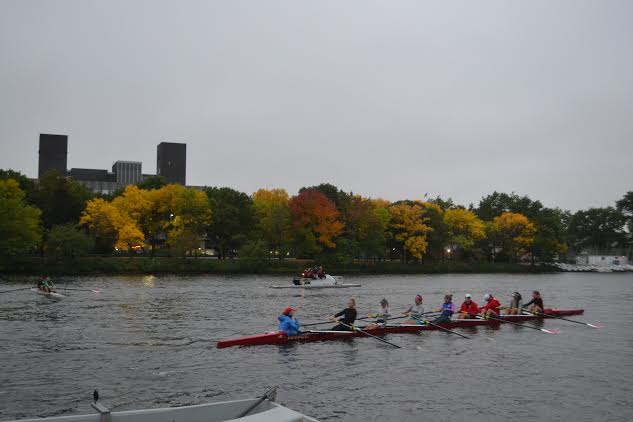
There are plenty of people up early in Boston–school teachers, garbage men and women, newspaper deliverers (yes, still!) and baristas. College students generally aren’t a part of this group–except, that is, for rowers.
6:00 am: In a race to beat the morning light, I make my way across the Boston University bridge, headed toward to the DeWolfe Boathouse on the Cambridge side of the river. I have my rain boots and rain jacket on in preparation for what is going to be a wet morning. Men and women rowers from BU speed by on foot. I pass a girl stopping on the bridge to take a photo of the dark, fog-covered skyline lit only by the yellow lights of the city.
I expect the boathouse to be a small house-like structure with, well, boats. The DeWolfe Boathouse is more than that, with newly finished wooden floors, wood-paneled ceilings, top-of-the-line exercise equipment, and a rainbow array of medicine balls.
“Dirty Water’’ by The Standells plays in the background as rowers stretch, preparing for practice.
So begins a day in the life of a crew athlete.
6:30 am: The men’s and women’s crew teams switch off warming up in the boathouse — today is the women’s turn to stretch outside. They go down a flight of stairs through the middle of the building to a room that looks how I imagine a boathouse should look. In rows of four or five, the boats, each with a different name, line the walls and a door opens out to the dock.
There are two women’s teams practicing — varsity and novice. The varsity team stretches on the dock in four lines — their bare feet, running shoes or flip flops pound on the wooden dock, which is painted with the BU crest. Some women wear sunglasses or headbands, their hair pulled into ponytails or buns. They all wear Spandex pants or shorts which make creases as they run.
6:40 am: One by one, the women delicately grab oars off the rack — about twice her height. The team is even more cautious as they take the boats off the racks to bring them out onto the water.
“Left side on shoulder!’’ one woman yells to the five or so people lifting it. “Walk it down!’’
They bring the boat to the water and it sits there touching the dock, bobbing up and down, awaiting the rowers.
Head coach Stacey Rippetoe talks to the team about the upcoming race, giving them tips using a yoga matt to point out intricacies of the race. She lists off which rowers are going to be in the two boats, the DeWolfe Pack and the Durkin boats, for the day with eight rowers in each.
Assistant crew coach Matt Hanig looks at me and says: “You’re going to need more clothes to go out.’’
6:45 am: He is right.
I get into a white motorized boat with Rippetoe and two women who aren’t practicing. I am equipped with a shirt, sweatshirt, jacket, raincoat and rain boots, as it is a wet morning.
(Full disclosure, the crew team is kind enough to give me a jacket to cover my legs and to sit on.)
Rippetoe unties the rope, backs up the boat, turns it toward the DeWolfe and the Durkin already out on the water.
We are off headed west.
“Keep blades in the water, push!’’ Rippetoe yells through her megaphone. In other sports, coaches might use cones or paint lines as their markings during practice. For Rippetoe and her team, they use landmarks, such as hotels, other boathouses and bridges.
“Let’s get through Weeks and then we will start the drill sets!’’ she says. Rowing crew is not just about doing laps up and down the river — it relies heavily on technique, as one wrong stroke could affect the whole boat. And yet wrong technique is not something the layperson would really ever see.
“Be smooth off the front end! Be relaxed and observant!’’ Rippetoe yells. She critiques, but rarely criticizes, giving an equal number of suggestions as she did compliments.
“This is the best you have ever done this drill, both crews,’’ Rippetoe says for all the athletes to hear.
Since it’s my first time out on the water, I am entranced watching these elite athletes do their sport. Some women’s faces crinkle as they row — hard work’s effect clearly visible. Others are smooth and relaxed, hiding the intensity of their morning workout.
Every few minutes I try to look around me to see the trees on the banks of the river touching the water, bouncing up and down, fall leaves floating on the top, and the bustle of city life on either side.
(I’d say, if you can take a boat to work on the Charles, do it.)
After rowing 9,000 meters, or a bit over 5 miles, the two boats reach a point where they can go no further. “On the other side of that bridge is a dam,’’ Rippetoe says with a chuckle. Watertown is on one side of the bridge, Newton on the other.
“Okay, turn around the boats when you are ready!’’
It’s time to head back to Boston.
8:00 am: “What’s going to happen if you mess up?’’ Rippetoe says. “Like a tree is going to fall on you?’’
The trip back is a little shorter, because it is less focused on drills and more on efficiency and speed.
“You want to have a connection to the water,’’ Rippetoe says through the megaphone regarding the way the rowers gently but firmly put their oars in the river.
What amazes me most is every stroke the team makes as they row west, they have to make again rowing east. They take another very small break on their way back to BU, but for the most part they row about 18,000 meters continuously, each stroke letting their bodies inch forward and then propel themselves back with all the strength in their thighs, simultaneously moving their oars in an attempt at perfect technique.
Emily Lerhe, a junior on the team, says she wouldn’t trade rowing for anything. She says she likes “the whole atmosphere of the sport, practice with teammates, feeling the physical movement of strokes, and the community it creates around the world so many different connections and people you can meet.’’
As they get close to the BU boathouse, ready to reach the dock, Rippetoe yells through the megaphone, “This was the best I’ve seen you row this year.’’
8:50 am: After both of the boats reach the dock, a few rowers gather their things quickly and rush over to the coaches’ boat — now referred to as “the school bus.’’ Some of the girls on the team have 9:00 am classes, so Rippetoe turns into a bus driver and speeds them across the river. Remember, they are student-athletes.
9:00 am and beyond: These athletes have already had an intense workout, but the rest of the day is still ahead of them.
“After freshman year, I realized 9:00 am classes were not for me,’’ senior Marisa Borchardt tells me. She takes most of her classes after 11 am just to make time for breakfast and a shower.
Borchardt says a typical day involves going to class, doing research with the dental school, making sure she has time to hang out with her friends (or her roommate who is also a crew athlete), and doing the second practice of the day: solos or lift.
The team has to do two “solo’’ practices a week where they either go out in a single or double boat for 70 to 80 minutes on a river or doing a biking or running workout.
“It’s a long time, but it is one of the most relaxing parts of your day,’’ Borchardt says. “No one is on the river and there is nothing more peaceful than rowing on an open river.’’
She tries to get to bed by 10 pm most days so she can get eight hours of sleep, but homework does not always allow that.
Borchardt says that even though her days begins at an “ungodly hour,’’ by 9 am she has already done something productive.
“It’s the ultimate team sport,’’ Borchardt says. “And when it comes down to it, at the end of the day, the people you surround yourself with sets you up with how the day is going to be.’’




To comment, please create a screen name in your profile
To comment, please verify your email address
Conversation
This discussion has ended. Please join elsewhere on Boston.com