
Tom Brady adds chapter to Boston’s growing sports history with Tampa
The young Florida sports city has been a landing spot for Red Sox, Patriots, and Bruins legends before.
COMMENTARY
It still seems odd to see and type, but it became official on Friday: Tom Brady is a member of the Tampa Bay Buccaneers, signed to a reported two-year contract guaranteeing him $50 million.
TB ✖️ TB pic.twitter.com/oyzSdNn1ZE
— Tampa Bay Buccaneers (@Buccaneers) March 20, 2020
Betting odds are often an overblown metric, but Tampa went from 60-to-1 Super Bowl shots at the Westgate in Las Vegas to 14-to-1 after adding Brady. Their season will certainly get plenty of focus around New England come September, or whenever coronavirus decides to let sports come back.
It won’t be the first time Cigar City has been on our radars since adding NHL and MLB teams in the 1990s: The Rays were well intertwined with the Red Sox before Chaim Bloom and Carl Crawford jumped north, from the 2008 American League Championship Series that sent Tampa to the World Series to a slew of extra-curriculars — Coco Crisp vs. James Shields in 2008, Pedro Martinez vs. Gerald Williams in 2000, Trot Nixon whizzing his bat past the mound in 2002 after Ryan Rupe plunked a pair of Red Sox in the first inning. (Topically, it was reported Tampa thought Nomar Garciaparra was stealing signs the night before.)
“The fans come in and they take over the city. They’re ruthless. They’re vulgar. They cause trouble. They talk about your family. Swear at you,” said Tampa’s Luke Scott in 2012, fanning the flames. “Who likes that?”
The 2011 Eastern Conference final between the Bruins and Lightning was a classic fueled by its own villains, namely Tampa coach Guy Boucher and the 1-3-1 defensive system, which Boston split open in scoring the only goal of an all-time Game 7. Tampa rolled in a five-game East semifinal two years ago, and looms in another should the NHL play out its season.
There aren’t too many memorable names who’ve made the Brady-esque leap from New England to the Gulf Coast, but there are certainly a few with which you’re familiar.
Logan Mankins
A six-time All-Pro selection in seven seasons, and a member of both New England’s All-2000s and 50th anniversary teams, Mankins was one of Brady’s fiercest protectors, a monster on the offensive line who played with an edge (and, in 2011, despite a partially torn knee ligament). His 2013 wasn’t his best, however, and it ended with the Patriots getting outclassed by the Broncos in the AFC Championship and Mankins allowing a critical fourth-down sack in the third quarter.
Signed through 2016 on a deal that, when penned, made him the highest paid guard in the league, the team approached Mankins about a restructuring. Mankins, who notably held out into November 2010 before getting his long-term contract the next year, declined the offer. The Patriots then traded the 32-year-old and a sixth-round pick to the Buccaneers during training camp, getting tight end Tim Wright, who was gone after one season, and a fourth-round pick that became two-time Super Bowl champion Trey Flowers.

Logan Mankins played the final two seasons of a Hall of Fame-caliber career with the Buccaneers.
It ranks among the more stunning departures of the Bill Belichick era, but it quickly faded, the Patriots immediately winning their first of another three Super Bowls in five years.
Tampa went 2-14 in 2014, ranking near the bottom of the league in both rushing and sacks allowed, then 6-10 in 2015. Mankins started 31 of 32 games and played nearly every offensive snap of Lovie Smith’s coaching tenure, making a seventh Pro Bowl as an alternate in 2015 at age 33. Tampa wanted him back for the final season of his contract, but Mankins opted to retire in March 2016, the same day as Peyton Manning made a far more public farewell in Denver.
Wade Boggs
A polarizing star during his time in Boston, where one person’s five-time batting champ was another’s me-first tabloid fodder, Boggs was five years removed from the Red Sox and 39 years old when he signed with the Devil Rays in December 1997. It was a homecoming for Boggs, who moved to Tampa as a preteen, and a chance for the expansion team to get a hyper-competitive future Hall of Famer and a likely celebration at a low price.
Sitting on 2,800 hits after 16 MLB seasons, the previous five with the Yankees, the headlines on Day 1 were that Boggs would get his 3,000th in Tampa’s neon-gradient duds. He needed 203 games and Lasik surgery on his eyes to get there, but he did on Aug. 7, 1999, with a two-run home run at Tropicana Field.
It was the last homer of his career. Boggs played in just 10 more games, needing knee surgery in September to repair a torn meniscus he’d likely suffered on a slide days before No. 3,000. Despite being 41, Boggs initially committed to doing the rehab and returning for a 19th season, but Tampa made it clear it wasn’t interested. Boggs retired in November, taking a special assistant to the general manager job, then transitioning to hitting coach for the 2001 season.
A career .328 hitter who failed to hit .300 just three times — his final years in Boston (1992) and New York (1997), and his Devil Rays debut — Boggs cruised into the Hall of Fame in 2005 with nearly 92 percent of the vote. The New York Times stoked rumors by reporting Boggs “had agreed with Tampa Bay to have a Devil Rays cap on his plaque,” with other outlets putting a number to it: $1 million, offered by Tampa owner Vince Naimoli. Boggs denied the story, and had no issue when the Hall immortalized him with a Red Sox ‘B.’
What’s lesser known is where the rumor likely came from: Jose Canseco. The fellow former Red Sox signed with Tampa before the 1999 season, and his contract contained such an agreement: “If he plays three seasons for Tampa Bay and is elected to the Hall,” the St. Petersburg Times reported, “he will go in as a Devil Ray.”
Alas, Canseco only lasted a year and a half, and The Chemist got just 6 of 545 votes in the 2007 Hall election, the first in which steroids were a major topic of discussion.
Manny Ramirez & Johnny Damon
I couldn’t forget about Ramirez’s cameo in St. Petersburg … heck, I still have the T-shirt. The least I could do is mention Damon, who actually played a role in Tampa’s shocking snipe of a wild-card berth from the collapsing Red Sox on the 2011 season’s final day.
Ramirez played his final MLB games with the Rays, though he’d bound through three more U.S. franchises, a season in Taiwan, and a season of independent ball in Japan (alongside former Sox future star Lars Anderson) as a 44-year-old before retiring. The Mannywood love fest that Ramirez received upon his trade from the Red Sox to the Dodgers in 2008 faded quickly once he was hit with a 50-game ban for performance-enhancing drug use in May 2009. Fifteen months later, balking at the possibility of being a part-time player, the Dodgers simply placed Ramirez on waivers, from which the White Sox claimed him to be their designated hitter.
He hit one homer and two RBI in 69 at-bats. Chicago, understandably, made no effort to bring him back.

Johnny Damon and Manny Ramirez pose with then Tampa GM Andrew Friedman and manager Joe Maddon on Feb. 1, 2011.
Tampa signed him and Damon, who spent four years with the Yankees and 2010 with Detroit after leaving Boston, as a package before the 2011 season. That both shared Scott Boras as an agent helped the deals get done, much to the glee of Friedman, who’d lost a slew of talent — most notably Carl Crawford to the Red Sox — from the 2010 American League East champions.
“One of them would have made our lineup better, but adding both will really take our lineup to the next level,” he told reporters.
The introduction was a comedy routine befitting two former Idiots. The 37-year-old Damon called Tampa his “dream team,” offered to take off his shirt and flex to show in what good shape he was, and quipped about how as a DH, Ramirez couldn’t “be the cutoff man anymore.” The 38-year-old Ramirez, signed for $2 million a season after making $20 million, turned to Damon when a reporter asked the two about playing all 162 games.
“Let’s do this,” Ramirez said. “You play 100 and I’ll play 62.”
Manny made it five. After a strong spring, he was 1 for 17 and the Rays were 0-6 on April 8 when his second failed drug test was announced; Ramirez immediately retired, rather than face the 100-game suspension, though it was negotiated down to 50 before he unretired to join Oakland in February 2012.
Damon, however, delivered. He had just 16 home runs and a .743 OPS in 150 regular-season games, mid-pack for a DH that year, but he was a steadying presence in the lineup and a leader in the clubhouse. Despite interest in returning after Tampa’s ouster to Texas in the Division Series, Tampa brought back Haverhill’s Carlos Peña instead to fill his role. Damon stayed unsigned into mid-April, when Cleveland brought him in for the final 64 games of his 18-year career.
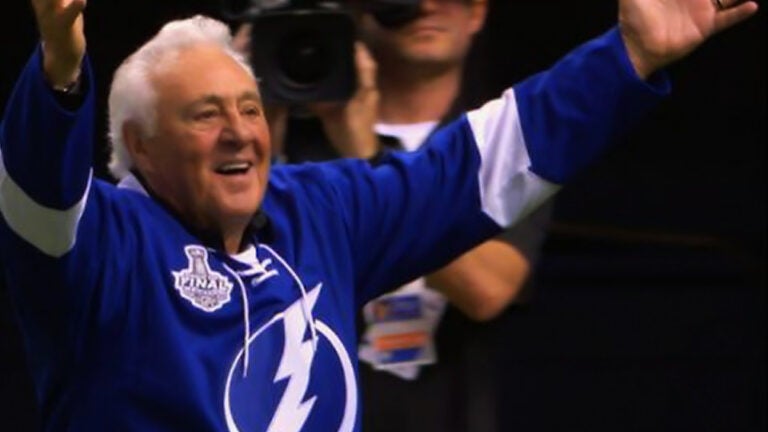
Phil Esposito
Espo wasn’t even the headliner when the Bruins acquired him from Chicago as part of a six-player trade in the summer of 1967, but his declaration that the deal “could be a big break for me” certainly came to pass. He was a superstar in the stratosphere of Bobby Orr, notching the first 100-point season in NHL history in 1968-69, then leading the league in goals each of the next six seasons. Boston went from last place in 1966-67 to two-time Stanley Cup winners and three-time finalists in Esposito’s eight full seasons.
His move to the Rangers on Nov. 7, 1975, for (most notably) Brad Park and Jean Ratelle was “probably the most startling trade in hockey history,” the Globe’s Tom Fitzgerald wrote, a Belichick-ian effort by GM Harry Sinden to avoid keeping aging talent too long. Esposito begrudged the team for years, but Sinden was ultimately right: A diminished Esposito played five and a half years on Broadway, retiring midway through the 1980-81 season, then bounced to their TV booth, their front office as general manager, and to two brief stints as coach.

Phil Esposito’s work in founding the Lightning is commemorated in a statue outside the team’s arena.
In 1990, he aimed to check off another box: Godfather, emerging as the head of Tampa Bay Hockey Group, Inc., seeking one of three expansion franchises the NHL was expected to award later that year. Though it was the second such group to go public, Espo’s grabbed the most headlines, staging a September exhibition game at Tropicana Field (then the Florida Suncoast Dome) that drew an NHL record 25,581.
Despite losing its biggest financial backer in October, Esposito’s group recovered and sold league owners, which awarded Tampa and Ottawa franchises in December to begin play in 1992-93. (San Jose got the other in May, starting a season sooner.) The Lightning, which Esposito christened them months earlier, bounced between two sites — ultimately playing three years at the “ThunderDome,” as they called The Trop in its 28,000-seat hockey configuration — before opening their current Tampa arena in 1996.
The team’s general manager until he was fired in 1998, Esposito has been part of the team’s radio broadcast since the 1999-2000 season. In 2011, he made headlines by declaring he couldn’t “give one damn about Boston” before the teams played for a shot at the Stanley Cup.
“My loyalties? Are you kidding? I gave birth to the Lightning. Are you loyal to your kids? You bet your [expletive] you are,” Esposito told NHL.com during Tampa’s series against the Bruins in 2018. “I had the greatest success I ever had, as a player, in Boston. There’s no doubt about it. I never wanted to leave Boston. But, the powers that were in Boston wanted me out.”
A little trivia: The other expansion group in the Florida derby, which sought to put a team at Tropicana Field full-time? Compuware, headed by Peter Karmanos and Jim Rutherford, which bought the Hartford Whalers in 1994 and moved them to North Carolina as the Carolina Hurricanes in 1997.


To comment, please create a screen name in your profile
To comment, please verify your email address
Conversation
This discussion has ended. Please join elsewhere on Boston.com