
MIAA cites pattern of ‘serious, egregious’ violations in Bishop Fenwick case
The unprecedented decision by the Massachusetts Interscholastic Athletic Association to bar all of Bishop Fenwick High School’s teams from participating in postseason tournaments in the 2023-24 academic year was driven by a pattern of alleged rule infractions spanning more than a year rather than “three honest and acknowledged errors” involving a single case, as the school’s board chairman has claimed, the MIAA stated Monday.
The punishment follows a contentious legal dispute over Fenwick’s request for the MIAA to grant a waiver for a 19-year-old student, Anthony Marino, to play baseball last spring in his fifth year of high school. The issue landed in Essex Superior Court last year after the MIAA denied Fenwick’s initial request and the school’s appeal.
Marino, of Lynn, has since committed to play Division 1 baseball at the University of South Alabama.
The court ordered the MIAA to hold an additional hearing on Fenwick’s appeal, and a second MIAA board unanimously rejected the request in March, ending the court battle and Marino’s hope of playing last spring for the school. The MIAA is the governing body for nearly 380 member high schools in the state.
“The MIAA would like to note that this appeal process has been riddled with contradictory and misleading information, and a severe failure on Bishop Fenwick’s part to do its due diligence before filing a waiver application,” the governing body stated in its official six-page notice to the school. The MIAA released a redacted copy of the notice Monday amid pushback from Fenwick and supporters of the private Catholic school in Peabody.

What’s more, the MIAA alleged that Fenwick violated its rules by permitting a seventh-grader to play on the school’s 2022 varsity baseball team, taking a spot from a high school student, without seeking a necessary waiver.
When the MIAA asked Fenwick to investigate, the notice states, school president Thomas Nunan responded that he found no rule violation. Even if Fenwick had obtained a waiver for the seventh-grader, he would have been limited to playing at the junior varsity level rather than on the varsity team, according to the MIAA rules.
“Based on all of the facts and circumstances, including Bishop Fenwick’s repeated failure to comply with MIAA’s rules and to accept responsibility for the misinformation or lack of information” in the waiver process, the notice states, “Bishop Fenwick’s conduct was sufficiently serious, egregious and repeated to warrant imposition of the discipline.”
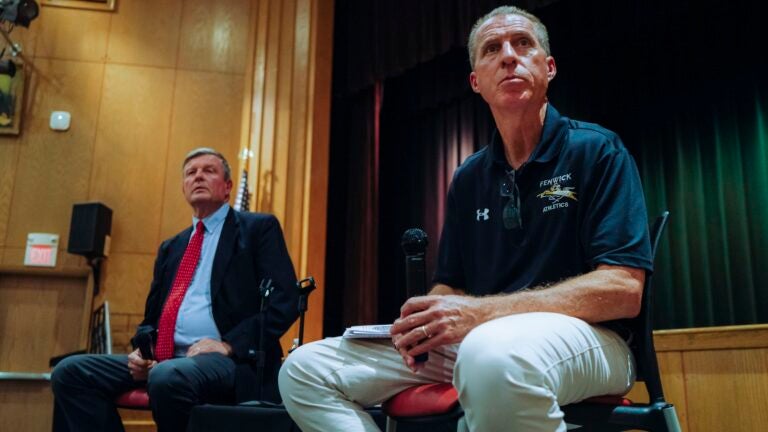
The school called a community meeting Monday night in part “to strategize how the Fenwick Family will confront — and overcome — this challenge,’’ according to the board chairman, Neil Harrington. Emotions ran high in a crowd of nearly 200, with many parents expressing anger at both school leaders and the MIAA.
Harrington and Nunan said they would continue to try to reduce the penalty. They raised the possibility of suing the MIAA and also leaving the MIAA, as Austin Prep of Reading did last year.
“I steadfastly and resolutely reject the accusation” that Bishop Fenwick was “knowingly deceitful,” Nunan told the crowd.
MIAA officials have not embraced Fenwick’s response that the penalty was unfair and especially detrimental to student-athletes who are not involved in the controversy. Many in the crowd echoed the school leaders’ sentiments.

MIAA board member Tom Arria, the athletic director at Cambridge Rindge and Latin, said in an interview, “In regard to any accusation that this was based on only one incident, I can assure you that the board would not hand out the harshest consequence in the history of the MIAA without scrutinizing every single side of the issue and turning over every single rock.”
The ruling was unanimously affirmed by the MIAA’s 23-member board, composed of school superintendents, school committee members, principals, assistant principals, and athletic directors from across the state.
MIAA executive director Bob Baldwin said, “We’re talking about a pattern of ongoing behaviors well over a year in duration. The board is certainly not taking a decision like this lightly.”
Marino’s name was redacted in the publicly released copy of the MIAA notice. However, details of the waiver request very closely align with the Essex Superior Court case. The Marino family’s lawyers did not respond to requests to comment.
The MIAA notice, citing multiple alleged inaccuracies and inconsistencies in Fenwick’s waiver request for Marino, stated, “At times, Bishop Fenwick attempted to distance itself from the waiver application by among other things suggesting that it was completed by the now ‘former’ athletic director, and that the appeals were the product of the family, not Bishop Fenwick.”
School principals and athletic directors are primarily responsible for enforcing MIAA rules and issues such as waiver requests, according to the governing body. The MIAA was particularly critical of Nunan and Fenwick principal Cecelia Marquez for their handling of the Marino case.
The notice said, “Although MIAA’s rules require that the principal understand and enforce its rules, Principal Marquez said that she really did not understand baseball. However, when asked directly, Bishop Fenwick’s president said that he was fully supportive of the application. From the MIAA’s perspective, no one took responsibility and accountability for what had happened.”

Marino, who turned 19 in January, attended Lynn Classical as a freshman and sophomore, then transferred to Fenwick and repeated his sophomore year. He did so, according to his lawsuit, after nearly two years of debilitating health ailments and medical treatment that negatively impacted his academic performance.
Marino’s ailments included three stress fractures in his spine and two disc protrusions, as well as a congenital kidney disorder, his suit states. During his sophomore year at Lynn Classical, Marino underwent two kidney surgeries, and the recovery from both operations caused him to miss a considerable amount of school and contributed to “his ever-increasing academic weaknesses.”
When Marino’s parents asked Classical if he could repeat the year, their request was denied, prompting them to approach Fenwick, which granted the request.
The MIAA limits student-athletes to four years of eligibility for interscholastic sports, unless they are granted waivers. The agency applies four criteria in considering waiver requests: whether a denial would cause an undue hardship for the student; whether granting a waiver would result in an unfair competitive advantage; whether granting a waiver would displace another student from a team; and whether granting a waiver would conflict with “the general well-being of MIAA interscholastic athletic objectives.”
Marino’s medical problems did not sway the MIAA, which cited the large number of student-athletes who missed seasons due to the pandemic.
More glaring apparently, from the MIAA’s perspective, was Fenwick’s alleged effort to downplay Marino’s baseball ability and potential to provide Fenwick a competitive advantage. During the initial hearing, the notice states, Fenwick did not mention that Marino previously had been Fenwick’s pitcher of the year or that he even pitched.
The MIAA, citing another alleged lack of transparency, stated that Fenwick informed the governing body that Marino “had garnered no interest by college baseball coaches.”
However, the notice states that “prior to the December court hearing, the student and his attorney were overheard talking about the student committing to a Division One baseball program.”





To comment, please create a screen name in your profile
To comment, please verify your email address
Conversation
This discussion has ended. Please join elsewhere on Boston.com