The Super Bowl is America — but still a game
COMMENTARY
The overall political context of this year’s Super Bowl actually may equal the superheated cultural and social context that surrounds every Super Bowl, which is pretty much what the ancient Romans would have had if they’d have invented nachos and corporate partners.
Most of this has to do with the fact that the country is a little unstrung these days, and for pretty good reasons. Some of it has to do with the fact that the owner, coach, and star quarterback of the New England Patriots all claim some variation of friendship with the guy doing most of the unstringing; and some of it has to do with the fact that the guy doing the unstringing won’t shut up about his BFF’s down along Route 1 in Foxborough.
Ultimately, the Super Bowl’s size is the Super Bowl’s politics. Everything that is gargantuan, garish, and grotesque about every major institution in the country is squeezed into one week in one city. The unruly — and, more than occasionally insufferable — maelstrom that swirls together corporate avarice, political chicanery, and military tub-thumping overwhelms the locale and most of the people who live there, and the football game itself is like one of those power kernels in some science fiction novel that lives at the heart of exploding cosmic phenomena.
The first Super Bowl that I attended was in Miami, in 1989, and the festivities were interrupted by the Overtown riots, which was quite the counterpoint to the festival of fat things that was going on around the city. On the night of the commissioner’s party, I was talking to a woman who’d taken shelter in her car with her infant granddaughter because some guys had seized her apartment for a sniper’s nest from which they could throw bricks and (it was said) the occasional shot toward the police line below.
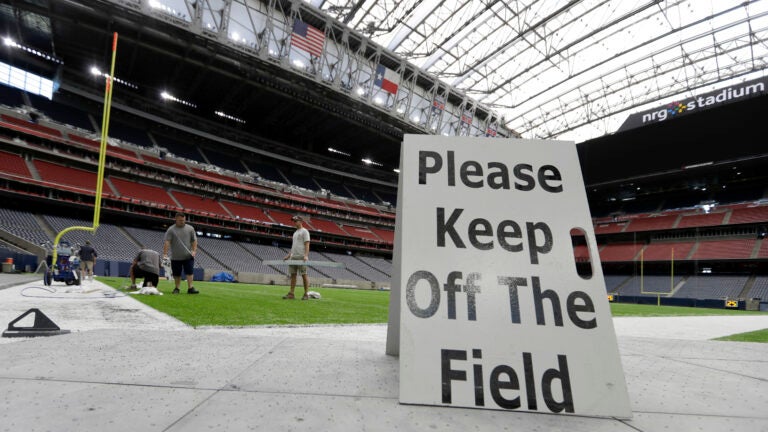
The second one I attended, like the one today, was in Houston. One afternoon, I strolled out of the media bubble and up to a little stone chapel that stood next to a tall pile of glass that once was the headquarters of the Enron Corporation, the energy giant that had collapsed in a staggering tangle of fraud and felonies not long before the game. I spoke to the minister who was in charge of the chapel and he told me how the grunts from the Enron building used to wander in at all hours of the day and just sit in his chapel, waiting for answers. The next Super Bowl I went to was in Jacksonville, and there was nothing remarkable about it except all the swells stayed on yachts that were moored at the docks along the St. Johns River.
They were all more alike than they were different — although, to be fair, Jacksonville was a little, well, homier than were the other two because Jacksonville, god love it, looks like the place in Florida where scenery gave up. Each one was bigger than the one that came before. Each one was noisier than the one that came before. Each one was more militarized than the one that came before. (Jacksonville actually took home the trophy for that among the three games to which I was a witness.) And each one was, in its own way, more political than the one before, not in the partisan sense but, rather, in the sense that each one was increasingly the property of what would come to be known as “the 1 percent” and, as we know, the struggle of class against class is a political struggle. This is one fought out at the beer carts — Ten bucks for 16 ounces of great American swill! — and at the souvenir stands — The $40 T-shirt means freedom! — and, probably, this year, some place outside on the sidewalks.
Folks are already a little tender about it. Anheuser-Busch tailored its big Super Bowl commercial to the current debate over immigration and it has taken heat from both sides. Conservatives thought it was sending a nod and a wink to the people stuck at America’s airports and liberals were a bit disturbed that the commercial was about a white guy coming to America when that really hasn’t been a problem since we were burning convents hereabouts in the 19th century.
Anyway, the Super Bowl was launched at the height of the unrest over the Vietnam War and the first ones ran through the remainder of that war largely untouched by the controversies because most of the people on one side of the debate either ignored it, or used it the way it was meant to be used, as a diversion from the mortal stakes for which the rest of the country seemed to be playing. That dynamic is lost to us now.
So, basically, as brutal as the sport is, and as preposterously inadequate as the NFL’s response has been to the destruction wrought upon its players, the game itself once it starts is probably the only thing that’s remained the same since Kansas City and Green Bay teed it up in the not-entirely-sold-out Los Angeles Coliseum. The players are bigger and the players are faster, which means that Isaac Newton has made the game more violent. But the field is still 100 yards long and a touchdown still counts six points. (OK, they made the extra point harder to convert.) Somebody has to cover somebody else, and some poor soul has to stand back there and return punts. Somebody will win and somebody will lose and it won’t matter a whit who buys what beer or whose commercial sells the most software or whose commercial makes the most people uncomfortable or angry.
The game is the only island against the gigantic, the garish, and the grotesque. The game is in the middle of everything and, still, apart from it.