
Get the latest Boston sports news
Receive updates on your favorite Boston teams, straight from our newsroom to your inbox.
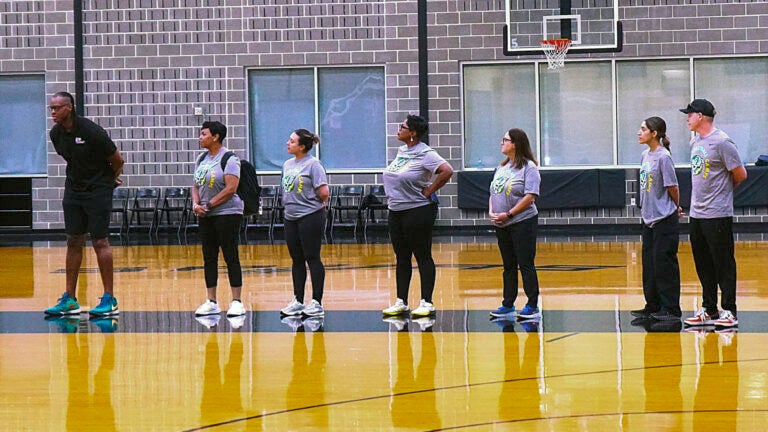
SAN ANTONIO and LOS ANGELES – Across sprawling San Antonio from the central bacchanal of the recent men’s Final Four, in a longtime Spurs practice facility with 11 championship banners on a wall (six Western Conference, five NBA), about 25 youths sat on the floor listening to a giant. He told them about Sally Ride, and about Jerry Sloan, and about a recent trip to Bhutan to teach basketball, and about empathy. He said, “I encourage all of you to create safe spaces [for others] wherever you go.” It felt puzzling to parse whether the moment seemed countercultural.
On the ensuing Saturday at a golf club along the west edge of Los Angeles, where the mainstays used to include Jim Brown parked out there like a buoy near the first tee, with the relentless 405 freeway visible way down below, the same giant tried to parse the national moment. Jason Collins is 46. His part-wobbly gait remains that of a 7-foot athlete who spent 13 NBA seasons and 830 games (including 95 in the playoffs) specializing in treating would-be buckets to a hard thwarting. And 11 years after he became the first publicly gay athlete to play in any of the four prominent North American men’s sports leagues, he still travels in his role as an “ambassador” with the NBA Cares program.
He had just spoken and taught at that first-of-its-kind “Final Four Inclusion Clinic,” geared toward “LGBTQ youth and allies,” as an organizer described it, and he had just noted again how all the kids in the drills do seem to want to take Stephen Curry-length shots. He had done so at a time in American history when the word “inclusion” has joined the words “diversity” and “equity” in taking on some headwinds blown clear from mountaintops such as the Oval Office and Pentagon. Collins navigates that as would someone reared on the unflappable day-to-day rhythms of the elite athlete. He keeps speaking about trying to be “a good teammate.”
“How do we create that environment [of acceptance]?” he said. “And the way we do that is by sharing our stories. It’s about forming those connections. It’s about looking at someone who might be different from us and being unafraid, and being, I guess, you know, some people say curious. And saying, ‘Okay, is there a way that we can connect and bond, and do we have common goals?’ And I understand that there are some people who do not want equality. And I think that is something that other people need to realize. Need to accept that, that there are some people who absolutely do not want equality. And I think that there are more of us who do want that world.”
As to whether that’s slightly more or many more, he reached for that athletic skill of focus: “I don’t know about all of that,” he said. “I don’t get into all of that. I just know that I think you have to be consistent, as much as you can with your own, obviously, mental health … you have to be consistent as far as being a good teammate. So I think all of us should strive to be good teammates.” He spoke of “sways” in culture and thought of an old interview he happened to catch with RuPaul who, from a piercing viewpoint, said, as Collins quoted it, “In our country, there’s going to be a back-and-forth.” As to whether the back seems to outpace the forth more than it did last decade, he’s not sure, and said, “Also, you don’t know how much of that is being amplified through bots.”
He said: “I got some great advice from Judy Shepard, Matthew Shepard’s mom. And she said … ‘You just keep living your life, you keep thriving, and that will be the way to sort of’ – I think you’re always going to have that component, I guess we’ll call them the ‘haters.’ Another friend of mine gave me some advice, ‘Don’t feel like you need to address every single hater.’ That’s energy that you’re wasting, too. If they’re saying something that you feel you absolutely need to respond to, go ahead. But it can turn into a game of whack-a-mole.”
Far from the fraught whack-a-mole that can govern the moment, the inclusion clinic breathed easily on the Saturday morning of the men’s national semifinals. The Sports Equality Foundation and the San Antonio Pride Center helped hatch it. Female and male coaches from around Texas and beyond graced it. The NBA backed it. The Spurs backed it with relish, as if you could hear the gruff voice of Coach Gregg Popovich urging on. “That is the unifying power of sports; it creates opportunities for young people to learn about themselves and those around them,” said Patricia Mejia, a vice president for Spurs Sports & Entertainment. Broadcasters such as CBS and TNT Sports backed it. “We’re looking to scale it beyond just even basketball,” said Ed Romaine, TNT’s senior vice president of marketing and brand development who, speaking for himself, said, “I feel personally like it’s a critical moment.”
Anthony Nicodemo, a high school teacher and coach in Greenburgh, New York, and a Sports Equality Foundation board member, aims to make it a Final Four habit, maybe even getting to mingle it with the main festivities at a compact city site such as that of Indianapolis (the 2026 host). “We know through various surveys through years,” he said, “that LGBTQ kids do not feel safe in P.E. class, an overwhelming majority.” And so: “It was very clear that [the clinic] was a very supportive and inclusive environment.” He saw it giving “kids watching the Final Four, reading about it,” a chance to feel “part of the Final Four.”
He said: “I think in a time when there is a lot of pushback, it is even more important to be visible. I am not a doomsday [type]. You figure out ways to get through.” He said the gay community had known days far harsher than these, but that the upcoming generation had not lived those days and so would need reassurance. “When things get tough,” he said, “you can’t make a run for the hills.”
In the quiet morning away from the hills, Collins told his story yet again: “But ultimately I accepted who I am. I am a gay, Black man.” He gave the familiar outline of reaching age 32 before coming out and how he didn’t want to “hide anymore.” He told of learning he had gone to the same high school as the astronaut and physicist Ride – the starry Harvard-Westlake of Los Angeles – and how, “I understand why she publicly didn’t disclose” her truth.
He spoke beneath one certain banner over which he could seethe: San Antonio’s 2003 version, representing an NBA Finals won (in six games) against the New Jersey Nets for whom Collins toiled among his six NBA stops. The clinic also brought him to a city he had visited often via basketball starting as a teen, including that time in 1998 when Stanford, with Collins and twin brother Jarron on the roster, reached the Final Four.
In the classic 86-85 overtime loss to Tubby Smith’s Kentucky in the first semifinal, Jason Collins could not play. He had spent his freshman year dealing with two knee surgeries as potentially consuming bummers. He had also spent that part of life, as he would say one week later in Los Angeles, “still trying to, you know, date women and say to myself, ‘I’m going to find, air quotes, the right woman who’s going to make these feelings go away,’ but obviously it doesn’t work that way.” Yet he had learned his way to contribute to Stanford’s team, such as making sure to pay attention in video sessions: “I can still learn the other team’s plays, what their tendencies are, so that if I see something from the sidelines, I can yell it out, say, ‘Okay, watch out for a baseline runner!’ You know, being positive. Being supportive. Helping your teammates [by] clapping, cheering, good body language.”
Now the session with the youths reached the question-and-answer portion, when he told of having no championship rings but said, “I’ll have a wedding ring in a couple months.”
A little cheer went up for that.
“Would you ever consider being a college coach?” a woman in the back asked.
“I like what I’m doing,” Collins smiled.
went a question one week later, high above the 405.
“I wouldn’t say anger,” he said. “Yes, there have been times where I’ve been disappointed. Um” – long pause – “it’s interesting, whatever emotion that you feel, it’s okay to feel that emotion. But I want, and I’m speaking to the next generation, or anyone, but I want you to use whatever you’re feeling for good, for positive. I think that is something that I’ve learned through sports, is even in a heartbreaking loss or a devastating injury, whether it’s the two knee surgeries, the wrist dislocation, the angst of being a closeted athlete, whatever it is that I’m dealing with. … But okay, how can you use it as fuel for a positive and not turn it into a downward spiral, but as a way to uplift, a way to say, ‘Okay, I’m going to use this to change something either in myself, something in my community, something in my country, in the world.’”
He said: “I can be a good teammate. I can always try.”
Receive updates on your favorite Boston teams, straight from our newsroom to your inbox.


To comment, please create a screen name in your profile
To comment, please verify your email address
Conversation
This discussion has ended. Please join elsewhere on Boston.com