
Taking a look at sports talk radio’s calming effect
Sports talk radio has brought a sense of normalcy during these unsure times.
COMMENTARY
A text message from my sister compelled me to go fill my gas tank early last week. By then it had been a few days since my family had been housebound, but she was alerting us to a rumor that the government was about to force us into lockdown for a couple of weeks. Get gas, she suggested, unsure of what would remain open. It didn’t make a lot of sense to me — but, then, a lot of things don’t make sense to me at this point.
So, I grabbed a pair of gloves, made sure the app on my phone was working so I wouldn’t have to swipe a card at the pump, and got into the car. I settled into the seat, turned the ignition, and then I heard the most reassuring sound I’d heard in days.
It was Felger and Mazz.
In that moment, and over the 15 or so minutes it took me to go to and from the gas station, I felt a sense of normalcy that had been missing since the global Covid-19 crisis came to our own doors and forced us to slam them shut. It made things feel more regular to hear Michael Felger cast shame on all the could-be contenders who weren’t willing to go big in bidding for Tom Brady. And to hear Tony Massarotti lament the loss of Jimmy Garropolo one more time.
I’d heard them say similar things so many times that it had started to annoy me by the end of the Brady Watch, but this time my annoyance and the retort being formulated within my inner monologue wasn’t merely a welcomed distraction. It was actually helping me to calm down a bit.
And I’m appreciative of the fact this sort of audio therapy is still available.
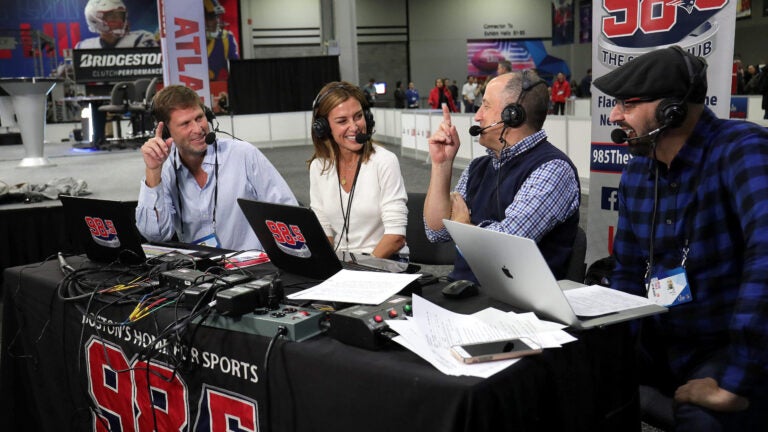
There are no sports being played, after all. There’s currently no plan as to when they’ll resume, either. Logically, if there are no sports, there’s no sense to sports talk radio. Yet as TV networks replace live programming with re-aired broadcasts of old games, as some local stations and newspapers shift sports reporters over to the news side, and as the bulk of the pro sports industry shutters up indefinitely, both The Sports Hub (98.5) and WEEI (93.7) have continued to roll out their regular lineups — just like they always have, for as long as I can remember my amygdala firing off too much cortisol.
In the early part of my college career, when I was a shy kid who missed his buddies from back home, I craved those 10 minutes between classes because I could turn on my Discman and catch a few minutes of Dennis and Callahan. At lunch, I’d often sit alone — but, in my ears, I’d be dining with the “A-Team” of Dale Arnold and Eddie Andelman.
After the terrorist attacks of Sept. 11, 2001, Glenn Ordway and the Big Show became a crutch as I hobbled through a world I wasn’t sure I was ready to navigate as a young adult. Then, like now, sports were shut down for a period of time, but even if Ordway and his co-hosts weren’t talking about games and players, they’d become such a part of my routine that hearing their voices each afternoon was like hearing from friends.
And as life started to move on, the timing helped in the transition back to something familiar, too, as later that fall they dug into the daily Bledsoe vs. Brady debate that raged over the radio waves for months. Day after day it was the same hosts, same guests, same callers making the same points — over and over and over again. But that feeling of familiarity satisfied exactly what I was craving.
Between then and now — between those two life-altering episodes in American history that coincidentally bookend Brady’s epic run with the Patriots — Boston’s sports radio stations have been there for me and my mental health at other highly stressful junctures, as well. Through career changes, through those first few world-tilting weeks with a newborn, through the aftermath of the Boston Marathon bombing, through the smaller moments when the hustle and bustle becomes a bit too pressurized, when my own world has started to seem like foreign territory, it’s been WEEI and the Sports Hub that have repeatedly helped ground me back at home.
Based on the volume of calls they’ve been taking this week, and their collective ability to engage audiences across multiple platforms, I’m guessing I’m not alone. And I’m also guessing I’m not alone in feeling grateful that they’re on the air, and that they’re providing this service.
At least for me, what they provide goes beyond the scope of a simple distraction. Podcasts, music, books, and binge-watching TV shows all have a place and serve a purpose as escapes. They’re certainly of value, too. But there’s something different about it being live and local. About the rhythm of the commercial breaks and hearing the same old ad slogans. About hearing a certain voice and recognizing the expected repartee.
There’s something reassuring about those stations’ ability to remind listeners that none of us is alone in this, and that someday sports will become important again — but for now Felger’s kids are watching too much “Captain Underpants”, and Mazz’s kids are fighting over the Xbox. (As they divulged this, I could relate; my own kids were on the brink of their own battle over a tablet.)
The format is criticized often. And a lot of it is valid, because it can be crass, and cranky, and cantankerous. But there’s comfort amid the cacophony and caterwauling that has allowed it to become a fabric of our culture, and in times like these, they provide a great service to those who might be seeking consistency if not calm. Especially those who might need the perfect companion for a 15-minute car ride into the chaos.


To comment, please create a screen name in your profile
To comment, please verify your email address
Conversation
This discussion has ended. Please join elsewhere on Boston.com