8 Boston sports villains from the ’90s
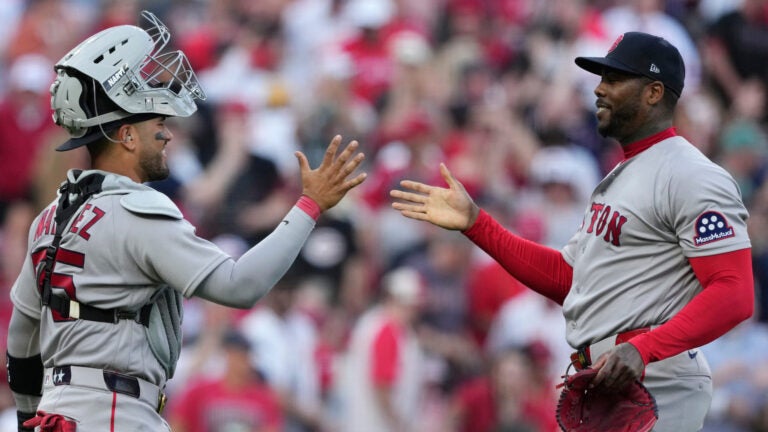
The Yankees began a new era of success in the '90s, further exacerbating "The curse of the Bambino."
In the spirit of March Madness brackets, Boston.com launched its own: Voting to decide who is Boston’s biggest sports villain. The Boston sports villain bracket continues with round-by-round voting, so head over and let your voice be heard.
Not one of the four major Boston sports teams won a championship in the 1990s. The Bruins lost in the Stanley Cup Final in 1990. The Patriots lost Super Bowl XXXI in 1996. The Red Sox started and ended the decade with trips to the American League Championship Series. The Celtics never made it out of the second round.
There was no shortage of villains, either. The Yankees birthed new legends and a new dynasty in the latter half of the decade. Bruins legend Cam Neely appeared poised to lead the team for years to come until incidents with a Penguins defenseman triggered an eventual early retirement. Just weeks before the 1994 Winter Olympics, a figure skater from Portland, Oregon, became embroiled in an internationally-covered scandal.
Here are eight Boston sports villains from the ’90s:
Roger Clemens
Clemens was the best Red Sox pitcher since Cy Young himself. He holds the highest WAR (81.0) by a Red Sox pitcher, is tied with Young for the all-time Red Sox lead in wins (192) and shutouts, and he struck out 2,590 batters in a Red Sox uniform, about 500 more than anyone else. Then there are Clemens’ two 20-strikeout games, three Cy Young awards with the Red Sox, and an MVP season in 1986.
But when Clemens’s contract expired after the 1996 season, general manager Dan Duquette decided to play hardball with the 33-year-old who had not been named an All-Star since 1992. Clemens ultimately signed with AL East rival Toronto in December 1996.
“Roger always wanted a four-year contract,” Duquette told the Boston Globe after Clemens walked away. “Frankly, we weren’t comfortable with doing that… [but] since Roger decided for free agency, the market has spiked. At the time of our offer, we didn’t see Roger as one of the best pitchers in baseball. He certainly hadn’t pitched that way in the last two years.”
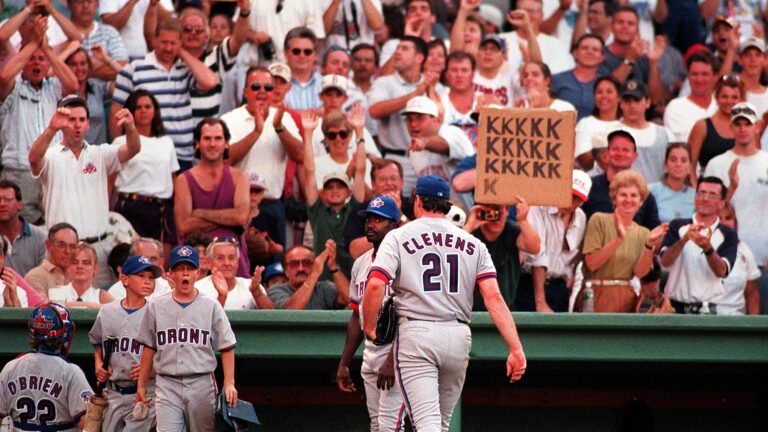
Over the next two seasons, Roger Clemens posted a 41-13 record, a 2.33 ERA, and compiled 563 strikeouts. He won the Cy Young award in both 1997 and 1998. He recorded 16 strikeouts in his first start at Fenway Park as an opposing pitcher on July 12, 1997, and appeared to stare down the owner’s box as he exited the game.
To make matters worse for Boston fans, the Blue Jays traded Clemens to the Yankees before the 1999 season. He pitched for the Yankees through 2003, won the World Series twice, his sixth Cy Young award in 2001, and helped knock the Red Sox out of the playoffs twice, in 1999 and 2003. He would return to the Yankees for part of the 2007 season.
In Game 3 of the 2003 ALCS, Manny Ramirez incited the second of two bench-clearing incidents when he responded angrily to a high pitch from Clemens. This confrontation is most well-known for Pedro Martinez throwing 73-year-old Don Zimmer to the ground.
Derek Jeter
Jeter burst onto the Yankees’ roster in 1996, winning the AL Rookie of the Year award on the way to the team’s first of four titles in five seasons. Jeter became the face of the Evil Empire until he retired after the 2014 season.
In addition to Jeter’s individual success helping the Yankees win so many championships, Jeter and Red Sox shortstop Nomar Garciaparra emerged at roughly the same time (Garciaparra played his first MLB game during Jeter’s Rookie of the Year-winning season and would win the award himself in 1997.) The two were often compared throughout Garciaparra’s tenure with the Red Sox, which ended in 2004.
While Jeter never took on an aggressively villainous role during one of the most intense periods in the Red Sox-Yankees rivalry, his consistent performance and work ethic made him a player Boston fans loved to hate.
When it was all said and done, though, Jeter made his final exit from baseball at Fenway Park on Sept. 28, 2014, to a standing ovation from Red Sox fans and players alike.
Ulf Samuelsson
Samuelsson, a Swedish defenseman, garnered a reputation as one of the NHL’s dirtiest players through the late ’80s and early ’90s. He found a nemesis in Bruins star Cam Neely, whose goal-scoring ability and physical presence made him one of the team’s top players from 1986-1991.
Neely and Samuelsson fought during a particularly vicious Bruins-Whalers game in December 1990. After the game, which the Bruins won 8-2, a bruised Samuelsson told reporters, “It’s a long year, and the next one is going to be interesting.”
Samuelsson was quiet during his next contest with the Bruins in January 1991, but a March trade sent the defenseman to the Pittsburgh Penguins for a playoff run. That playoff path sent the Penguins and Samuelsson through the Bruins in the 1991 Conference Finals.
As Neely carried the puck through the neutral zone during Game 3 of the series, Samuelsson advanced on the Bruins star, separated Neely from the puck, and delivered a knee-to-knee hit that sent Neely struggling back to the Boston bench. Neely would remain in the game for a short time before exiting due to an injury caused by the hit.
An additional Samuelsson-Neely collision in Game 6 of that series left Neely with leg injuries that forced him out of all but 22 games over the next two seasons. Neely continued to play – and succeeded when he did, scoring 50 goals in 49 games in 1993-1994 – but ultimately ended his career in 1996 at age 30. Samuelsson, on the other hand, won two Stanley Cups with the Penguins in 1991 and 1992.
Neely publicly criticized Samuelsson for his play and the hits he delivered in the years after Neely’s injury, but Samuelsson leaned into the villain role. He told the Boston Globe in February 1992 he tailored his play to take top players off their games.
“It’s really simple. I’ll do whatever it takes to keep opposing players from putting the puck in the net,” he said. “Sometimes it’s illegal. I’ll do whatever it takes.”
Tonya Harding
Tonya Harding earns a spot as a Boston sports villain due to the inescapable, life-long link between her and fellow American figure skater and 1994 Olympian Nancy Kerrigan, who hails from Stoneham, Massachusetts.
On Jan. 6, 1994, Kerrigan was attacked after a practice session in Detroit by Shane Stant just before the U.S. Figure Skating Championships, bruising Kerrigan’s legs. Stant was later revealed to have been hired by Harding’s ex-husband, Jeff Gillooly, and Shawn Eckhardt, a friend of both Harding and Gillooly.
Harding became a villain in the aftermath of the attack when suggestions rose that she may have been aware of or conspired in the planned attack, which was intended to keep Kerrigan from competing in the Figure Skating Championships and the Winter Olympics.
Both Harding and Kerrigan competed on Team USA in the Olympics that February in Lillehammer, Norway. Kerrigan won the silver medal in women’s singles, while Harding placed eighth amid dramatic moments in her free skate program.
Harding ultimately pleaded guilty to hindering the investigation into Kerrigan’s attack and was forced to resign from the U.S. Figure Skating Association. She also received three years of supervised probation, community service, and a fine.
Kerrigan said in a 2017 interview with ABC News she never received a direct apology from Harding. The saga was depicted in the 2017 film I, Tonya.
Paul O’Neill
O’Neill played right field for the Yankees from 1994 to 2001 and was an All-Star in four separate seasons with the team. He never had any personal feuds with the Red Sox, but his stellar hitting against the Yankees’ rival (.305/.382/.527 in 108 games against the Red Sox in his career) put him at the heart of the Yankees teams that dominated baseball in the late ’90s.
Brian Cashman
Brian Cashman has served as the Yankees’ general manager since 1998 and was the team’s assistant GM from 1995 to 1997. He has been at the forefront of the modern Yankees-Red Sox rivalry nearly every step of the way.
Cashman did not draft the “core four” of Derek Jeter, Mariano Rivera, Andy Pettite, and Jorge Posada that led the team to three World Series titles in a row at the end of the 1990s, but he did keep the team competitive throughout the 2000s, paving the way for two legendary Red Sox-Yankees ALCS duels in 2003 and 2004.

Brian Cashman has been the architect of the Yankees for over 20 years.
Cashman acquired Roger Clemens from the Blue Jays in 1999, further exacerbating Clemens’s status as a Boston sports villain. After what would have been a blockbuster trade between the Red Sox and Rangers for Alex Rodriguez fell through in winter 2004, Cashman traded Alfonso Soriano and prospect Joaquín Arias for A-Rod, thereby creating one of Boston’s most hated sports villains through the 2000s.
Bill Polian
Polian served as the general manager of the Buffalo Bills from 1986-1992, ultimately building a Bills team that would play in – but lose – three Super Bowls in a row in the early ’90s. The Bills’ dominance during those years, in turn, marked one of the lowest points in Patriots franchise history. In the three seasons the Bills returned and returned again to the Super Bowl, the Patriots went 9-39 and only won one game in 1991.

Bill Polian was elected to the Pro Football Hall of Fame in 2015.
After a two-year stint as the Panthers’ general manager in the franchise’s first years in the NFL, Polian joined the Indianapolis Colts as the team’s general manager and president in Dec. 1997. His first spring with the Colts gave him the first overall pick in the ’98 NFL Draft. He picked Peyton Manning over Ryan Leaf, who only played four seasons in the NFL, to be the team’s franchise quarterback. Manning would go on to be one of the NFL’s top players through his 17-year NFL career.
Polian was elected to the Pro Football Hall of Fame in 2015 and, most recently, co-founded the Alliance of American Football, which began play in 2019.
Desmond Howard
The Patriots reached the Super Bowl for only the second time in team history during the 1996 NFL season. A 24-year-old Drew Bledsoe matched up against Packers legend Brett Favre in his prime. The Packers won Super Bowl XXXI 35-21, but the Green Bay player who did the most damage was kick returner Desmond Howard.
Howard returned four Adam Vinatieri kicks for 154 total yards and saved his best for last, a 99-yard return for a touchdown late in the third quarter. That score expanded the Packers’ lead to 14. The Patriots would not score again in the game.
“That really took the wind out of our sails,” Drew Bledsoe said to the Boston Globe in 2015 of Howard’s touchdown return. “It’s bittersweet. I’m still really proud of the fact we made it. The truth is I’ve never watched that Super Bowl. It’s too painful.”
Howard won Super Bowl XXXI for his efforts on special teams.