
Czech Women Continue Wimbledon Onslaught
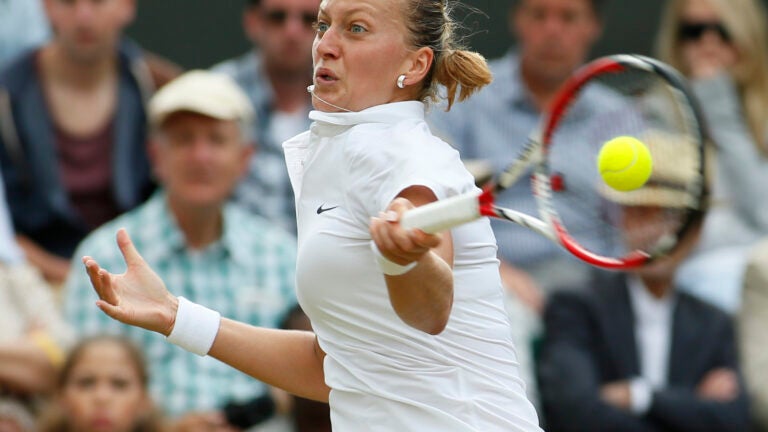
WIMBLEDON, England — The top 10 women in the tennis rankings hail from 10 countries, which is why the surge of Czech players into the second week of Wimbledon is an unexpected curiosity.
For the first time in the Open era, four women from the Czech Republic — and none from the United States, Great Britain, Spain and Italy, among many others — reached the Final 16, all of them in the same half of the draw.
On Monday, as the field began to narrow to the quarterfinals, three Czechs marched on. At least one will reach the semifinals, because two Czechs play each other in one quarterfinal.
Another player in the Final 16, Zarina Diyas, was born in Kazakhstan but moved to Prague when she was 5 and was raised there.
Given that there are no grass courts in the Czech Republic, and most players spend winters playing on indoor hard courts and summers on clay, this is a bit of a Wimbledon anomaly.
“Good, right?’’ Barbora Zahlavova Strycova asked late last week of the Czech Republic’s success, which was not matched by the men, none of whom reached the fourth round. “We are great. It seems like we feel good on grass. I’m very happy. We’re such a small country. We have really good players.’’
Czech women certainly have a strong history in tennis. The lineage is anchored by Martina Navratilova, who was born in Prague and later became a U.S. citizen, winning 18 Grand Slam singles titles along the way, including nine at Wimbledon. Other players, such as Hana Mandlikova and Jana Novotna, the 1998 Wimbledon winner, followed.
The current wave is deeper, but not extraordinarily so. Only No. 6 Petra Kvitova is ranked in the Top 23, and only five Czech women are in the Top 100.
Kvitova, the best of the Czechs and the 2011 Wimbledon winner, beat unseeded Shuai Peng on Monday, 6-3, 6-2, in a match delayed by midday rain for a couple of hours, like all others not played under the retractable roof of Centre Court.
Kvitova will meet Zahlavova Strycova in the quarterfinals. Zahlavova Strycova continued her surprising burst through the tournament, following her third-round victory against Li Na with a fourth-round one over Caroline Wozniacki, the former No. 1.
At the same time, No. 23 Lucie Safarova beat her countrywoman Tereza Smitkova in two sets to make the quarterfinals, too. The 6-0, 6-2 match took just 48 minutes.
She next plays No. 22 Ekaterina Makarova of Russia, who upset fourth-seeded Agnieszka Radwanska in two sets, just as she did in the fourth round of last year’s U.S. Open.
The Czech players have uncommonly close ties. Kvitova’s warm-up partner is Smitkova, and she trains at the same facility as Safarova and the sixth-ranked men’s player, Tomas Berdych, in Prostejov.
Success has proved contagious. Czech women won the Fed Cup in 2011 and 2012; Czech men won the 2013 Davis Cup, though none of them advanced past the third round here. Berdych, the No. 6 seed this year and the 2010 runner-up, was a surprise first-week victim.
“Four Czechs into the second week, and none of them are named Berdych — it’s amazing,’’ Navratilova said.
Navratilova said that the club system in the Czech Republic, like the one she came through 40 years ago, put the emphasis on playing matches, an ingrained skill that the women seem to have brought to Wimbledon.
“They play a lot of sets,’’ Navratilova said. “Players these days, they don’t do that enough, particularly women. But in these clubs, you hang out, you may hit for half an hour, and then you play a couple hours of sets: singles, doubles, whatever. So you become really competitive and learn the sport the way it should be taught, which is through competition rather than just repetition.’’
And while Czech players are not raised on grass courts — not many players are — their skills are honed on clay and then adapted to hardcourts. Jiri Fencl, coach for Lucie Hradecka, said the blend worked well.
“Since we usually spend four to five months indoors, our players get to learn to play on some very fast surfaces, where you get awarded when you go for your shots or forward attacking at the net,’’ he wrote in an email. “Not that long ago, we had kids’ tournaments played at school gyms where the surface is wooden, just like you have on basketball courts. And that is fast, believe me.’’
Zahlavova Strycova, 28, has been this tournament’s breakout star among the Czech contingent. A longtime Top 100 player, she has one career tournament victory, at Quebec City in 2011. She arrived at Wimbledon in familiar fashion — unseeded and ranked 43rd. The only sign that her game was on the upswing was a runner-up finish on grass at Birmingham, her best result of the season.
In February 2013, Zahlavova Strycova was handed a six-month suspension by the International Tennis Federation for violating anti-doping rules. Tests the previous fall found a positive result for the banned stimulant and weight-loss drug sibutramine, prohibited in the United States because of worries about side effects that can include heart attack and stroke.
Zahlavova Strycova denied any intent, but was required to return prize money and lost ranking points. The suspension was backdated to the time of the test, and Zahlavova Strycova considered retiring. In the end, she said she found time to round out her interests, allowing her to appreciate tennis.
“I’m not happy what happened, but I took off and I didn’t focus on tennis at all,’’ she said. “I didn’t follow any results. I also lived a normal life. It was good for me.’’
Given what is happening at Wimbledon, it was good for her whole country.
The soft spritz of rain that washed out about six hours of play on Saturday was long gone, but its effect was still evident on Monday’s schedule. Remnants of the third round had yet to be completed, a concern to those on both sides of the divide to the fourth round.
For those with third-round matches to complete, it meant the possibility of playing five matches in seven days should a championship run occur. For those already into the fourth round, they had to await the stragglers — Roger Federer and Rafael Nadal among them. It meant an extra day off on Monday, and the possibility of a compressed schedule beyond.
Kei Nishokori, seeded No. 10, finished off Simone Bolelli, and Stan Wawrinka beat Denis Istomin.
Two women’s matches, cut short on Saturday, came to quick conclusions. Sabine Lisicki, last year’s Wimbledon finalist and a grass-court powerhouse, reached the quarterfinals, as she has her previous four appearances, with a three-set victory over No. 9 Ana Ivanovic. Lisicki’s middling results the rest of the season kept her undervalued as a contender, and she arrived as a sneaky No. 19 seed.
Canada’s rising star Eugenie Bouchard, seeded 13th, ended the run of France’s Alize Cornet with a 7-6 (5), 7-5 victory, to claim another quarterfinal slot. Cornet, seeded 25th, had knocked out No. 1 Serena Williams in the third round.
Madison Keys, the last U.S. woman remaining in the tournament, withdrew after warm-ups before resuming her match with Yaroslava Shvedova.
Keys, 19, had suffered a thigh injury midway through the second set late Saturday, bringing her to tears, and Sunday’s day off was not enough to heal what was diagnosed as an adductor strain. Keys had lost a first-set tiebreaker, and was about to begin a second-set one, when darkness stopped play.
Keys said the injury is not serious, but Sunday was not enough time for it to heal.
“It’s definitely not how I want to be leaving Wimbledon, but it happens,’’ she said. “You know, you just have to take it in stride, just accept it, just try to get better.’’
U.S. women, including Venus and Serena Williams, were 0-5 in the third round.



To comment, please create a screen name in your profile
To comment, please verify your email address
Conversation
This discussion has ended. Please join elsewhere on Boston.com