5 things to know as the World Cup escalates
Crazy tiebreaker scenarios, the "Bling-bling gang," and Argentina's moment of silence.
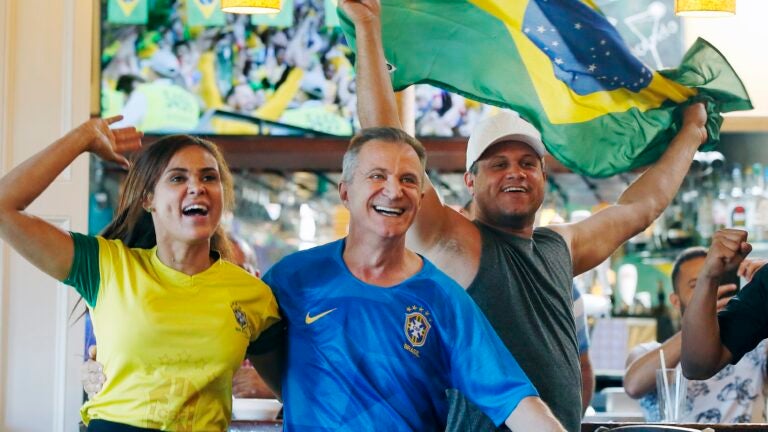
While it feels like only yesterday that the frenetic 2018 FIFA World Cup got underway in Russia, the tournament is somehow more than halfway complete. A festival of group play games has left a fascinating, if incomplete, picture of men’s world soccer.
Traditional soccer superpowers teeter on the edge of World Cup elimination while unheralded outsiders dream of knockout round glory. With one game to go in the first round, 25 of 32 teams remain technically alive. Six teams have qualified for the round of 16, including the hosts.
Looking at the final slate of group play games, qualification scenarios and strange tiebreakers abound. Mexico, despite scoring two impressive wins so far (including a 1-0 opener against Germany), face a scenario where El Tri would shockingly not make the next round.
History has already been made in a number of ways, even if not all of them are relevant to the eventual winner.
Panama, as an example, scored a World Cup goal for the first time in the nation’s history against England on Sunday (2018 being the first edition of the tournament that Los Canaleros have ever qualified for). Despite being down 6-0 and on the brink of elimination, the goal’s significance was clear:
A celebration years in the making!
Panama fans around the world got hyped after their first-ever FIFA World Cup goal. pic.twitter.com/eGlRYgwz5y
— FOX Soccer (@FOXSoccer) June 24, 2018
A tournament that has veered far off its expected script now steers onto final approach for the knockout round. Here are a few things to know as World Cup drama, already in abundance, ratchets up:
Counting cards and drawing lots
With so many teams still alive in hopes for knockout round qualification, it’s possible that strange tiebreaker scenarios could emerge. Since World Cup group play only consists of three games per team, very little separation is created in the standings.
FIFA tiebreaker rules extend to eight levels, including the straightforward method (points, goal-difference and goals scored), as well as more specific head-to-head methods for teams with identical margins.
At a certain point, it can get bizarre. The seventh round of tie-breaking is based solely on “fair play conduct.” In other words, the team that’s accumulated the fewest yellow and red cards wins.
This might decide the winner of Group G between England and Belgium, who have each scored eight goals and allowed two. A tie between the countries – who play each other in the final group game – would go to the fair play tiebreaker. And considering the potential advantage of finishing second in the group (do to possibly avoiding traditional favorites on one side of the bracket), it’s led some to speculate that one team might intentionally try to get a yellow or red card to manipulate the tiebreaker.
IF this finishes 6-1 and IF England and Belgium draw on Thursday, then 1st/2nd in Group G will be decided on fair play record and finally — if that’s level – drawing of lots. If 2nd place more desirable, might be worth picking up a sneaky yellow card now … #ENGPAN #ENG
— Oliver Kay (@OliverKay) June 24, 2018
Of course, in the event that there is no “fair play conduct” separation, the final stage of tie-breaking is “drawing of lots.” This might happen with Portugal and Spain in Group B.
Favorites not firing
Heading into the tournament, four teams (Brazil, France, Germany and Spain) were identified as the favorites. Of that group, only France has a 100 percent win-rate, though both victories have been less than electrifying.
While World Cups wins are ultimately the province of a narrow elite, the 2018 edition has yet to see a favorite emerge. Defending champions Germany lost to Mexico in the team’s opening game, and needed a stoppage-time beauty from Toni Kroos to keep control of their qualification destiny and avoid group stage elimination for the first time since 1938:
TONI KROOS CALLED GAME.
What a set piece! What a goal! pic.twitter.com/KA0QkOSWZN
— FOX Sports (@FOXSports) June 23, 2018
Brazil, who fizzled to a 1-1 draw against Switzerland, then found Costa Rica immovable for more than 90 minutes before finally, joyously achieving a breakthrough. Superstar forward Neymar scored a second goal to become third all-time leading scorer in the vaunted history of Brazilian men’s soccer, though his postgame tears attracted far more attention.
It could prove to be a tournament ripe for a dark horse. Belgium, Croatia, England and Mexico are all among those jockeying for position should none of the pre-tournament picks find their gear.
Iranian history
One of the biggest wins of the 2018 World Cup occurred outside of Russia. It happened in Tehran, Iran.
For 37 years, Iranian women were completely barred from watching their national team inside an actual stadium. The government-imposed policy was finally, if briefly, relaxed during the team’s second game against Spain.
A number of women were admitted to Tehran’s Azadi Stadium to watch a live broadcast of the game (which took place in Kazan). It marked another step in an ongoing movement.
Women/families finally entered to Azadi stadium after 37 years of ban, to watch #IRNESP on screen. pic.twitter.com/oSBXHMWI8h
— OpenStadiums (@openStadiums) June 20, 2018
Avoiding the goalless draw
For neutral fans hoping to see an exciting World Cup, the results have been promising so far. On top of the unpredictable results has been a consistent string of goals.
Through the first two rounds of group play, there were zero scoreless games, which was a record:
1954 – This World Cup has been the longest without a goalless draw from the start since 1954, when none of the 26 games finished 0-0. Answered. #WorldCup https://t.co/8HNVcmgG4l
— OptaJoe (@OptaJoe) June 24, 2018
Interestingly, this hasn’t necessarily been because of a goal rush. Scoring was historically low heading into the weekend.
Thankfully, a prolific two days (especially the 14 goals in three games on Sunday) helped to turn things around.
THE DANCING COLOMBIANS ARE BACK!
Cuadrado finishes the breakaway after another beautiful pass from James and celebrates in style. pic.twitter.com/NBiJXM6MGF
— FOX Soccer (@FOXSoccer) June 24, 2018
The ‘Bling-bling gang’ and Argentinian mutiny
It wouldn’t be a legitimate World Cup without an appropriate level of histrionics or acrimony emanating from nations struggling in the tournament. In 2018, lovers of drama need look no further than Argentina.
The two-time World Cup winners (producers of such past theatrical gems as Diego Maradona’s “Hand of God” goal) have experienced a stunning setback thus far in their Russian expedition. A disappointing draw against Iceland, the smallest nation to ever reach the World Cup, preceded a truly horrific 3-0 capitulation to Croatia.
Despite not being eliminated (and, in fact, facing a fairly reachable path to the second round), Argentinian media were so distraught with the team that they even held an actual moment of silence on live television:
In response, Argentinian players (whose ranks include Lionel Messi) have reportedly mutinied against coach Jorge Sampaoli ahead of the final (decisive) group game against Nigeria.
In Germany, the normally methodical Mannschaft have been the subject of backroom gossip. After winning the World Cup in 2014, the defending champions have looked disjointed. To this backdrop emerged a report from German media outlet Sport Bild of rival factions within the German team.
A group of players dubbed the “Bling-bling gang” reportedly oppose another group dubbed “the Bavarians.” Germany face South Korea on Wednesday with hopes of continuing their imperfect title defense on the line.
All of this has rendered the original behind-the-scenes tournament bombshell a near afterthought.
Spain, winners in 2010 and one of the considered favorites in 2018, fired national team coach Julen Lopetegui a mere two days before opening against Portugal. After news broke that Lopetegui planned to leave the national team to take over Real Madrid following the World Cup, the Spanish soccer federation moved to dismiss him with immediate effect.
It was a stunningly dramatic decision, taken because the federation felt “compelled to act” due purely to disrespect.
“The federation cannot be left out of a negotiation by one of its workers and be informed five minutes before the press release,” said Spanish soccer federation president Luis Rubiales, who named former Real Madrid captain Fernando Hierro as hasty replacement.
In a perfect summation of the bizarre situation, stalwart Spanish defender Pique made the unexpectedly relevant comparison to something American fans might remember: The 1989 NCAA champion Michigan men’s basketball team, who also switched coaches pre-tournament.
Universidad de Michigan. Baloncesto. 1989. Campeón de la NCAA. No sería la primera vez que ocurre. Todos unidos, ahora más que nunca.
— Gerard Piqué (@3gerardpique) June 13, 2018
Spain face Morocco on Monday at 2 p.m. with their own second round hopes in the balance.