How a Uruguayan soccer fan stays in touch with his roots living in Boston
"When you’re born, a lot of people already have their team, their club picked out for them."
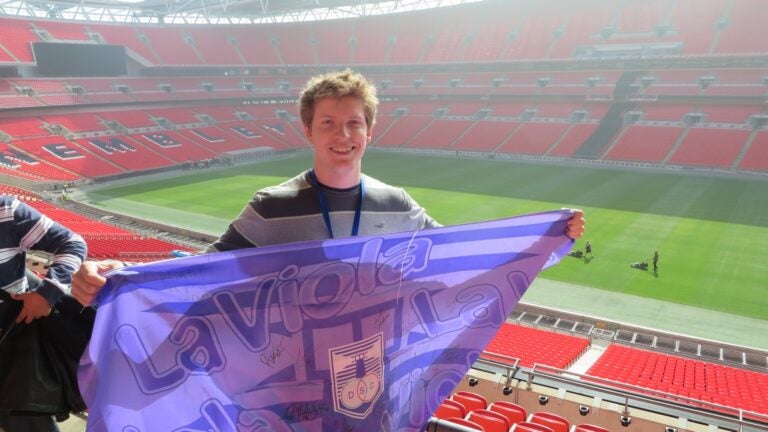
When Ignacio Cetrangolo talks about being a fan of his Uruguayan soccer club, it means something different than what many Americans think. After all, his name has been attached to the club since birth.
Cetrangolo, who has lived in Massachusetts since 2002 and works in Boston as a structural engineer, was born in the coastal Uruguayan city of Punta del Este. And his team is Defensor Sporting.
“It’s more than a sport there, it’s really a religion,” Cetrangolo said. “You don’t really get that here. It’s a different type of feeling when you watch sports there, or South America in general.”
With Uruguay once again in the World Cup as a potential dark horse contender, Cetrangolo says he’s “cautiously optimistic.” But to comprehend how a nation of just 3.5 million people is able to compete on the world stage, it’s important to understand the country’s soccer DNA.
For Cetrangolo, it’s been a way of life for him, even after moving to the U.S.
“I wouldn’t trade it for the world”
Fundamentally, fans’ relationship with their team is different in places like Uruguay. As Cetrangolo relayed, fans have a close bond with their club. In in many cases, including his own, it’s familial.
“The way that the sport works there is not like here where it’s a franchise system,” he says of the differences with the U.S. “It’s a club. There are elected officials, and you pay a membership fee every month. So because of that, you really get into the team. And Uruguay is small, so you know a lot of the players. You see them when they’re little with their parents.”
Many fans, including Cetrangolo, have been linked with their club since birth.
“When you’re born, a lot of people already have their team, their club picked out for them,” Cetrangolo explained. “You’re given a membership club card, like an I.D. card. Not everybody does it, but you take a photo of your baby, you go to the club, pay the fee. I wouldn’t trade it for the world.”
Defensor Sporting have produced a respectable history over the decades. While their four Uruguayan league titles might not compare with domestically dominant clubs Peñarol or Nacional, Cetrangolo is proud of their tradition. After all, it’s one that his family is tied into.
“My family traces back there,” he says. “My grandfather was on the board of directors. And my great-grandfather was a goalie.”
That isn’t his only family connection to Uruguayan soccer. His great-grandfather on his mother’s side was treasurer of the Uruguayan Football Association in 1950. It coincided with the national team’s second World Cup win.
“He was in charge of setting up the parade and the celebrations. No one believed that they would win it. He was the only one.”
From Uruguay to the United States
Uruguay’s position in South America is defined – for better or worse – by its larger neighbors. Across the Rio de la Plata estuary from Uruguay’s capital, Montevideo, sits Buenos Aires and Argentina.
And it was the Argentinian financial crisis in the early part of the century which led Cetrangolo and his family to the United States, as Uruguay’s economy was directly affected by the downturn.
“There was less tourism, commerce went down, unemployment went way up,” Cetrangolo explained. “So a lot of people, including us, left. My parents’ friends left to Spain or Canada. Some people stayed, but it was hard to find jobs.”
The move to Massachusetts was made because of a longstanding tie that his mother had.
“My mother, when she was in high school, she did a student exchange program with a woman in Milton. So when we came, we stayed at their house for a couple of months. My father came first, a few months before, to stay with them. He found a job after a few months, and was good to go. Then the rest of us came over. It was September, so I started school right away, fourth grade.”
Luckily, Cetrangolo arrived in the U.S. from a Uruguayan school that was bilingual, so he had practice speaking English. From there, he quickly acclimated. And he continued playing soccer locally through high school. More recently, Cetrangolo officially became a U.S. citizen.
“I have a passion for Boston teams as well,” he says. Yet his fandom for Uruguay and Defensor Sporting has remained strong even as he’s carved out a live thousands of miles away.
“It’s Suarez and then everybody else”
Luckily for a diehard fan of a team on another continent, Cetrangolo lives in the era where global communication has never been better.
“Technology really has made a difference,” he says. “Ten years ago, I couldn’t get internet radio. And now I can listen to Defensor Sporting games even though some of them aren’t even televised.”
The radio broadcast is done by fellow club members. Like so much else with the team, there’s a personal connection.
“Because of these people doing the radio, I can tune in. And I know them, too,” Cetrangolo says. “When I go to games, I’ll go to the booth and they interview me. And it’s just for fun for them. They’re not doing it for money, it’s just because they want to get the games out to people in the world.”
Going the extra mile has been a staple of Uruguayan soccer in its history. The national team won the first World Cup (as host) in 1930, repeating the feat against the odds in 1950 by defeating a heavily favored Brazilian team in the Maracanã Stadium.
“We always like being the underdog,” Cetrangolo reasons. Asked to explain how Uruguay continues to produce elite talents like world renowned striker Luis Suarez, Cetrangolo has an idea as to why.
“I think it’s just since it’s so ingrained in the culture,” he says. “It all just ties together the way society is in general. I think that people like the challenge, for anything. They don’t like to be favored, or having things easy. They like to do things the hard way.”
And with the World Cup back on the forefront of national discussion, Cetrangolo knows where his native country’s priorities are.
“It’s Suarez,” he says, “and then everybody else.”