
Taylor Twellman talks Revolution stadium, U.S. Soccer and concussion awareness
The former New England star isn't shy about speaking his mind as an ESPN analyst.
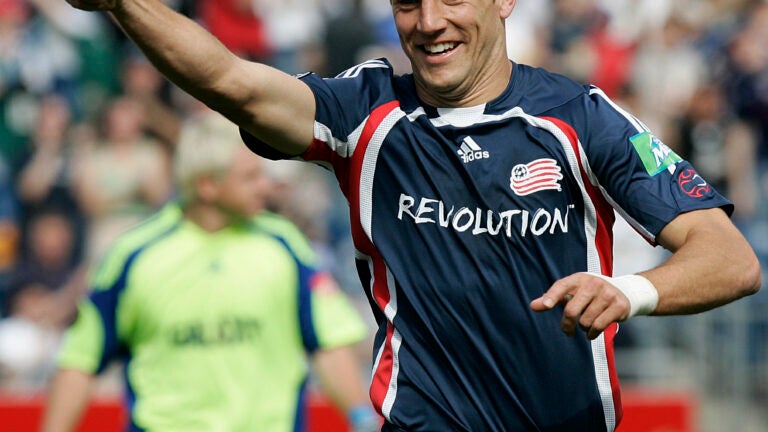
Taylor Twellman has made the transition that has confounded so many retired professional athletes: The former New England Revolution forward has successfully traded his jersey for a microphone.
The all-time leading scorer in Revolution history, Twellman is currently a member of ESPN’s team, a familiar voice in broadcasts of both the U.S. men’s national soccer team and Major League Soccer. With the 2016 MLS season underway and the Copa America Centenario and UEFA European Championship right around corner, it seemed like an appropriate time to check in with Twellman.
This interview has been lightly edited and condensed for length and clarity.
What are your thoughts on the U.S. roster for Copa America now that you’ve had some time to digest it?
Taylor Twellman: I think this is a tournament that [U.S. head coach] Jurgen Klinsmann has looked at as a must-win. It’s a tournament that if the World Cup started today, this is his 23-man roster. My initial thoughts are still the same: I am a little surprised that there may not have been a younger roster considering this not a must-win tournament regarding World Cup qualifying or Confederations Cup. I think Jurgen is looking at it as this is a great opportunity on home soil, so to speak, to get some good experience. There are five players over the age of 33, which is a little surprising.
Speaking of that, especially as a former forward, were you surprised at Jordan Morris’ omission and Chris Wondolowski’s inclusion?
TT: No, I think that’s less about those two players and more about big picture. The big picture is the fact that five players of 33 years of age [and over] are included in what Jurgen Klinsmann will explain, again, as if this were a World Cup tournament right now, this would be his 23-man roster. I just think it’s more about that there is an old guard still and the younger players haven’t taken over or helped that transition along. And I think that’s part of what the big story is. It’s less about Wondolowski vs. Morris and more about the bigger picture that the younger players haven’t taken over yet.
If the U.S. doesn’t get out of the first round, will U.S. Soccer view that as a failure? And could it cost Jurgen Klinsmann his job?
TT: No, I do not [think so]. I think the fact that Jurgen Klinsmann has survived a Gold Cup semifinal loss to Jamaica, a loss at Guatemala and a loss to Mexico in the CONCACAF playoff game just says that Sunil Gulati and U.S. Soccer are perfectly fine with the direction it’s going. So, again, I think Jurgen Klinsmann’s job is all based on quite simply the World Cup qualifying. He knows that, everyone else knows that. So I don’t think Copa America has any bearing on that.
Recently the news in regards to MLS was the Italian national team coach saying that because Sebastian Giovinco is an MLS player, he had to “pay the consequences,” and that’s why he wasn’t on [Italy’s] roster. Do you agree with that assessment of MLS?
TT: I went HAM on it on Twitter. In a nutshell, Giovinco and [Italy head coach Antonio] Conte have had history way before Major League Soccer. When Conte was in charge and Giovinco was at Juventus, Giovinco was never called in. The fact that he was called in for two European qualifiers while at Toronto and he performed in those qualifiers and then for it now to be an issue, quite frankly, I thought was weak. And if you’re to convince me right now at this present moment that Giovinco is not good enough to be in the preliminary 30-man roster for Italy, then you better tell me five to seven options better than him. This is arguably the worst team that Italy’s had going to a major tournament for years, so when it’s all said and done I think it was a convenient excuse for Italian media. And I think it showed itself, but as I tweeted, if he played in Scandinavia, you want to tell me that he would be going to the Euros? The answer is no, so don’t tell me Giovinco is not going to the Euros because of Major League Soccer. He’s not going to Euros because Conte doesn’t like him.
So if Giovinco was playing in Scandanavia he’d be picked for #EURO2016?! Conte wasn’t picking Gio period and should’ve said so. #Weak
— Taylor Twellman (@TaylorTwellman) May 24, 2016
The Revolution made a fairly dramatic trade for striker Kei Kamara. Do you think that he’s the answer for them, or do they have larger issues?
TT: Kei Kamara helps them, but Kamara isn’t the real issue for the team. And the real issue for the team I’ve felt throughout the year is defending. They’ve really struggled, particularly in open play, dealing with crosses and what not and it’s showed itself. However, Kei Kamara, once he starts scoring goals, he makes Lee Nguyen, Diego Fagundez, Teal Bunbury, Juan Agudelo and Kelyn Rowe all more effective. So it does address a major issue I’ve felt that they’ve had — not having a true number nine. But the game last week against FC Dallas still showed that they have major issues defending.
With the Revolution, the continuing subplot is always their stadium situation. How important do you think it would be for the Revs to get a stadium in the Boston area? How would it compare to some of these other cities with a soccer-specific stadium?
TT: Well, it’s the most important thing in order for the Revolution to grow. When you’re attracting free agents, when you’re talking to players coming from overseas, when you’re trying to move the needle the way that they need to, so to speak, they need a stadium. They need a stadium downtown. Listen, it’s very unique situation, because if you understand the economics of the situation, that stadium in Foxborough is 100 percent privately financed. So the Krafts need to know that the stadium downtown is a 100 percent home run. That is not owned by Foxborough, so [it’s] way different than all these other stadium situations in Major League Soccer. The Krafts are going to do it, but they’re going to do it when it’s the right business decision because, otherwise, they’ve already got a stadium that’s paid for. So as to the argument that the Krafts don’t want [the downtown stadium], well listen, it has to be smart for them to do it. And it has to be the perfect location, not in Framingham. It has to be downtown, it has to be right, 100 percent downtown. And they know that. Until they can get all their ducks in a row, they’re not going to do it. And business-wise, you’re still getting 20,000 at Gillette Stadium. But in order for it to grow, the stadium is vital. It’s 1A on the task sheet. They need a stadium. It needs to be grass and have a roof, because if they pull it off in downtown Boston, it’ll be a top-four, top-five market to play in in Major League Soccer.
Do you think that playing in Foxborough and on a turf field played a role in Jermaine Jones’ departure?
TT: The turf field plays a role in any player decision going to Foxborough. It plays a role in every decision going to Seattle, and it plays a role in every player decision going to Vancouver. Portland is the only team that it doesn’t really play a role in the decision because their turf is very unique. If you’re going to play on turf, it’s the only way to pull it off. So, the Revs and the coaches and everyone else will tell you something else. I’m neutral and I hear when every player talks about Gillette Stadium and the turf is a massive, massive part of that discussion.
I know that a subject that clearly means a lot to you is the ongoing treatment of concussions in sports. Do you see a marked improvement in the last couple years in soccer and American sports? And does that differ from the European game?
TT: The education and awareness is high in America, but I still see stupid, uneducated decisions being made in our backyard. So I would be extremely naive and ignorant if I said that we, as a country, are making better decisions than around the world. Are we educated? Are there avenues to be educated and awareness? Sure. But we’d be patting ourselves on the back too much and too often if we think that we are making better decisions. Now, saying that, I think soccer could lead the charge on drastically changing that because both girls and boys play our sport. So you could educate the masses and change them as opposed to just looking at hockey or looking at football. Cheerleading’s a huge issue for girls. Equestrian is another issue. Concussions happen in everything. So, yes, is the awareness there? Sure. Are better decisions being made? I hope so. But I still see questionable decisions being made.
In that respect, I know that your foundation, Think Taylor, had a lot of success last year. Do you have anything specifically planned for 2016?
TT: Well, we have a concussion awareness week that will be in September with the MIAA [Massachusetts Interscholastic Athletic Association]. We’re looking at every athlete that plays in MIAA in the fall, which is about 100,000 athletes. [They] will be participating in the Think Taylor concussion awareness week.


To comment, please create a screen name in your profile
To comment, please verify your email address
Conversation
This discussion has ended. Please join elsewhere on Boston.com