
Brandon Copeland spoke passionately about racial justice, police brutality, and the media’s agenda. Here’s what he had to say.
"There's a difference between trying to disable somebody and trying to murder somebody."
Related Links
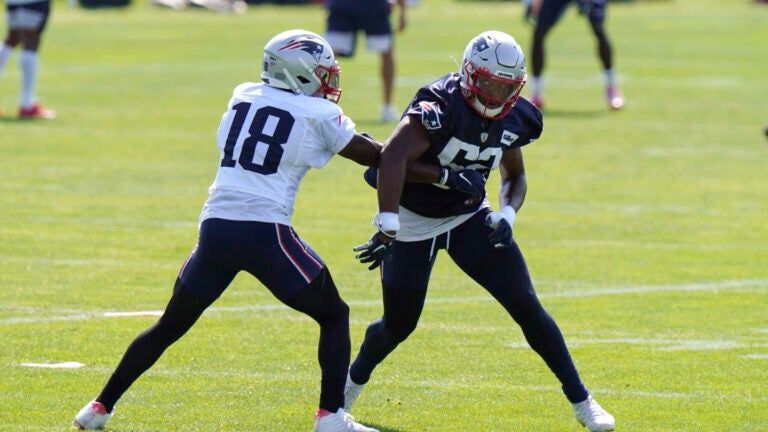
After training camp practice on Friday, Patriots linebacker Brandon Copeland spoke passionately about the events that have unfolded following the shooting of Jacob Blake.
“I think the world, the country are seeing things that have been happening to the black community [and] minorities in general for a long, long time,” Copeland said over video conference. “I clearly understand and know that not everyone is a bad cop or bad officer, however, it is time for a change and for people to be help accountable for their actions. I don’t think that’s too much to ask.”
Copeland, who signed with the team in March, said his grandfather, Roy Hilton — who had an 11-year career in the NFL, grew up in Mississippi during the Jim-Crow era.
On a mission to help communities of color, Copeland himself has stepped up. The University of Pennsylvania graduate taught online financial literacy classes in April, donated meals to those in his hometown of Baltimore and the Boston area, and runs a foundation, Beyond the Basics, that focuses on youth empowerment.
As a father to his 13-month old son, Bryson, Copeland said he will have to have important conversations with him about racism. The world, he said, views young Black children as a “threat” because of the color of their skin.
“The problem is, with the things that are going on in this world, that have been going on, there are certain things I can’t coach my son through,” he said. “I can try to prepare him for these situations and have “the talk” with him and multiple talks with him … unfortunately some people will look at him as a threat because of the color of his skin. Not having known, or even having met him and understanding his heart at all.
“How do you tell him, don’t wear a hoodie because someone might take you as a threat? Don’t go for a jog because some random vigilante might think that you’re a threat and take your life. The issue is accountability, we see these videos of black men and women, and all this brutality so to speak– not even just from police, but we see these videos of these things happening. The scary thing is, a lot of these people are walking free until those videos are released and the public is outraged. That is the scary thing, that is what alarming.
“Sorry, that’s a bit long winded but, personally, we’ve had these conversations as a country, but it’s time to move the needle forward. And again, I don’t think it’s too much to ask for people to be held accountable for their actions. There’s a difference between trying to disable somebody and trying to murder somebody.”
In light of the recent protests that erupted among multiple sports leagues, including the NBA, WNBA, and the postponing of games across MLB, MLS, and the NHL, Copeland said that “everyone has a role to play”, including NFL players.
“Everyone has their own quote-on-quote role to play within this thing: there’s a franchise role, a team’s responsibility, things we want to do as a team and other teams have their choices and their own decisions to make, things that the Union should be doing or encouraging and supporting people to do.
“But, there’s also the individuals: there’s so many guys in this locker room who have been doing great work in the community. A lot of you know, the McCourty twins, what they’ve been doing. My original reason for starting a financial literacy teaching and education literacy [program] was to help teach people who look like myself and get them access to information that they otherwise would not get because their school systems aren’t giving it. I’m all for us uniting and finding ways that we can push the movement and messages forward, and get people access to to information, voter registration, all of those things.”
He also “challenged” the media to “hold each other accountable” with how they paint different narratives about people of color. After George Floyd’s death, Copeland tried to educate himself on media agendas by watching different news channels. He noticed how “the same inputs produced two totally different outputs”.
“For example, when you look at the NFL Draft and you see these young men being drafted, which should be one of the best days of their lives, and all you see are bullet points next to their name talking about, ‘Their dad was a crack-head, their brother was shot and killed or is in jail.’ As opposed to highlighting the human being that they are, now you have a bunch of million viewers looking at that and thinking that every black man is some broken-story, so to speak, that we all should be not-necessarily fearful of, but looking at him through that lens.”
News, he then argued, has an impact on the perspectives of the younger generation.
“If there’s one thing I could ask of you all, which I know none of you asked for my opinion, it’s hold each other accountable and make sure people understand the difference between an opinion piece and a factual piece because that’s what’s going to have somebody just naturally [or] subliminally taking in messages as they grow up, to just think that Black men are more dangerous than their white counterparts.
[For example] a thirteen-year old boy, after a Black man is shot, they look into all the mistakes they’ve made in their past, as opposed to thinking, ‘Does this man deserve to be shot in the back seven times in front of his children?’
Get Boston.com's browser alerts:
Enable breaking news notifications straight to your internet browser.


To comment, please create a screen name in your profile
To comment, please verify your email address
Conversation
This discussion has ended. Please join elsewhere on Boston.com