
Get the latest Boston sports news
Receive updates on your favorite Boston teams, straight from our newsroom to your inbox.
After a turbulent lead-up, the Winter Olympics in Beijing are set to open Friday, with COVID-19 concerns and political strife the backdrop for the second Games in a six-month period.
Preliminary matches in curling and ice hockey will get the competition started Wednesday before Friday’s Opening Ceremony formally kicks off a jam-packed fortnight (with events taking place in three different zones in China) before things conclude Sunday, Feb. 20. Rising COVID cases and subsequent lockdowns across the country mean these Games — perhaps the most controversial in history — will be staged behind closed doors.
With a record 109 medal events across seven sports and 15 disciplines, athletes and federations navigating more than just competition, household names trying to cement their legacies and rising stars writing their own, here’s everything you need to know about an Olympics like no other.
First day of competition: Feb. 2
Opening Ceremony: Feb. 4, 6:30 a.m. EST
Closing Ceremony: Feb. 20, 6:30 a.m. EST
Time difference: Beijing is 13 hours ahead of the Eastern time zone; 8 a.m. in Boston is 9 p.m. in Beijing, and 8 p.m. in Boston is 9 a.m. in Beijing the next day.
Dates and times in EST.
⋅ Women’s snowboard slopestyle final: Saturday, Feb. 5, 8:30 p.m.
⋅ Men’s snowboard slopestyle final: Sunday, Feb. 6, 11 p.m.
⋅ Women’s skiing giant slalom final: Monday, Feb. 7, 12:45 a.m.
⋅ Women’s skiing slalom final: Wednesday, Feb. 9, 12:45 a.m.
⋅ Women’s snowboard halfpipe final: Wednesday, Feb. 9, 8:30 p.m.
⋅ Men’s figure skating final: Wednesday, Feb. 9, 8:30 p.m.
⋅ Men’s snowboard halfpipe final: Thursday, Feb. 10, 8:30 p.m.
⋅ Women’s skiing super-G final: Thursday, Feb. 10, 10 p.m.
⋅ Women’s skiing downhill final: Monday, Feb. 14, 10 p.m.
⋅ Women’s hockey gold medal game: Wednesday, Feb. 16, 11:10 p.m.
⋅ Women’s figure skating final: Thursday, Feb. 17, 5 a.m.
⋅ Men’s hockey gold medal game: Saturday, Feb. 19, 11:10 p.m.
For the second time in 15 years, Beijing is hosting the Olympics — but this time for the winter edition. It is the first city to host both the Summer and Winter Games.
Beijing was chosen as the host city in 2015 amid plenty of tumult, with other candidates withdrawing from the bidding because of inflated costs (the recent memory of Sochi 2014, the most expensive Games in history with its $51 billion cost more than triple the original budget, was looming large), lack of support, and exorbitant demands from the International Olympic Committee.
With the withdrawal of initial front-runner Oslo, Beijing was selected in a narrow vote over Almaty, Kazakhstan.
A number of venues from the 2008 Games, including many in Beijing’s Olympic Green, are refitted and repurposed for winter sports.
· The Opening and Closing ceremonies will be held in Beijing’s spectacular National Stadium, popularly known as the Bird’s Nest.
· Next door, the National Aquatics Center — often called the Water Cube during the 2008 Olympics — will host curling. It’s being rebranded as the Ice Cube.
· Also in the same complex is the National Indoor Stadium, which will host hockey. Some hockey will take place at the slightly smaller Wukesong Sports Center as well.
· One new building — the National Speed Skating Oval — was built in the complex.
Other venues hosting sports in Beijing include:
· The new Big Air Shougang, which will host, of course, big air skiing and snowboarding.
· The Capital Indoor Stadium, where the figure skating and short-track speedskating will take place.
For other sports, athletes will need to travel outside the capital city.
Alpine skiing and sliding events (bobsleigh, skeleton, and luge) will take place in the mountainous suburb of Yanqing, about 50 miles northwest of the capital, with artificial snow to compensate for the region’s limited snowfall. The remaining competition, from freestyle skiing to biathlon to snowboarding, will be held around Zhangjiakou, a city 140 miles from Beijing.
NBC is carrying the Olympics once again, broadcasting more than 2,800 hours of programming over 17 days. With the broadcaster discontinuing its NBC Sports Network at the turn of the year, coverage of events will air on NBC, USA Network, and CNBC.
NBC will be live in prime time every evening beginning at 8 p.m. Monday through Saturday and at 7 p.m. on Sunday.
But like you, NBC’s broadcasters will be watching from afar. Because of China’s aggressive and strict COVID-19 policy, NBC said, it couldn’t risk the safety of its employees. Instead, events will be called live from NBC’s headquarters in Connecticut.
“We have to do everything to keep people safe and sound,” said Pete Bevacqua, NBC Sports Group chairman. “But with advancements in technology, that connectivity between what we’re doing in Beijing and what we do here in Stamford in our home base, I know we won’t skip a beat.”
In a departure from previous Olympics, in which every moment could be found on NBCSports.com with an authenticated TV login, coverage of every single event will be available on Peacock, NBC’s streaming service. But only for premium subscribers.
Peacock Premium costs $4.99 per month (no cable subscription required) and is free for select Xfinity customers.
Along with live event coverage, the NBC prime time show, and studio programming, Peacock Premium also will host full replays of all events immediately after they conclude, plus medal ceremonies and other daily programming.
For last summer’s Tokyo Games, NBC pushed just full coverage of a select group of sports — particularly popular offerings like basketball, gymnastics, and track and field — to streaming.
While there are no sports debuting in Beijing, there are seven new medal events to bring the record total to 109:
· Women’s monobob
· Men’s and women’s big air in freestyle skiing
· Mixed team competitions in freestyle skiing aerials, ski jumping, and snowboard cross
· Mixed relay in short-track speedskating
From established stars with plenty of medals to their name, to the up-and-comers ready to break out on the world stage, there are plenty of athletes worth keeping an eye on. Here are some:
⋅Snowboarding will be one of the marquee sports, headlined by defending halfpipe champions Shaun White and Chloe Kim. The most decorated snowboarder in Olympic history, White is back for his fifth and likely final go-around, without his signature orange locks this time, in the hopes of making it four golds out of five on the halfpipe.
Just 21, Kim is already a halfpipe superstar after taking gold in PyeongChang as a 17-year-old. She holds just about every major halfpipe title — Olympic, World, X Games — and is poised to put on a show in Zhangjiakou.
But Kim enters Beijing in flux, burnt out from her rise from halfpipe prodigy to Olympic champion. She spent nearly two years away from the sport after throwing her 2018 gold medal in the trash. Will she return to her place as the world’s best?
Along with Kim, American snowboarding’s youth movement is led by Red Gerard, who also took gold at 17 four years ago. His crowning moment came in the slopestyle, and he’ll defend his title in China.
No woman has been more successful in snowboard cross on the world stage than Lindsey Jacobellis, who joins White for a fifth Games. The five-time world champion can’t seem to shake her Olympic curse, however. She hasn’t medaled since she settled for silver in 2006, having thrown away the gold with a premature celebration.
Sixteen years after that embarrassing moment, Jacobellis hopes to finally right the wrongs of Turin.
⋅Alpine skiing looks like a showdown between American Mikaela Shiffrin, the sport’s biggest star and three-time World Cup overall champion, and rival Petra Vlhova, from Slovakia, who bested Shiffrin to win the World Cup title in 2021. Shiffrin will defend her gold medal in the giant slalom from 2018 while chasing redemption in the slalom after failing four years ago to defend her title from 2014.
The American men failed to medal n Alpine skiing in 2018. Their best hope may be Bryce Bennett, who notched a surprise downhill World Cup win Jan. 14 to snap a five-year drought in the event for the United States.
⋅ It’ll be another showdown to watch in men’s figure skating, with American Nathan Chen squaring off with his biggest rival, Yuzuru Hanyu. The Japanese superstar is chasing a third consecutive Olympic gold, while Chen, just 22, was unbeaten for more than three years from his disappointing showing in PyeongChang until the 2021 Skate America in October, winning three world titles in the process.
The American women’s medal hopes sit firmly on the shoulders of 16-year-old Alysa Liu, who is already a two-time national champion. Look for Madison Chock and Evan Bates in ice dancing as podium threats.
⋅ It’d be a shock to see anything but another US-Canada matchup in the women’s hockey gold-medal game, and it should be one of the marquee events at the Olympics. Hilary Knight, Kendall Coyne-Schofield, and the Americans are defending champions for the first time in two decades; Marie-Philip Poulin and Rebecca Johnston are back for their fourth Games, hoping to help Canada return the gold medals back north.
The NHL backed out of these Games with rising COVID concerns — both in China and across the league — so the men’s game’s brightest stars won’t shine in Beijing. The US will be led mostly by collegiate players, including Hingham native and Michigan star Matty Beniers.
⋅ Short-track speedskating offers little medal hopes for the Americans, but the long track offers plenty. In the last two Games, the US was unsuccessful, but Joey Mantia enters as the two-time defending World Cup champion over 1,500 meters, and Erin Jackson (500 meters) and Brittany Bowe (1,000 and 1,500) are among the medal favorites. The US should be in for plenty of hardware.
Jackson’s inclusion is a particular boost. She is arguably the world’s best over 500 meters, but missed out on qualification after slipping at the US trials. Bowe gave up her spot in that event so Jackson could take part.
⋅ The most interesting story in the sliding events is that of Kaillie Humphries, a two-time Olympic bobsledding champion for Canada who is now representing the US after claiming that Bobsleigh Canada Skeleton coach Todd Hays harassed her. She and Elana Meyers Taylor are the favorites in the monobob.
New England is well-represented on the Team USA roster. Here are some to keep an eye on:
⋅ Medway’s Zack DiGregorio will compete in luge doubles after qualifying with teammate Sean Hollander.
⋅ Julie Letai of Medfield will race in the 3,000-meter short-track speedskating relay after battling back from knee surgery in 2020.
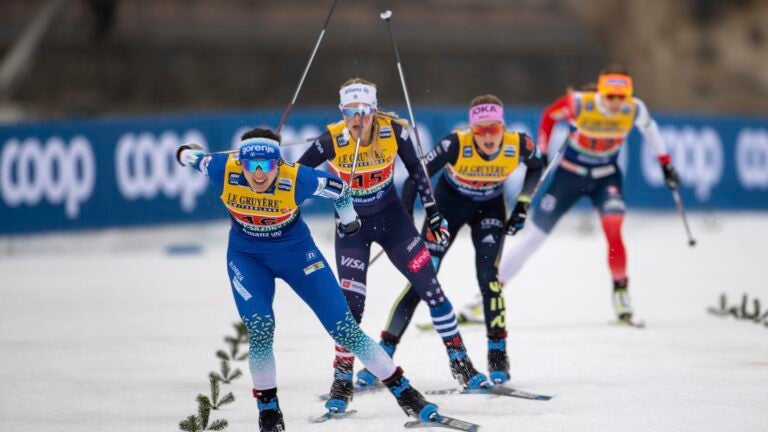
⋅ Cross-country skiing will feature Waltham’s Julia Kern, a two-time world championship medalist and the youngest American to make a World Cup podium. Jessie Diggins, defending gold medalist in the women’s team sprint — though without partner Kikkan Randall, since retired — lives in Boston and trains in Vermont.
⋅ The US men’s hockey team will be coached by David Quinn, a Cranston, R.I., native who played for Boston University and coached the Terriers for five seasons before taking the head job with the New York Rangers.
⋅ The American women’s hockey team will be coached by New England natives: Woburn and Boston College’s Courtney Kennedy and New Bedford’s Brian Pothier are assistant coaches.
These are perhaps the most controversial Games in history. For a full rundown on why, read John Powers’s story on everything that surrounds this chaotic global event.
But here are two key reasons:
· Once again, COVID looms: As in Tokyo, it’s hard to get away from COVID’s impact on the Olympics. The biggest effect is the closing of another Games to spectators. Initially, Chinese residents were to be permitted to attend, but organizers announced Jan. 17 that only select invitees would be allowed in, with no ticket sales to the general public. It doesn’t help that Omicron is surging and multiple Chinese cities are locked down as a result.
The NHL pulled out its athletes Dec. 23.
The IOC slightly eased COVID protocols in the lead-up, easing the threshold for positive PCR tests and reducing the period for which someone can be deemed a “close contact” to seven days from 14.
Athletes and staff must be vaccinated to avoid a 21-day quarantine upon entering the country; those who test positive without symptoms can leave isolation after two days of negative tests.
· Political boycotts and China’s human rights record will stay in the headlines: Several countries — most notably the US, United Kingdom, and Australia — have announced diplomatic boycotts of the Olympics. The issue at the center is China’s human rights record, and in particular the treatment of Uyghurs in the northwest Xinjiang province.
The suppression of protests in Hong Kong and the dispute over the sovereignty of Taiwan remain points of contention, while other nations’ boycotts are over economic sanctions and trade disputes.
A diplomatic boycott means that the US will not send any dignitaries representing the country to the Olympics, as is typically custom.
Receive updates on your favorite Boston teams, straight from our newsroom to your inbox.




To comment, please create a screen name in your profile
To comment, please verify your email address
Conversation
This discussion has ended. Please join elsewhere on Boston.com