What the US halfpipe ski team learned from the last Olympics
PYEONGCHANG, South Korea — At the 2014 Sochi Olympics, the US halfpipe ski team had a long layoff between the beginning of the Games and the start of its training and competition. It built up a lot of stress, waiting for things to get kicked off.
So this time around, the team went to the Aomori Spring Ski Resort in the northern part of Japan for a training camp, rather than killing time before they could begin practicing at Phoenix Snow Park. The resort had a halfpipe available to the skiers, but it snowed so much that they wound up spending the majority of the time skiing fresh powder.
“The goal was to avoid kind of what we did last time,’’ said Ben Verge, US halfpipe ski coach.
“Our goal was to go to Japan, get away from the media, get away from everything . . . I think we completely accomplished that goal, and got everybody to reset their minds and reset their bodies and come here hungry and ready to ski.’’
The skiers documented their adventures on Instagram, showing off the wintry wonderland throughout their trip, including the continuous dumping of snow and their treks through the backwoods.
“It was just snowing so much,’’ said Annalisa Drew, the Andover native competing in her second Olympics. “We expected it to snow, we all brought powder skis, but it’s just nice to just go out and not have to compete and [have] less stress.’’
Qualifications for women’s halfpipe are Sunday night on the east coast and the finals are Monday night; qualifications for the men are late Monday night on the east coast and the finals are late Wednesday night.
Longer halfpipe changes the Games
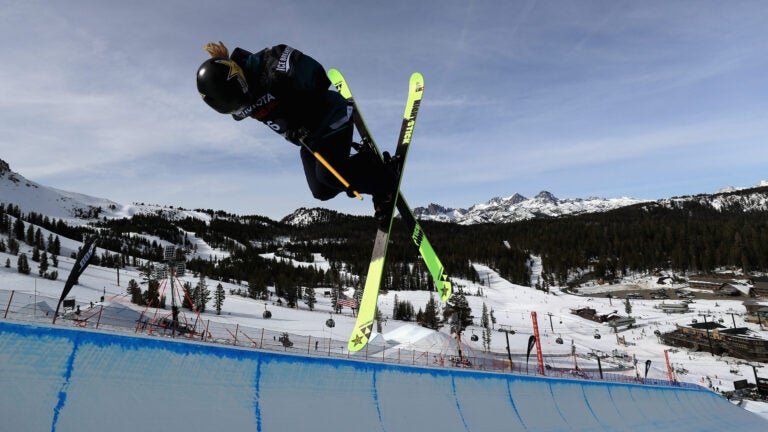
The halfpipe here at Phoenix Snow Park is 650 feet long, about 100 feet longer than the ski team has competed on leading up to these Games. That can be a plus for some and a puzzle to solve for others. David Wise, who won gold in Sochi, said it will definitely affect competition. He said the men can average about five hits per run.
“Having it be 100 feet longer, depending on the day, depending on the conditions, mean that a lot of us could maybe get six hits,’’ he said.
“I’m excited, I wish halfpipes were 800 feet long. The more hits, the better.’’
But there is a balance: More hits can mean less amplitude.
“Also, part of our sport is amplitude. We want to be able to go as high as we possibly can, so we can’t get a ton of hits without going a little bit smaller,’’ Wise said.
Devin Logan, the slopestyle silver medalist in Sochi from West Dover, Vt., said she usually gets in about six or seven hits. She said that adding a trick to an already set run can be difficult but that the extra length can provide the more speed with the tricks she already has.
“I think the first day of practice, you’ll figure it out pretty fast,’’ she said. “You kind of have to at this point. We’ll adjust and it’ll be great.’’
#momprobs
Brita Sigourney’s mom has kind of been trying to get her daughter to quit skiing halfpipe basically since she started. It is inherently dangerous, making it hard for some parents to watch, no matter how supportive they may be.
“I’ve had my fair share of injuries, so that has definitely been reinforced in her mind throughout it all,’’ said Sigourney, a two-time Olympian.
Sometimes, family members can’t even watch because they are too nervous, like Logan’s mom and Sigourney’s sister at the Sochi Games.
“My mom was in Sochi and she turned around and didn’t even watch my run and watch the scores come up,’’ Logan said.
But they are making progress.
“I think if anything she’s maybe come around more to it at this point. They’re just so proud of me,’’ Sigourney said of her parents. “It’ll be great to have their support and I just hope that my family will be able to keep their eyes open while I’m skiing.’’
On the other hand, Aaron Blunck’s mom has a harder time watching other competitors go, rather than her son.
“She has confidence in me, knowing I’m going to go out and be OK,’’ said the two-time Olympian. “She knows if I crash, I’m going to get back up and do whatever it takes to get back up there. She gets more nervous honestly watching all the other competitors than she does about me.’’
Love at the Olympics
For Valentine’s Day, Blunck is going to treat his teammates to a meal — at the McDonald’s near the Athletes’ Village.
Logan and her boyfriend, a former Olympic speed skater who now works for NBC, were able to spend some time together a couple of days ago before their schedules picked up.
“He sent me a bitmoji today of flowers,’’ Logan said. “No McDonald’s though, so he’s got to step his game up.’’
Wise premiered a video project he and his wife have been working on for two years to commemorate their vow renewal.
“We’ve been married for seven years now and kind of coming up on our fifth anniversary, we started shooting this video, so I’m relaunching that,’’ said Wise, whose wife and two children will be here to watch him compete.
“To have them here supporting me is just going to be amazing, I’m really excited to see my kids at the bottom of the halfpipe when I finish a run,’’ he said.