Women’s giant slalom postponed by high winds
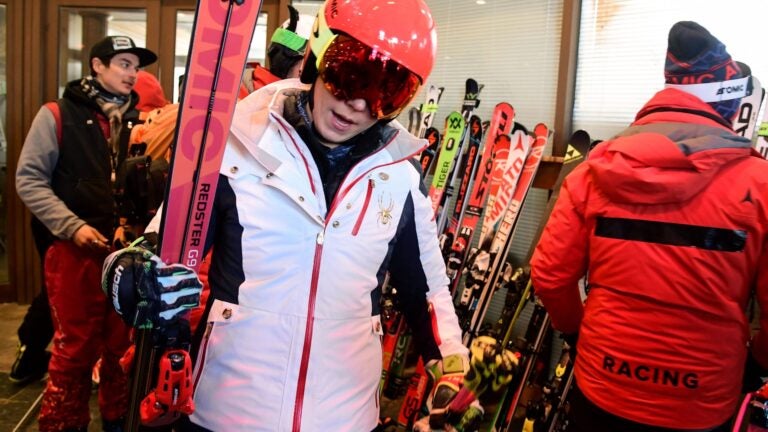
PYEONGCHANG, South Korea — Mikaela Shiffrin’s pursuit of more Olympic gold will have to wait. For the second straight day on Monday, Alpine ski racing at the Winter Olympics was postponed because of high winds, this time the women’s giant slalom.
Officials called off the event a little more than two hours before it was scheduled to begin at Yongpyong Alpine Center, where the technical ski racing events are being held. It was rescheduled for Thursday. On Sunday, the men’s downhill was postponed, also to Thursday.
Shiffrin, one of four Americans entered, was scheduled to start seventh out of 81 competitors.
“It’s a bummer that we’re not able to race today. But with the training block I’ve had, I’m prepared and feeling good. I’ll use this time to continue to train and refocus on Wednesday’s slalom race. We have a great gym and space to eat and take plenty of naps, so I’ll use this time to recharge,’’ Shiffrin said.
Shiffrin was not at her best in events in Italy and Switzerland leading up to the Olympics. She attributed her performances to fatigue after a stretch in which she won nine of the 10 events she entered.
“She is not concerned, we are not concerned. You definitely have ups and downs in all seasons. She is highly skilled, she has the ability to attack this,’’ said Paul Kristofic, the head coach of the US Ski Team’s women’s team.
“It’s a good challenge, a good test for all and she is one of the best.’’
Shiffrin, who has one Olympic gold to her name from the slalom in Sochi in 2014, has the opportunity to medal in more than one event at these Games. She said Saturday she was not sure how many of the five events she would compete in, but wanted to enter them all.
However, with the Olympics schedule now being compressed into a shorter timeframe, her ability to participate in all five will be an even larger question mark.
The start of the women’s snowboarding slopestyle event was delayed on Monday, also because of the wind. Qualification was cancelled Sunday and all competitors advanced to the final.
Handling the cold
For Tim Burke and Lowell Bailey, these Winter Olympics are their fourth. And the coldest of the four, by far.
“Torino was warm. Really warm,’’ said Bailey, a US biathlete. “Vancouver was really warm and Sochi was really warm. So, yeah, the bar’s pretty low for that.’’
Temperatures here have been in the single digits and teens in the mornings and after sunset, and rise to the low 20s during the day. The cutoff for international competition is minus-4 degrees Fahrenheit (minus-20 Celsius), which Bailey said he and have teammates have experienced in World Cup competitions.
“That’s cold,’’ he said. “I think we’ve all been in the position where race day morning is minus-24 [Celsius], minus-25 [Celsius], and the high is minus-20 [Celsius] and race time comes along and the race goes because the temperature is just eked up enough to break that barrier and it’s tough.’’
Although the conditions are not entirely unfamiliar, it still demands extra thought in attire, especially in a sport that relies on shooters’ ability to feel their fingers and hands to efficiently load the rifle and pull the trigger.
“It’s very important to have feeling in your hands,’’ Burke said. “That’s something that can be extremely challenging in these conditions because we just can’t get away with wearing very thick gloves because you need to be able to feel the trigger, to be able to feel your clips as you load the rifle, so if you start to lose feeling in your hands, it makes it very challenging.’’
Burke, who said some of his coldest competitions have come in Finland and Siberia, has experienced being unable to feel the clip in his grip while he is loading the rifle.
“I’m just watching my hands to see them actually holding the clip,’’ he said. “In those situations, you just have to try and rely on muscle memory and realize that everyone’s probably also dealing with the same thing.’’
Susan Dunklee, a teammate of Bailey and Burke, said she will place hand warmers on her wrists to help heat up the blood circulating into her hands and fingers.
“It helps your hands stay a little bit warmer,’’ she said, before adding, “not much you can do.’’
All three said layering is extremely important, especially utilizing layers that have special wind protection in them. Dunklee will wear glove liners or an extra pair of long underwear.
“The colder it gets, the more layers you’re wearing,’’ Burke said.
In addition to the cold, the wind has been strong. For precision shooters, that forces sight adjustments, sometimes mid-race. Burke said the wind on the course here has been switching directions, which is something they usually do not have to accommodate; he said they are more accustomed to wind from one direction.
“The wind will have a big impact on the races, but so far from the conditions I’ve seen it’s doable, you can hit the targets,’’ Burke said. “But it will make it interesting.’’
Coyne nets US winner
Former Northeastern star Kendall Coyne scored the go-ahead goal at 11:29 of the second period on a one-timer, and the United States women’s hockey team rallied to beat Finland, 3-1, in Gangneung to remain perfect when opening an Olympic tournament . . . Canada kicked off its bid for a fifth straight Olympic gold medal in women’s hockey by routing the Russians, 5-0, breaking open the game with three goals in the second.
Former BU star Marie-Philip Poulin, Canada’s captain, had three assists.
North leader exits
North Korean leader Kim Jong Un’s sister headed home Sunday night after a whirlwind three days in South Korea, where she sat among world dignitaries at the Olympics and tossed a diplomatic offer to the South aimed at ending seven decades of hostility. Kim Yo Jong and the rest of the North Korean delegation departed for Pyongyang on her brother’s private jet, a day after they delivered his hopes for a summit with South Korean President Moon Jae-in during a lunch at Seoul’s presidential palace. Kim Yo Jong, 30, is the first member of the North’s ruling family to visit the South since the end of the 1950-53 Korean War . . . NBC apologized to South Koreans for an on-air remark by an analyst that cited Japan as an example that has been important to the country’s own transformation. The remark was made by analyst Joshua Cooper Ramo during NBC’s coverage of Friday’s Opening Ceremony. He was noting the significance of the visit by Prime Minister Shinzo Abe of Japan. ‘‘Every Korean will tell you that Japan is a cultural and technical and economic example that has been so important to their own transformation,’’ Ramo said. Japan occupied Korea from 1910-45. Petitioners said anyone familiar with Japanese treatment of Koreans during that time would be deeply hurt by Ramo’s remark.