
Gold medalist Tessa Gobbo reflects on Rio and post-Olympic life in Cambridge
"It was just such an honor to race for the USA and with my teammates."
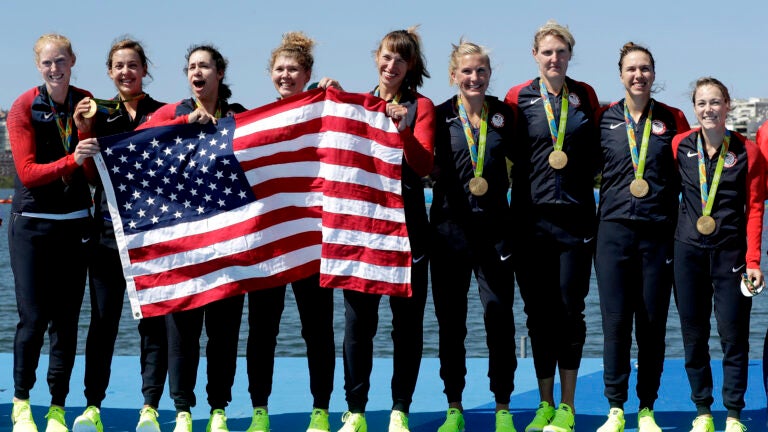
Midway through the gold medal race for women’s eight, the U.S. rowing team showed no signs of being a heavy pre-race favorite. Neck and neck with the Dutch team, the two-time defending gold medalists trailed Canada. But like a well-oiled machine finding its gear, the Americans made a decisive (winning) move in the second half of the race, pulling away to win Rio gold.
The race was won with the patience and poise of a veteran boat, belying the fact that the team carried five newcomers. Among the list of Olympic rookies was Tessa Gobbo, a 25-year-old New Hampshire native. Her impressive rowing career began while attending Northfield Mount Hermon in Massachusetts before vaulting onto the radar of the U.S. team while attending Brown in Rhode Island. Given her connections to three regional states, she is a truly New England gold medalist.
After graduating college in 2013, Gobbo immediately jumped into training for Rio. And despite the intense battle in the gold medal race, she helped the team win its third consecutive gold medal in women’s coxed eight. With victory achieved, Gobbo is now preparing for a new challenge: life after the Olympics. And she’ll be starting the journey as a Cambridge resident.
Like thousands of other residents in the Boston area, Gobbo moved during the week of September 1st, leaving the home of her host family in Princeton, New Jersey that had become so familiar over the past three years. In Cambridge, she moved in with her boyfriend.
“He’s coaching at MIT now,” Gobbo said in a recent interview. “We planned to make that move in once I was done. So I packed up all my things from New Jersey and now it’s all in the new apartment.”
Before she delves too deeply into her post-Olympic plans, Gobbo is content to not only rest, but be closer to her roots.
“My family’s from New Hampshire, and I’m so excited to get to spend more time close to them,” she said.
And she also plans on stopping by a few local schools as a speaker.
“I’m really excited to get to talk to some kids, and I’ll visit all of the alma maters eventually,” Gobbo explained. “It’s been nuts and I haven’t really had time to reflect yet, but I’m really excited to do that. It was just such an honor to race for the USA and with my teammates.”
The only thing that’s not clear at this point is her future, both in rowing and elsewhere.
Gobbo isn’t sure yet if she wants to train for another Olympics. And exactly what her future holds is also a mystery, though she does have one clear notion.
“I’m keeping it super broad, but I just think high school students are the most fun and just fantastic people, so I’m hoping to work with high school students in one capacity or another.”
Given her own background, it’s not surprising that Gobbo wants to work in such an environment.
Arriving at Northfield Mount Hermon as a freshman, Gobbo already possessed natural athletic talent that would one day help propel her to gold. But in her early days as a high school student, she dreamed of playing hockey, not rowing. It was only when Northfield women’s crew coach Vicky Jenkins identified her as a possible candidate to join the team that her interest swayed:
I think my high school coach sort of recruited these twins, Rebecca and Elizabeth Donald, who were a couple of years older than me, to be like “make sure this freshman at least tries out for rowing.” And they did and everybody looked out for me, making sure I got involved with the sport. I’m very fortunate for that.
In that time, Gobbo developed her talent as quickly as she did her passion for rowing. In some cases, there were inevitable growing pains:
Of course, like all high school students in that age group, everything is so emotional. Just being so emotional about rowing, everything has to be perfect and everyone has to give it their all. It took me several years to calm down and put rowing as a sport into perspective. So I have to holler out to all my high school teammates that put up with me.
She also credited her coaches, both at Northfield and beyond.
“My high school coach sort of made sure I didn’t know I was good until I was suddenly one of the top recruits in the country,” Gobbo recalled. “And that’s really hard to do with a high school student. That kept me grounded. And I had incredible college coaches who made sure I was tough, so that when I got to the national team I would be tough enough.”
Upon arriving at the training camp with the U.S. team following her successful college career, Gobbo admitted her initial anxiety to be among a team that had won every major race in the world since 2006:
It was so intimidating, of course. These are people that I looked up to and just knew were incredible rowers. I guess I felt that I belonged in the sense that we’re all between 5’10” and 6’4” and I’m 6’1” so I’m right in the size range, but I was just excited to be there.
You know you’re working with the best rowers in the country and if you don’t show up for one practice, you’re putting yourself at a disadvantage and you’re letting your team down.
Quickly, her life in New Jersey (where the team trains) fell into a familiar routine.
“It was the same day for three years,” Gobbo said, only half jokingly.
“I lived with a host family, because rowing is not the most lucrative sport,” Gobbo explained, laughing. “So I sort of have a second family in Princeton, New Jersey now which is incredible in itself. The Parents have four kids, so I got to watch the two youngest sons grow up.”
Arriving at the Olympics in 2016 after years of work, there was an expected level of tension.
“I couldn’t say the world Olympics until it was done,” said Gobbo. “It made interviewing beforehand very difficult.”
And despite the widely-discussed issues with the water in Rio as well as Zika, the U.S. women’s team experienced no major problems:
My experience was a very positive one and I’m not an expert on Zika or the water conditions or urban crime or any of that, but I really had a good experience. Nobody from USA rowing got sick from the water. We threw our coxswain in and she’s still fine. So the water really turned out not to be an issue. And I didn’t get a single bug bite.
Focused completely on the race, Gobbo explained that the weight of expectations, coupled with strong competition from other countries made for a difficult final race. Yet in the second half of the 2000-meter race, the favored U.S. team showcased its talent:
We were the favorites going in, because of the history of U.S. women’s rowing. I think it took us a little longer to get in front than we would have liked, but at the same time, it’s the Olympics and everyone’s just going for it. I’m really happy with how the race went. The second half of the race was when we were able to show everyone what we can do and really came together as a boat. It was a lot of fun.
Gobbo said that her favorite Olympic moment was in the immediate aftermath of winning gold, celebrating with teammates and loved ones. With the gold medal won, years of stress and hard work was vindicated, allowing for a fitting final few days as a team.
“We had a little over a week from the final to when we left,” Gobbo said. “It was incredible. It was nice to spend some time with teammates outside of the very stressful racing and practice conditions that we were usually in.”





To comment, please create a screen name in your profile
To comment, please verify your email address
Conversation
This discussion has ended. Please join elsewhere on Boston.com