
Celtics announcer Mike Gorman weighs in on calling Olympic basketball
"It’s a very tough game. It’s kind of like watching very good ballplayers playing in a Y[MCA]."
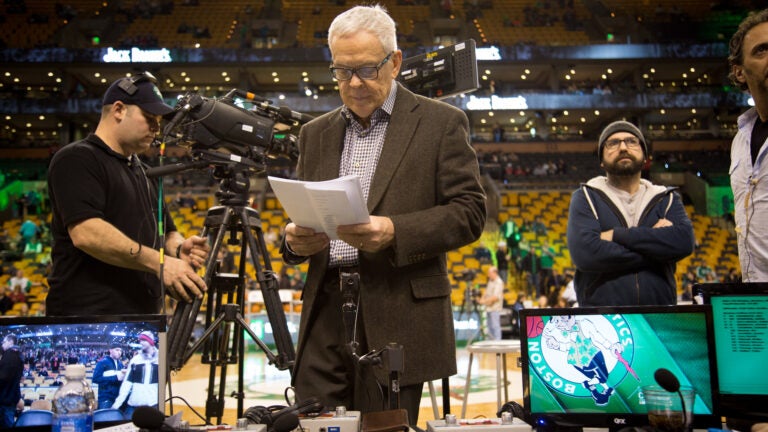
Other than the United States, Celtics play-by-play announcer Mike Gorman has called games for every men’s basketball team in the Rio Olympics. And he’s done it all from a studio in Stamford, Connecticut.
“I don’t know what the percentage is,” Gorman says of the total number of announcers broadcasting remotely. “It seems as I walk around Stamford that it’s pretty large number of announcers who are doing events from Connecticut.”
According to NBC Sports Group, the official U.S. broadcaster of the Rio Olympics, there are “more than 1,000” employees working out of the Connecticut headquarters. Several major sports are being almost completely broadcast from over 4,800 miles away.
“Swimming, obviously the people are there live,” Gorman explained. “Track and field, they’re there live, but field hockey, soccer, all these other sports, they’re pretty much being done from Stamford on monitors.”
Gorman described exactly how a broadcast of an Olympic event happens when the announcers aren’t in the same country.
With fellow commentator Fran Fraschilla, Gorman said they’re situated in a booth where multiple screens show the game broadcast as well as the arena as a whole. One issue he’s had is with the size of the screen that he’s looking at.
“I wish they’d get us bigger monitors to be honest with you,” he said. “It’s pretty small, the screen that we operate off of.”
Another major difference for Gorman, who has been the TV voice of the Celtics since 1981, is not being aware of what will be shown in the broadcast.
“They take an international feed, which means we have no idea where the camera’s going next. We also can’t ask for any shots of anything, so we’re just kind of constantly playing catch up with the video that you see.”
Yet despite being thousands of miles away from the Rio basketball, Gorman is still very aware of the atmosphere. In fact, it’s even shaped what he calls his favorite team of the men’s competition so far.
“My favorite team is Argentina, because of their fans,” Gorman said. “Their fans sing the entire game. They’re having a good time, singing songs, drinking beer and they never sit down for the whole game. It’s really cool.”
This also isn’t the first time that Gorman has worked an Olympics from a remote location. In 2012, he traveled to NBC studios at 30 Rockefeller Plaza in New York City.
But Gorman wasn’t there to call basketball games, as he’s done thousands of times in his career. Instead, he was there for handball.
“It was kind of fun because the first team handball game I saw, I did, which was really an interesting experience,” Gorman remembered. “By the time the Olympics were over, I had a pretty good handle on the game, but it took a while.”
Gorman also offered thoughts on several other topics, including LeBron’s potential as a handball player and also the differences of U.S. and international basketball:
On U.S. chances for gold: “I think the USA is in for a long weekend. These teams are very good. They play together. They don’t occasionally make the extra pass. They always make the extra pass. They force teams to play defense for longer periods of time than they want to do.”
What’s surprised him: “The thing that probably surprised me the most is it’s a much more physical game. The American team has made no bones about it. They don’t like it. They feel like they get fouled a lot and it doesn’t get called. Well, they do by NBA standards, but not by international standards. It’s a very tough game. It’s kind of like watching very good ballplayers playing in a Y[MCA]. You don’t get calls. Nobody complains. You just keep playing.”
The difference in passing styles: “Where the American game tends to break down into a series of pick-and-rolls and one-on-ones, the international game you see many more plays. It’s not unusual to see seven, eight, nine touches of the basketball before somebody takes a shot. You rarely see that with the American team. Two or three passes is a lot.”
The threat of Australia: “(Matthew) Dellavedova becomes a much better player in international play because his physicality doesn’t get him in foul trouble like it does in the American game. Andrew Bogut is another example. He’s been very outspoken during these Olympics about the fact that he kind of thinks these United States teams should be quiet and play. If they don’t like the physical play, they shouldn’t be here. And I think he’s a little upset at the way he might’ve been handled at Golden State, so there are some guys with some things to prove.”
Possible U.S. lineup changes: “The one change I would think the United States will make going into the quarterfinals is (DeAndre) Jordan will start and (DeMarcus) Cousins will sit. Cousins really hasn’t shown much of anything on the defensive end of the floor and hasn’t been that good offensively.”
And how the U.S. will look to play: “I think the United States is going to come out with a defensive mindset. They’re going to try and show their athleticism defensively, and what that can sometimes result in is players kind of over-committing. You’ll see a lot of backdoor layups and cuts to the basket for guys that’ll be wide open. These international teams are ready for the way the United States wants to play and they have answers for it.”
On LeBron’s ability converted to handball: “I can see where a player of LeBron’s size and athleticism would be a factor, but I can remember last time being really amazed at the size of these guys. I can remember the Croatian team, and the average size of their front line was like 6’9” 250 pounds. So these aren’t small guys. If LeBron played, he wouldn’t be able to just go out and dominate. They have really big kids who play this game.”




To comment, please create a screen name in your profile
To comment, please verify your email address
Conversation
This discussion has ended. Please join elsewhere on Boston.com