
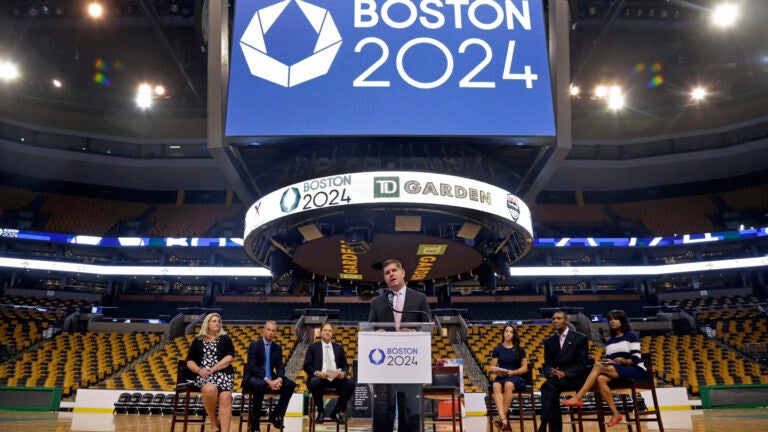
One of the biggest blunders in Boston sports history, the 2024 Olympic pursuit, ended a year ago
COMMENTARY
One year later, the remnants serve as a dichotomy of a city’s grandest aspiration and its internal battle against half-truths and long-term schemes just under construction.
There’s a Boston 2024 t-shirt on eBay for $39.99, along with an Olympic candidate pin for $10. The binders containing reams of information from last summer’s “Bid 2.0” are now buried under a season’s worth of periodicals and scribbled notes on desks across the city. Needham’s Aly Raisman, who, in 2015, joined the plagued campaign to bring the Olympiad to Boston just as the organization was finding its footing slick with the public, is instead off to try and stick her landings with the U.S. women’s Olympic gymnastic team in Rio beginning next weekend.
The International Olympic Committee will choose among Rome, Paris, Budapest, and Los Angeles next September for the “right” to host the 2024 Games. Boston, mercifully, is not an option, a finality that ensued on July 27, 2015, when the USOC pulled out of the Hub, only hours after Boston mayor Marty Walsh refused to sign a host city contract that would have put state taxpayers at risk.
If you look hard enough, you can probably find a gently-used 2024 bumper sticker somewhere.
“I think people are not regretting or lamenting the demise of Boston 2024 a year later,” said Chris Dempsey, former co-chair of No Boston Olympics, a group of volunteers and supporters who vehemently opposed Boston’s Olympic bid committee’s quest to land the 2024 Summer Games. “The more people learned about Boston 2024, the less they liked it.”
As officials in charge of the 2016 Summer Games in Rio make last-ditch efforts to present a habitable, disease-free affair in South America, Boston’s one-year anniversary of escaping the IOC’s wrath might be seen as a once-in-a-lifetime missed opportunity. That opinion appears to be in the minority though, overtaken by a much more prevalent sigh of relief that Massachusetts avoided (additional) dirty politicking and massive overrun bills sent directly to every resident of Stockbridge, Acushnet, Dracut, or any other city or town of the Commonwealth that would ultimately have about as much to do with the Olympic Games as Dan O’Brien in 1992.
“I think what the opponents of the bid should be proud of was that we did help sort of accelerate that conversation, by bringing facts and information to the debate that otherwise wouldn’t have been there,” Dempsey said. “Probably the most crucial issue always came down to the taxpayer guarantee, the fact that the IOC was requiring Boston 2024 and the city to sign a guarantee that the public would be on the hook for cost overruns. And that’s something that, obviously, the IOC never wants to talk about, and Boston 2024 never wanted to talk about.
“The public was savvy enough to see through that and say, holding the bag, not an acceptable situation for Massachusetts taxpayers.”
But the more groups like No Boston Olympics demanded that Boston 2024 open the books, or provide some assurance of financial planning, the tone-deaf organization, led by the likes of CEO Richard Davey, chief bid officer Erin Murphy, and Boston Celtics owner Stephen Pagliuca, continually refused to address its floundering bid. By the time revisions came to the committee’s Olympic plan last June in “Bid 2.0,” the group had already cemented its legacy as a shifty segment of developers that couldn’t be trusted by the general public.
It should go down among the biggest blunders in Boston sports history.
“I do think that there are some lessons to be learned about what happened,” Dempsey said. “As I look back, I don’t sense that today the city of Boston and the state of Massachusetts have a whole lot of regret about saying no to the IOC.”
That is reflected in a recent WBUR survey which found that the past year has done little to sway voters’ minds about the viability of the Games in Boston. Broke down by demographics, the same people who wanted the Olympics still want the Olympics. The same people who wanted the Games gone still want the Games gone.
If the state were still in the process, we’d be only four months away from the ballot question that Boston 2024 said it would support in November, which would mean a period of Olympic tug-of-war not unlike what we experienced in the months leading up to the USOC’s surrender.
Maybe Massachusetts could handle the Olympics, leading more to the 80 percent approval rate the USOC is finding in Los Angeles (only about 44 percent were in favor in Boston). But with Boston 2024 in charge, the pursuit became a gong show.
But even the most uniformed endeavor would have found difficulty in selling the Olympics to a public in the midst of learning about the inhumane conditions die to greet athletes in Rio next month.
Dempsey said it’s unfair to compare Boston’s pursuit to what’s happening in Rio, ravaged by pollution, an unfinished athlete village, and rampant crime, but he does note it’s a significant reminder that the IOC’s business model is significantly flawed and needs to reform.
“We’d have other issues,” he said. “The problems with the Olympics go far beyond whether the velodrome is done on time or whether the Olympic village has toilets that are working properly. Much more fundamentally, there are issues around this whole idea that you need to move the event around every two and every four years, and that you need cities to bid on it and make all sorts of promises about the things that they’re going to deliver without any real ability to necessarily back that up.”
If Dempsey sounds like a guy who’ll refuse to watch the gobs of hours of Olympic coverage coming to a cable box near you next month, well, he’s already done some recon work on checking on the U.S. men’s basketball team’s recent rout of Argentina. Dempsey, head of business development for Masabi, a company that makes the MBTA’s commuter-rail mobile ticketing app, was 10 years old when the original Dream Team plowed through Barcelona, and he said — really — he looks forward to watching the 2016 U.S. athletes in Rio.
“You’ve got to love moments like that,” he said. “You’ve got to love Team USA, the athletes, and the work that they put in. I’ll be watching and I’ll be rooting on the USA.”
He’ll likely also still be discussing the downsides of the Games with friends and family at the same time. Old habits…
“It’s definitely kind of a split feeling when you watch the games now,” he said.
As long as it’s not our problem.
Boston 2024 died a year ago, as likely did the dream of Massachusetts ever hosting the Olympics.
Anybody have a hat for sale?
Here’s how Boston might have looked before, during, and after the Olympics
[bdc-gallery id=”115186″]


To comment, please create a screen name in your profile
To comment, please verify your email address
Conversation
This discussion has ended. Please join elsewhere on Boston.com