
Get the latest Boston sports news
Receive updates on your favorite Boston teams, straight from our newsroom to your inbox.
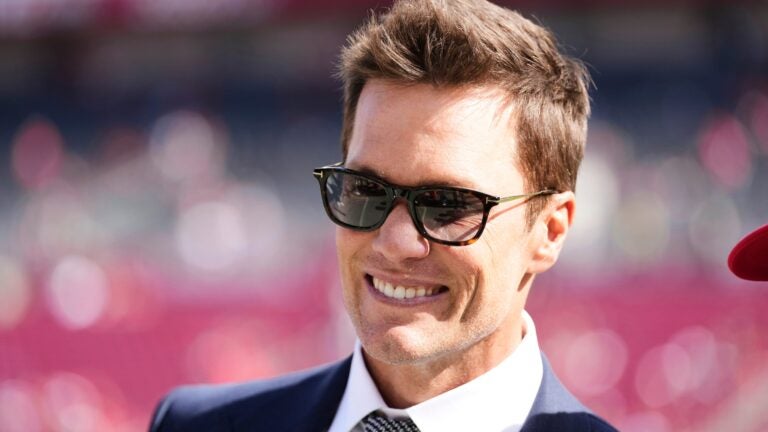
NEW ORLEANS — Tom Brady met with reporters over a conference call this week, to talk about calling his first Super Bowl.
Asked about Patrick Mahomes chasing him for greatest-ever status, Brady answered, “We all have our own individual journeys.”
Asked about his role as part-owner of the Las Vegas Raiders, Brady offered: “I’m there to support the team and the leadership and the overall vision for success.”
Queried about what he wanted to work on for next season in the booth, Brady answered: “Everything.”
It was, in short, a masterclass in speaking without saying much.
A few hours later, the announcer that Brady replaced on Fox’s top broadcast team, former tight end Greg Olsen, sat on a dais inside the convention center here. A smattering of people sat in the audience. Olsen, though, was animated, talking about data in his broadcasts and the Eagles offense. “Every single team in the league on third and five is treating that like a passing down,” he explained, excitedly, except the Eagles because of their famous tush push play.
Troy Vincent, an NFL executive and fellow panelist, said Olsen’s facility with explaining the numbers behind the game was so good “the ladies at Ruby Tuesday” can better understand. “So, thank you,” Vincent said.
Alas, for Olsen, it doesn’t particularly matter. Because he’s not Tom Brady.
There aren’t many who can add to the NFL’s idea of bigness. Taylor Swift did it last year. Brady, with his supermodel ex-wife, Super Bowl rings, and Adonis jawline, can also add a layer of spectacle to the Super Bowl, which he will call on Sunday for more than 100 million people. That, in part at least, is why Fox signed him to a reported 10-year, $375 million contract.
“We definitely think about who you want connected with your brand, right?” said Brad Zager, president of production and operations for Fox Sports. “Fame and success usually go with credibility; they are big parts of that … I’d be lying to you if I sat here and said that we don’t look at fame and think that when viewers turn on the television that has immediate credibility to the viewers.”
Fox turned to Brady after ESPN poached the venerable duo of Joe Buck and Troy Aikman. Olsen had the seat first, alongside play-by-play man Kevin Burkhardt, but was bumped to the number two team to make room for Brady. Since the top-secret recruiting campaign, Brady has been an object of fascination.
When he debuted this season, the early returns were mostly critical. His voice was no good; his teeth were too big. Seemingly every minor mistake — like once calling the Eagles the Phillies — generated its own headline. He also bought a piece of the Raiders, which led the league to limit his access to teams and what he can say, and sparked its own set of alarms about how long he’ll stay in the job.
What all of that has led to on the air depends on whom you ask.
“He’s been incredible,” said Fox Sports CEO Eric Shanks.
“He’s very natural,” said Al Michaels.
Frank Hawkins, the former head of media for the NFL, said: “He’s sort of okay.”
Brady is working diligently, according to everyone around him. Brady said a key for him is still translating into words what he used to innately understand as a quarterback. Zager said much of the learning process is broadcast mechanics: where the monitor should be placed in the booth; how to deal with a producer’s voice in your ear.
Brady also seeks feedback constantly. He calls fellow broadcasters Michaels, Cris Collinsworth, Dick Stockton and others. His friend and podcast co-host, veteran broadcaster Jim Gray, watches Brady games, takes pages of notes and then reviews them with Brady. Gray said they stress that Brady might see 10 different things on a play but that he can only pick one point to make in the 15 seconds between plays.
The result is an improving broadcast. Brady was astute, for example, illuminating the timeout strategy at the end of a Rams-Bills game in December. And there is a notable looseness to him that was missing from his earlier games. During the playoffs, he has cracked jokes about the frosted-tips hairstyle he once had. And during the NFC championship, when the camera panned to Nick Foles, the career backup whose Eagles upset the Patriots in Super Bowl LII, Brady offered, “Nick I don’t hate you! I’m just jealous of you. You caught it, I didn’t,” in reference to a trick-play catch Foles made during the Eagles’ win.
“He wants to touch perfection,” Gray said. “It’s like a jellyfish. He can grab it for a moment but he will continue to keep grabbing. He’s only going to get better.”
Then there are the so-called Brady rules. Brady bought a stake in the Raiders and cannot attend midweek production meetings where the crew meets with players and coaches and has limitations in criticizing referees. Instead, Brady debriefs with his colleagues, calls into press briefings and listens to what players and coaches tell reporters.
The conflict of interest peaked when Brady pulled double duty, actively trying to hire Detroit Lions offensive coordinator Ben Johnson at the same time that Fox broadcast a Lions-Washington Commanders playoff matchup. During the game, the Athletic noted, Brady never said Johnson’s name, even after he called a critical failed trick play in the second half.
“The loser is ultimately the fans,” Hawkins said. “The NFL is approaching it the right way to protect integrity, but most of Brady’s insights tend to be generic. They are about how he would have called a pass or something like that, as opposed to insights from what [a coach or player] was thinking.”
To be sure, Brady is not the only announcer who’s had other league entities also paying their bills. Jessica Mendoza called Sunday Night Baseball while working for the New York Mets. Brad Gilbert has been a coach and a tennis analyst at the same time. Dale Earnhardt Jr. calls NASCAR races and is a team owner. Aikman, in an interview, said he was once part of a prospective NFL ownership group and went to Fox brass to seek approval for it, though his group was ultimately outbid.
An executive in the NFL league office said the NFL monitors every broadcast the same way, whether it’s Brady at Fox or Aikman at ESPN or Collinsworth at NBC. The executive spoke on the condition of anonymity because he was not authorized to discuss internal NFL business publicly.
Aikman, for instance, was critical of referees for calling a roughing penalty against the Houston Texans during a playoff game against the Chiefs. The executive said if Brady had been equally vociferous, the league wouldn’t have viewed it any differently or delivered any sort of punishment.
“In that three-hour game window, there’s not a lot he couldn’t say. He has wide latitude.” the official said, adding the rules are in place more for something Brady might say outside the booth.
A number of media executives and broadcasters throughout the industry said they thought less about what Brady could or would say than his time commitments. They wondered whether anyone could be actively involved in running a team and still put in the requisite work to call the NFL’s biggest games. Anecdotes from the locker room, for example, have the potential to enrich a broadcast when deployed by an analyst.
Shanks, though, dismissed the idea. “We’re definitely getting 100 percent of Tom Brady,” he said.
“It’s a win to have him in the booth. It’s a win to have him with the Raiders,” said the NFL’s executive vice president of distribution Hans Schroeder. “We’d be crazy not to want our best players still involved in the NFL.”
Famous quarterbacks have been entering the broadcast booth for decades. Some fit; some don’t.
Joe Montana, for example, hated the job immediately. He didn’t like the travel or the demand to be opinionated.
“I found it really difficult to criticize players or make judgments even though I played the game,” he said in an interview. “I don’t know his reads, his playbook, what you can see things from defense.” He added: “The money is crazy now. Maybe that would have been different for me.”
Aikman, on the contrary, said he naturally felt a responsibility to deliver a take.
“One thing I learned early on: if something happens or a coach is going for it on fourth down or going for two, it’s the analyst’s job to weigh in on it,” Aikman said. “That’s why you’re calling the game. You can’t stand on the sideline and pick and choose what you talk about. The bigger the game, the more important that becomes. You have to have an opinion.”
Brady has been mostly sequestered this season. Most of his media appearances are on his own podcast or Fox platforms. Instead of the normal Super Bowl week press availability, Brady did the conference call with a smaller group of reporters. “They’ve kept him in bubble wrap,” said one person with direct knowledge of the strategy. “They treat him like porcelain and I don’t understand why. He’s Tom Brady.” (Fox said there was a scheduling conflict with player availability that kept Brady from the larger media availability.)
It has, though, in some ways, added to an air of mystery around him. So when he spoke this week about the Raiders and his broadcasting journey, it was illuminating to hear him sound a bit like both Montana and Aikman.
In describing his approach to criticism, Brady described a hypothetical offensive line play: “Maybe the guard was expecting help from the center, but the center didn’t deliver it. You could get mad at the guard for getting beat … but you don’t understand the actual communication that’s going on up front.”
He continued: “I try to be conscious of that, and at the same time, there’s things that I have been critical of that I’m not afraid to kind of speak my honest opinion as soon as I see it.”
Gray said Brady likes to pick his spots but there was another reason he chooses his words so carefully: essentially, because he’s Tom Brady. When Brady criticizes a player, it’s instantly newsworthy, said Gray. Like when he questioned quarterback Daniel Jones’s decision to ask the Giants for a release this year. “He understands that when he says something that it carries weight,” Gray said.
But, unlike Montana, Brady also extolled the joy of the job and said he’s looking forward to the next nine years.
Fox certainly hopes so. On its website, Fox Sports has a special menu for Brady content, complete with a goat icon next to his name. He starred in an IndyCar ad, a new sport coming to Fox, and is a favorite among sponsors.
At a Fox Sports dinner for the company’s full roster for talent and production this week, Brady was tapped to give a speech to the group. Brady gave a heartfelt thanks for being part of the team, and then some rah-rah pregame pump-up words to rally the team.
“It was run through a wall [for this broadcast],” said Zager. “It was great.”
Receive updates on your favorite Boston teams, straight from our newsroom to your inbox.




To comment, please create a screen name in your profile
To comment, please verify your email address
Conversation
This discussion has ended. Please join elsewhere on Boston.com