How the NFL drug testing and appeals process works
The league last updated its policy in 2014.
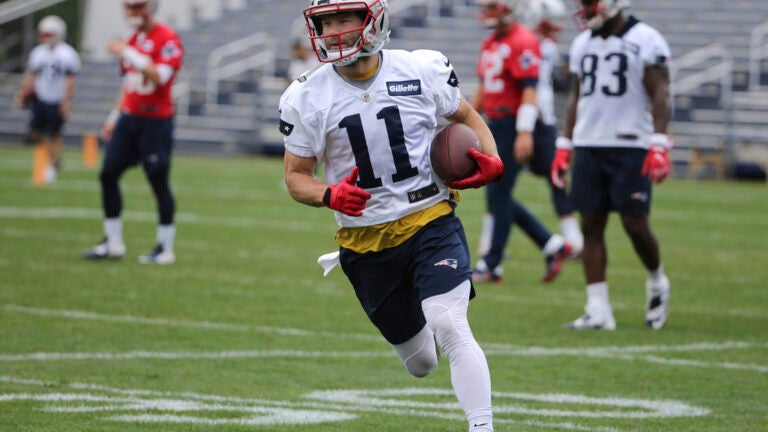
On Thursday, a report emerged that Julian Edelman was facing a four-game suspension to start the 2018 NFL season because of positive test for performance enhancing drugs.
Edelman, according to ESPN, is currently appealing.
“The appeal is underway right now as we speak,” Adam Schefter said on ESPN’s “NFL Live” during a Thursday segment.
Naturally, this provokes questions about the league’s methodology in regard to testing athletes for performance enhancing drugs. The NFL updated its drug policy in 2014 in response to sustained criticism about its fairness.
Here’s how it works:
How the NFL tests players
Every year on April 20, the NFL officially begins testing for the new season. The league has an extensive list of banned substances that each player is required to be aware of.
PSA: The drug testing period opens today. If you want to learn more about the health and safety resources offered: https://t.co/IoTX6r4j1S
— NFLPA (@NFLPA) April 20, 2018
“The final responsibility rests with you to ensure that you do not take a banned substance,” the NFL Players Association bluntly states on its website.
Players under contract are subject to testing throughout the preseason and regular season, as well as the offseason. Any travel dates must be disclosed with the league, as a missed test is treated the same as a failed test. Not surprisingly, there are strict rules about completing a test within four hours of notification.
In the uniform standard of other drug policy practices for athletes around the world, an “A” and “B” sample system is used for urine tests. If a banned substance is detected in the A-sample, the B-sample is used to double check.
Under the league’s updated drug policy, a player is allowed to send an independent toxicologist to be present for and observe the B-sample test. In the past, this has been done at the UCLA Olympic Analytic Laboratory. Regardless, both samples are required to be tested at the same facility, but by different technicians.
“To confirm the results of the A-bottle test,” NFL policy states, “the B-bottle test need only show that the substance revealed in the A-bottle test is evident to the ‘limits of detection.'”
Separately, the NFL now also conducts blood tests for Human Growth Hormone (HGH). An individual player can get tested up to six times in a year (with certain exceptions if there has already been a violation or a player is tested due to “reasonable cause“).
How do NFL drug policy appeals work?
If a player is suspended by the league for a drug policy violation, they have the right to appeal.
According to an NFL announcement about the 2014 change to the league policy:
Appeals of positive tests in both the substance abuse and performance enhancing drug programs (including HGH) will be heard by third-party arbitrators jointly selected appointed and retained by the NFL and NFLPA. Appeals will be processed more expeditiously under uniform rules and procedures.
“I’m told the appeal has not yet been heard, so officially we are not likely to hear any word today, or perhaps in the next several days,” NFL Network reporter Ian Rapoport said on Thursday.
Rapoport’s assertion that the appeal hadn’t been heard by Thursday is notable because of the following line in the league’s policy:
During the off-season, the Notice Arbitrator shall assign appeals on a rotating basis such that a hearing may be scheduled within thirty (30) days of the issuance of the notice of discipline.
In terms of timing, previous appeals have taken over a month to be ruled upon, though there is no specific timeline.
How past player appeals have gone
Over the last three seasons, more than 50 players have been suspended for performance enhancing drugs. Extending farther back, the number of players who have successfully appealed a drug policy violation is comparatively small.
The most recognizable name to win an appeal was Richard Sherman in 2012. The then-Seahawks cornerback warded off a four-game suspension for performance enhancing substances when a decision ruled there had been improper practices in the collection of his urine sample.
Another in 2012 was Giants running back Andre Brown, who avoided suspension for Adderall when it was revealed he had a prescription. More recently, Texans offensive lineman Duane Brown appealed against a suspension for a banned substance. He won when it was confirmed that eating too much meat during a trip to Mexico was what produced an unnaturally high level of clenbuterol.
Appeals in 2018 have so far been rejected. Bengals linebacker Vontaze Burfict lost his appeal in April after the story of his suspension was originally reported in March. And Saints running back Mark Ingram’s case against his own four-game suspension was dismissed by an arbitrator in May.