
Sign up for the Today newsletter
Get everything you need to know to start your day, delivered right to your inbox every morning.
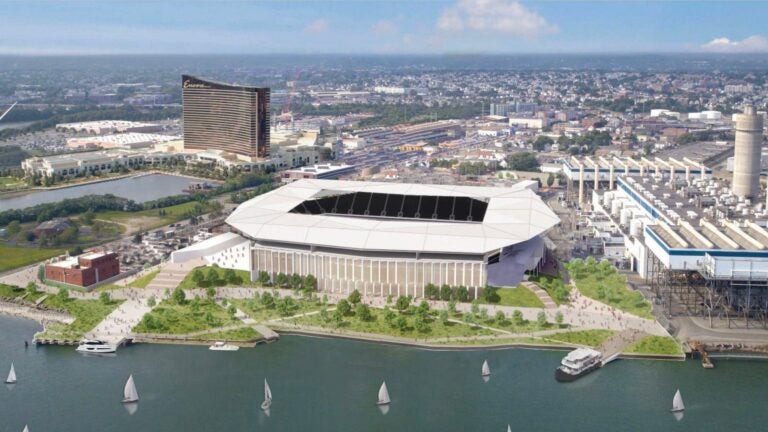
The Revolution’s timeless dream of a soccer-specific stadium in the Boston area has never been closer to becoming reality, yet Robert Kraft remains skeptical that the current Everett-based plan will be viable given, as he described it, the “political people” and “all the agendas.”
Speaking to reporters at the NFL’s annual league meeting in Florida on Tuesday, Kraft fielded a plethora of Patriots-related questions before NBC Sports Boston’s Tom E. Curran brought up another topic.
“Any update on the Everett stadium, and where things stand, and how it’s coming?” Curran asked.
Kraft paused before referencing an earlier era in Boston-area stadium discussions.
“I think back to when I bought the Patriots. I had gone out to St. Louis and met with James Orthwein, and knew we had a stadium that was inadequate,” he said, referencing the old Foxboro Stadium. “I called the then-governor and said, ‘I’m going to keep the team from moving to St. Louis, but I need your commitment that you’re going to help me get a stadium in downtown Boston.’
“And he said, ‘I’m there, You’re in,'” Kraft recalled of then-Gov. Bill Weld. “And of course we all know what happened.”
For younger New England sports fans who may not specifically remember, the Boston-based project ground to a halt (and its later iterations were also blocked over the ensuing years) due to local opposition. Eventually, after briefly entertaining the notion of moving the team to Hartford, Connecticut, Kraft and the Patriots struck a deal to remain in Foxborough.
It’s an experience that, coupled with subsequent failed efforts to build a stadium (this time for the Revolution), inevitably informed Kraft’s view of the local political scene.
“The political environment here is a little different. So we built the only stadium in America that’s 100 percent private,” Kraft said of Gillette Stadium, which opened in 2002. “And we’re willing to do that for soccer.”
The current Revolution plan is to build a stadium to seat up to 25,000 on a 43-acre parcel of land located at 173 Alford St. Currently, it’s the site of the shuttered Mystic Generating Station along the Mystic River.
“Usually 20-25,000 is what comes to a soccer game. We’re willing to do this privately financed stadium in Everett,” Kraft explained, “but politics takes over in Beantown unlike most places. So, we’re willing to do it. We just need the political people and get all the agendas putting team-first. And we hope it happens, but we can’t force it.”
To build a stadium on the land in Everett, the Revolution had to work with local lawmakers to get a specific carveout on a Designated Port Area (which previously prohibited any building that didn’t pertain to industrial port usage). After multiple years of failing, the prevision was included in legislation that was passed in late 2024.
However, a lengthy and complicated process remains, including the requirement of separate community agreements between the Kraft Group and the cities of Everett and Boston.
Boston Mayor Michelle Wu has maintained that she is still yet to hear directly from the Krafts.
“Things really haven’t kicked off very much in terms of substantive conversations, because there really hasn’t been that much to discuss from the project proponents: We haven’t really seen specific details,” Wu told residents during a March community meeting in Charlestown about the proposed Everett stadium. “To this date, I still have not gotten a call from the Krafts. … There’s been just radio silence.”
While the Boston mayor said that she would “welcome” a stadium for the Revolution in Everett, it would only be in the scenario where “we can get the transportation impacts right.” She noted that the city had — to that point — engaged in two meetings with Kraft representatives.
“We don’t have enough information right now to understand what exactly is being proposed,” she told Boston.com after the Charlestown meeting. “I hope that as the conversations advance, whether or not there are more direct phone calls, I trust my team to do the job that they need to do. We just need to make sure that, on the other side of the table, they’re also doing their jobs and providing the information that residents are very much interested in.”
As an added twist, Robert Kraft’s son, Josh Kraft, is currently campaigning against Wu in the hopes of unseating her as Boston mayor in the upcoming 2025 election in November. Josh Kraft has been a vocal opponent of Wu’s favored soccer project, the revamping of White Stadium for the public-private partnership alongside the NWSL expansion team now known as Boston Legacy Football Club.
Get everything you need to know to start your day, delivered right to your inbox every morning.



To comment, please create a screen name in your profile
To comment, please verify your email address
Conversation
This discussion has ended. Please join elsewhere on Boston.com