
Sign up for the Today newsletter
Get everything you need to know to start your day, delivered right to your inbox every morning.
Major League Soccer revealed each team’s “roster profile” on Thursday morning, confirming some important details about how each club has navigated the league’s unusual (and specific) rule structure.
For the Revolution, this offered a cross-section of the club’s extremely busy roster turnover that’s taken place over the past 12 months, as well as providing a glimpse at would may come in the future.
On a basic level, New England has chosen to go with the “U22 Initiative Player Model.” This, per a rule update from 2024, means that the Revolution have selected the option to have roster space for a maximum of two Designated Players (who can exceed the cap maximum for allowed salaries) as well potentially four U22 Initiative players (who are younger players that can have larger salaries count as smaller charges against a team’s cap).
The alternative model, which New England can still choose at midseason if the team meets certain criteria, is the “Designated Player Model.” Under this route, an MLS team can carry three DPs on its roster, with only three U22 players.
While New England has opted for the U22 model, it technically has space for two more U22 signings. As it stands to begin 2025, the Revolution have the following DP/U22 players:
In addition, the Revolution have six players on the roster who the club has used “Targeted Allocation Money” (TAM) to help fit under the maximum salary as allowed by the cap.
New England’s current TAM contracts are:
In a specific sense, the league update is interesting information for passionate fans who are more familiar with the niche rules.
On a more broad level — for more casual fans — the takeaway is that the update showcases the huge level of change that the roster has undergone in the last 12 months. Case in point: Of all the DPs, U22s, and TAM players, only Gil and Chancalay were on the roster to open the 2024 season (and Gil is the only one who was a part of the suddenly distant Supporters’ Shield-winning campaign in 2021).
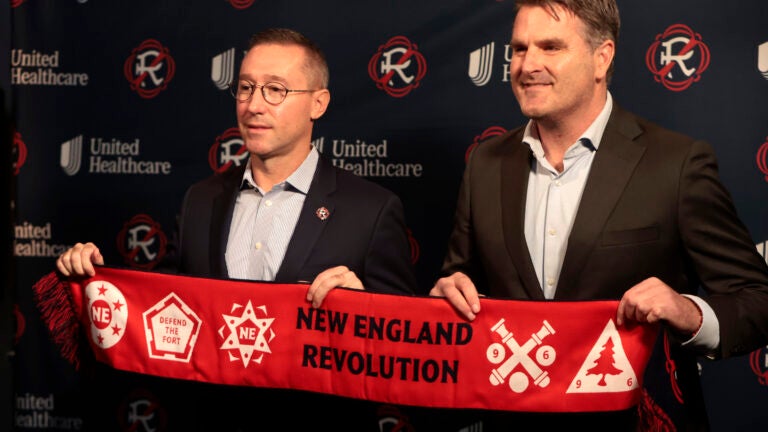
Revolution Sporting Director Curt Onalfo spoke to Boston.com on Thursday about the state of the club’s roster, and the stunning level of year-over-year turnover.
“We made enormous change in the offseason,” Onalfo explained.
“We wanted to get there better in a lot of areas,” he admitted. “We leaked goals last year, so we needed to get better defensively, and we didn’t score enough goals, so we wanted to get better in the attacking part of the field.”
In 2024, the Revolution experienced one of the more challenging seasons in team history. Finishing 14th out of 15 teams in the Eastern Conference, New England tied with San Jose for an MLS-worst goal differential (-37).
Another of the team’s problems was that despite its lackluster results, the Revolution were somehow simultaneously up against the salary cap, lacking flexibility to make changes.
But through in-season trades (which sent the likes of defenders Henry Kessler and DeJuan Jones elsewhere), as well as a huge list of offseason departures (18 players from ’24 are gone), Onalfo and New England created an abundance of flexibility.
Part of it led to the notable acquisition of striker Leonardo Campana, the 24-year-old Ecuadorian, from Inter Miami in a Dec. trade. Because it was a trade between two MLS clubs, New England was able to utilize a league-record amount of General Allocation Money (GAM) to complete the deal while keeping the talented Campana below the Designated Player threshold.
Onalfo characterized it in a simpler way.
“If you had to get him from outside the country, he’d be a DP,” the Revolution executive said of Campana. In effect, New England has a star-caliber player on a non-star contract (at least in terms of how he fits into MLS roster rules).
While it can quickly become a convoluted conversation — rich with MLS-specific jargon — the higher level takeaway appears to be that the Revolution have leveraged league rules for the team’s benefit (provided of course that Campana delivers goals at the expected rate).
“The way I look at it was we actually spent $10 million, in terms of buying players in, in this window,” Onalfo said of the bigger picture.
Assessing the staggering level of change to the team, he acknowledged his own surprise at the scale and swiftness of the roster makeover.
“The truth of it is I honestly can’t believe we were able to do as much as we did in this window,” Onalfo explained. “You have intentions and goals, and you have things you want to achieve, and all that we wanted to get done, we were able to get done. It was really kind of remarkable.
“It’s a tribute to an incredible team effort from everybody that’s on my staff,” he added. “And then obviously the coaching staff as well, because we work in collaboration. Normally, I would say it would’ve taken another window to do some of the stuff, but it just worked out. We had these goals, and we just kept pushing. We just kept plugging away.”
Part of it was the drive to amend the disastrous 2024 campaign.
“We were so upset with how the season went,” Onalfo bluntly assessed. “We were just like, ‘Let’s do this.’ Sometimes it’s difficult to move certain guys out that maybe you want to, and then also finding the pieces that you want [to add]. There are a lot of times when you’re going after players and you don’t get them for a lot of different reasons. So we’re certainly happy with the amount of moves we made and where we are.”
The Revolution opened the regular season on Saturday with a 0-0 draw on the road in Nashville.
The MLS Primary Transfer Window stays open until April 23, meaning teams can still make signings and trades until then. It reopens in the Secondary Transfer Window at midseason from July 24 through Aug. 21.
For now, Onalfo said that New England is likely done making moves (leaving the door open should circumstances — injuries, or otherwise — require).
“It looks like we’re set at this point,” he said of the current window.
Looking ahead, his focus on flexibility remains, as the Revolution have two open U22 spots under the current roster model. And, as Onalfo outlined, New England can still switch to a “Designated Player Model” should the team wish to add a third DP.
“We did that model,” he said of the U22 format, “but we did it in such a way that we’re leaving it open so that we could actually switch back to a three-DP model in the summer if it made sense for us.”
There are a few other minor complications that the Revolution will have to consider. MLS also limits the number of “international roster spots” that each team can have at a given moment. New England currently has seven international roster spots, all of which are accounted for the active roster. When Chancalay returns from long-term injury — the Argentine has been out since mid-2024 after suffering a torn ACL — it will force the team to free up (or acquire) another international roster spot to register him.
The other interesting roster development to watch will be the status of Ganago, the Cameroonian forward acquired on loan in Jan. from French Ligue 1 side FC Nantes. The terms of the loan are for six months, and also includes an option to buy his contract outright. According to the Revolution, the loan can also be “extended by six months if certain playing-time conditions are met.”
Should Ganago, a talented player considered to have vast potential, perform at a high level in his first six months with New England, the purchase clause in his contract might mean he ends up qualifying as a DP (necessitating New England to change its roster construction to a Designated Player Model).
In either case, the team’s cap situation is far healthier now than it was 12 months ago. After a year in which the Revolution front office was largely constricted in what it could do, Onalfo has positioned the club to be much more nimble with moves it can make.
As always, it will all depend on the results on the field.
Get everything you need to know to start your day, delivered right to your inbox every morning.




To comment, please create a screen name in your profile
To comment, please verify your email address
Conversation
This discussion has ended. Please join elsewhere on Boston.com