
Get the latest Boston sports news
Receive updates on your favorite Boston teams, straight from our newsroom to your inbox.
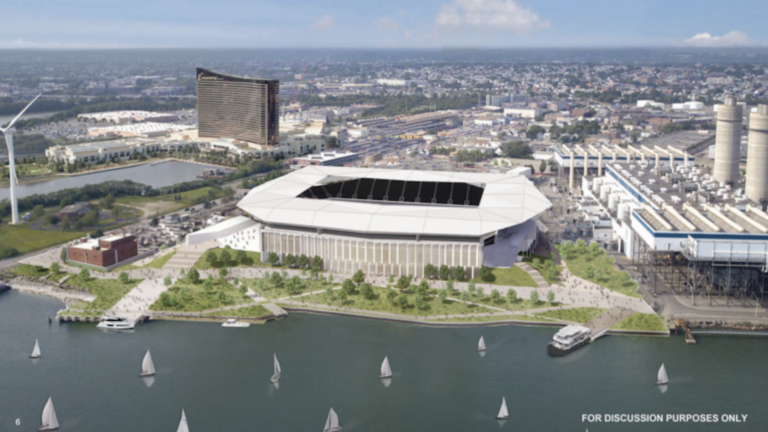
The Revolution’s eternal quest to build a Boston-area stadium took another step forward on Tuesday when the Mass. legislature announced that a crucial provision relating to the team’s proposed Everett project had been included in the long-stalled economic development bond bill (H.5100).
Specifically, the bill includes language that would remove the “Designated Port Area” (DPA) distinction from a 43-acre parcel of land located at 173 Alford St. in Everett, allowing the Revolution to pursue the building of a 25,000-seater stadium there.
The reason that the legislative carveout was needed is because the proposed site is the location of the now-shuttered Mystic Generating Station along the Mystic River. A section of the site was bought by Wynn Resorts in 2023, appearing to clear a path for the Kraft-owned Revolution to buy it for stadium development. However, the prevailing DPA language prohibits any non-industrial construction on the site, including a stadium.
In order to get around the DPA, the Revolution needed either a carveout or an official review from the Mass. Office of Coastal Zone Management.
After unsuccessful attempts to get it through the legislature in 2022 and 2023 (one in the House, one in the Senate), the stadium provision was initially filed again in late 2023 as a standalone bill. It gained passage through the Senate in July after being bundled into a much larger bill pertaining to economic development, but disagreements over several parts of the bill — including the Revolution’s stadium proposal — stalled its progress.
It failed to pass prior to the end of the state’s formal session (July 31), a fact which normally would have sent the stadium bid back to square one in 2025. Yet because it was tied to the larger bill, which includes vital state topics like biotech funding, a special session was sought to secure the bill’s passage even after the deadline. The push received support from Gov. Maura Healey, who urged an agreement to be reached “as soon as possible.”
The question, from a Revolution standpoint, was whether or not the compromise lawmakers reached after negotiations would still include the DPA carveout provision. On Tuesday, club officials and fans finally got a response, with the crucial stadium-related language remaining in the bill.
The final wording of the bill added stipulations, addressing the earlier concerns of Boston representatives about the possible effect of building a stadium in close proximity to the city. The changes include:
Per Jon Chesto and Samantha J. Gross of The Boston Globe, Boston Mayor Michelle Wu said she is “grateful to the Legislature for recognizing the need for Boston to be included in discussions of this major proposal. We look forward to learning the details of this proposal and working on behalf of Boston residents to represent community needs at this site.”
State Senator Sal DiDomenico, who proposed the initial version of this year’s stadium bill, celebrated its inclusion in the final iteration.
“This language paves the way for the public process to move forward on a project that will help my community clean up a power plant site that has been a health and environmental hazard for decades,” DiDomenico said. “This will result in hundreds of millions of dollars in private investment, cleanup of a hazardous waste site, creating good paying union jobs, and opening our waterfront for the public to enjoy.”
Now, barring an 11th-hour hold-up with either the legislature’s vote or the signature of Gov. Healey, it appears New England’s MLS team has cleared a major hurdle on the path to building a stadium of its own.
Receive updates on your favorite Boston teams, straight from our newsroom to your inbox.





To comment, please create a screen name in your profile
To comment, please verify your email address
Conversation
This discussion has ended. Please join elsewhere on Boston.com