
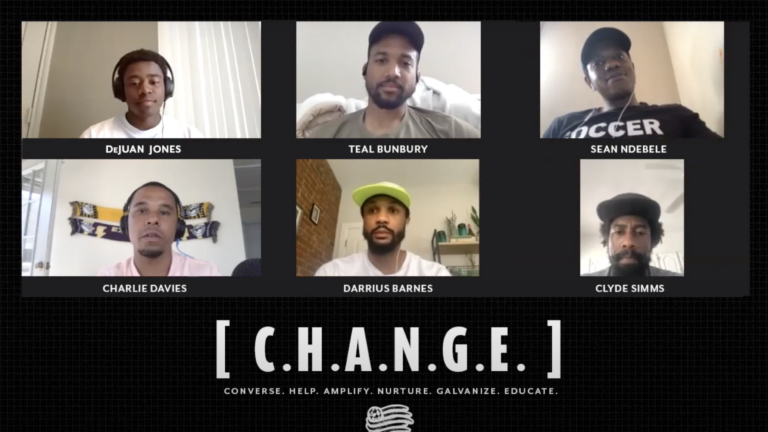
Revolution players and staff held a roundtable discussion about racial injustice. Here’s what they had to say.
Former Revolution forward Charlie Davies moderated the discussion.
Scanning the Revolution’s 2020 roster, the international nature of the team is immediately apparent. In total, 11 different nations are represented, hailing from three continents.
Even the club’s domestic players come from different parts of the country, with 11 states represented.
Soccer is often described as the world’s game, and New England’s roster reflects that. The game’s diversity has a capacity to inspire, as it did for former Revolution forward (and current club ambassador) Charlie Davies when he attended a World Cup game as a child.
“One of the reasons why I love the game we play is because in 1994, I went to my first soccer game at the old Foxboro Stadium which was South Korea-Bolivia,” Davies explained. “I had never heard of or seen people from those countries, yet the power of the unity inspired me. It pushed me to play the game because it felt like I’d be accepted.”
But soccer has also been a microcosm for wider societal issues. In a recent roundtable discussion, both current and former New England Revolution players and staff shared their thoughts on the recent protests against police brutality and racial injustice.
On the topic of Black Lives Matter, Davies — moderating the discussion — asked the group what they would say to people who dismiss the movement with a retort that “all lives matter.”
“I think it’s a lot to do with people maybe not fully understanding when people are saying Black Lives Matter,” said forward Teal Bunbury. “It doesn’t mean, there’s no preface, or there’s nothing coming after just trying to say ‘Black Lives Matter Only.’ Only Black Lives Matter. That’s not what it means. It’s all-encompassing, but it’s to bring light to the struggles of Black people, of what they’ve gone through to say, ‘Hey, we have some issues and problems that are going on.'”
DeJuan Jones used the specific example of George Floyd.
“Four officers, just to arrest George Floyd, which turned into a murder? It’s just hard to think how that could even happen,” said Jones. “We’re not saying that all lives don’t matter, just in this instance, we need to have more of a focus on Black lives at this point to be on an equal playing field.”
Darrius Barnes, who played for the Revolution from 2009-2016, now works on the marketing side of Major League Soccer. A Duke graduate, Barnes has used his ability on the field to help advance his education and career off of it.
Still, when asked if he had ever encountered racism in soccer, Barnes explained how pervasive it is with a story from his youth:
I feel like in some respect we’ve all dealt with it. Whether it was maybe not on the pitch, but it could’ve been in contract negotiations, or you felt like you might’ve been slighted in a different way because of your race. I know for me on the pitch I’ve had a couple instances where I was playing where there had been some covert racism and also all-out blatant racism.
When I was younger growing up in North Carolina, I was the only Black person on my team for a number of years, played in Savannah, Georgia. I couldn’t have been no more than 10-12 years old, and I was called the n-word by a white kid in a game. That was really the first time that something like that had really happened to me. It upset me, I was infuriated.
I told me parents after the game, and I respect my parents for the way they handled it, just knowing that everybody’s not going to like you. There are ignorant people in the world, and people have different upbringings. Really don’t blame the kid, that’s more of a family or parents issue, because racism is taught. It’s taught and it’s learned.
Beyond the youth level, Barnes noted that he also experienced racism in New England.
“I think the most painful one for me was at the professional level,” Barnes began. “You call a teammate in a training [session] because of a wrong tackle — and excuse my language — calls you a ‘Black s***.’ Those are things that happened years ago, five years ago that really kind of ingrained some painful tattoos on you that stay with you. Those things don’t leave. You might try to forgive and forget, you might move on, but those things stay with you. And these are things that a number of Black players, Black people are dealing with on a daily basis. We have to get past that. We have to come together and for someone that you called a teammate that you go out on the field and battle with, to look at you that way, it definitely hurts.”
Yet as former Revolution midfielder Clyde Simms pointed out, a team environment can be the exact recipe to bring about a change in an individual’s viewpoint.
Simms recently posted about his own thoughts on racial injustice in America. In the roundtable, he said that the inspiration for his Instagram was a story of a teammate from his time at East Carolina University.
https://www.instagram.com/p/CBJd0XEAnxm/?utm_source=ig_web_copy_link
“I’ve also seen kind of the reverse in a locker room,” Simms said in response to Barnes. “I know in college kids are coming from all different backgrounds and all different areas around the nation and different countries as well. One kid in particular — who I’m really close friends with now — all the way through high school he went to school with one Black kid. And as a freshman you could just tell he was a certain way with Black people in general.
“Over the course of our four years at our university and playing and being in the locker room and basically becoming brothers with a lot of Black players — we had a lot of Black players on our team — he completely changed as a person,” Simms continued. “And I’ve seen that a few different times. I think that’s something that a lot of people in the world don’t get, that experience. Because a lot of it is basically just being afraid of what you don’t know. A lot of them don’t know us. That’s what prompted my letter on Instagram.”
Here’s the full roundtable discussion:
https://youtu.be/NY_piM6z8IQ




To comment, please create a screen name in your profile
To comment, please verify your email address
Conversation
This discussion has ended. Please join elsewhere on Boston.com