
Get the latest Boston sports news
Receive updates on your favorite Boston teams, straight from our newsroom to your inbox.
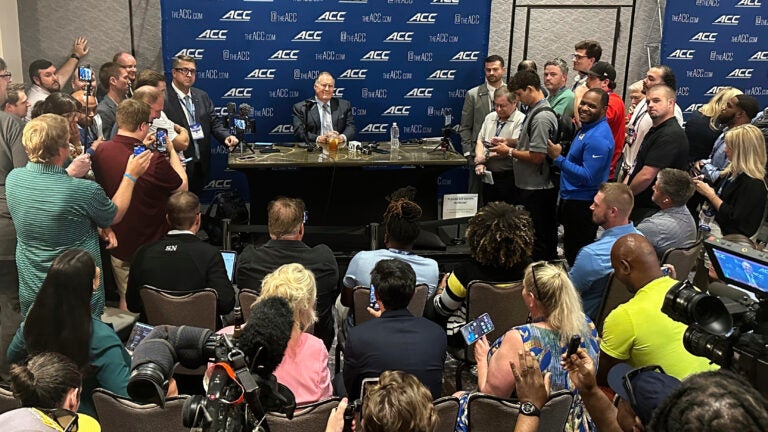
Bill Belichick had his first media day as head coach at North Carolina on Thursday, as he takes his first crack at college football after nearly five decades in the NFL.
“It’s really exciting for me to be here,” Belichick said. “Chancellor [Lee] Roberts, you know, he’s made such a huge difference, and the opportunity to come to North Carolina been very supportive, you know, has given us a great opportunity.
“The roster is very competitive, and I look forward to seeing how all that plays out. Everybody’s got a lot of focus, obviously, on the TCU opener [on Sept. 1], which is in our sights. But really, right now, the big thing for us is just stacking good training days, one on top of another one at a time, and being ready to go, not only for the opener, but for the entire regular season and the ACC schedule.”
Belichick and his staff will be tested on their player development and evaluation as the Tar Heels underwent massive roster turnover — Belichick said there were 70 new players — ahead of a new era.
“Developing players, that’s really what coaching is, and that’s what we do,” Belichick said. “We take great pride in that, myself and our staff and players who want to be developed. A Carolina player is a player who wants to be a good football player, who wants to work hard, who wants to make a commitment toward improving on a regular basis, both [in terms of] training and team execution on the field.”
Belichick referenced his history of player development, from his first head coaching stint in Cleveland to his biggest successes with famous late draft picks in Foxborough.
“Going back, whether it was it Cleveland where Mike [Lombardi] and I put together an offensive line where four of the five starters were free agents,” Belichick said, “or at New England, where we had a number of low draft choices, or high draft choices, I should say, guys like [Tom] Brady and [Julian] Edelman, players like that, who turned out to be great players, as well as some of the other players, higher picks that develop, like [Rob] Gronkowski and so forth.
“So, development is a big part for us, and players that want to come in, work hard, be good players, learn, and compete … Competition is what makes us all better.”
Belichick, a six-time Super Bowl champion with the Patriots, takes over a North Carolina program that finished near the bottom of the ACC last season with a 6-7 record, 3-5 in conference play. The Tar Heels lost the Fenway Bowl to UConn in the shadow of the Green Monster.
North Carolina had some modest success under Belichick’s predecessor, Mack Brown, who led the Tar Heels to four winning campaigns in his six seasons but lost four consecutive bowl games, before he was relieved of his duties ahead of that Fenway Bowl defeat.
Belichick will be looking to bring North Carolina to relevancy in a conference dominated by historical powerhouses such as Miami and Clemson. Dabo Swinney, the latter’s two-time national champion coach, said he’d already learned plenty from Belichick since the 73-year-old took over at North Carolina, something Belichick seemed to laugh off.
“Yeah, we’re all learning from Dabo,” Belichick said. That’s very, very nice of him to say that, very complimentary … I have a ton of respect for Dabo and what he’s done, had a great opportunity to spend some time with him at the ACC coaches’ meetings, enjoyable guy to be around.”
“I don’t know if that’ll be true on Saturday afternoons,” Belichick added, jokingly. “Probably not.”
The biggest on-field question surrounding Belichick’s move has been how he’ll handle coaching college players — particularly in the world of NIL and player payments — after a half-century in the pros. Belichick sounded excited about the opportunity.
“The great thing about working with the college players is just the growth and the development,” he said. “I saw a little bit of that last year when I was at Washington with coach [Jedd] Fish and [Belichick’s son] Steve out there to see how much the players improved from the spring until the start of training camp.
“I’d say, on the college end, you’re right, the players are a little bit younger and less skilled. Sometimes that’s an advantage; there are fewer bad habits to break. But I would say also, the players are much more receptive to the coaching. We’re excited to see how all that manifests itself out on the field and we actually start playing football, but I think we’ll be ready to start when we when we get going next week.”
It wouldn’t be a Belichick media session, however, without a tangent on football’s more marginalized roles and positions. Belichick was asked about the history of the fullback, which opened the door for the football historian to break out an extended monologue on one of his favorite positions.
After two minutes chronicling everything from color-coded adjustments when Belichick started with the Colts in 1975 to the fullback’s place in modern spread offenses, Belichick cracked a smile and quipped: “So, yeah, that’s been an evolution.”
Receive updates on your favorite Boston teams, straight from our newsroom to your inbox.




To comment, please create a screen name in your profile
To comment, please verify your email address
Conversation
This discussion has ended. Please join elsewhere on Boston.com