
Sign up for the Today newsletter
Get everything you need to know to start your day, delivered right to your inbox every morning.
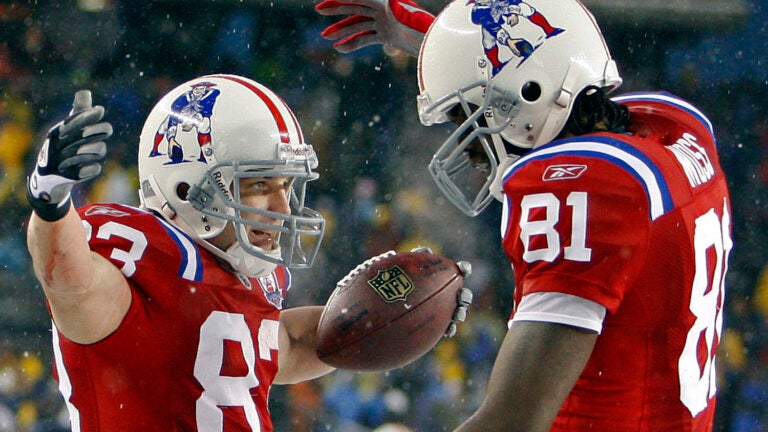
It’s not often a team can pull off two all-time great trades for players at the same position in the same offseason, but that’s exactly what Bill Belichick and the Patriots engineered in a franchise-altering two-month span in 2007.
As the modern Patriots take stock of the team’s less-than-ideal wide receiver corps — simultaneous also to the Boston.com bracket of the “best trades in Boston sports history” — it’s worth looking back at the time New England was able to add both Wes Welker and Randy Moss for next to nothing.
The origin of the momentous 2007 offseason was rooted in a polarizing trade from the year before.
In Sept. 2006, after a prolonged holdout, the Patriots traded wide receiver Deion Branch to the Seahawks in exchange for a 2007 first-round pick. Branch, a Super Bowl hero, was merely the latest of the team’s early dynasty-era receivers to head for the exit (New England had already lost David Givens to the Titans as an offseason free agent departure).
The Branch trade, though it fetched a prized first-round pick, was a shock to the system for a few of the team’s veterans.
“I don’t think any of us envisioned something like this happening,” defensive lineman Richard Seymour told ESPN. “It took the air out of me. It really did. When you look at Deion Branch, he embodies everything we want in a football player. Everything we talk about, the kind of guy we want on this football team, he did as good a job as anybody of embodying that.”
“It’s a tough day for a lot of guys on this football team, especially guys like myself who came in with Deion Branch,” Seymour added. “To not have No. 83 in a Patriots uniform definitely hurts.”
Already immersed in the 2006 season, the Patriots adapted to the circumstances as best as the team could, with backup Reche Caldwell more than doubling his previous season highs in both targets (102) and receptions (61), while 35-year-old veteran Troy Brown posted his best statistical season since 2001.
Yet it wasn’t enough in the AFC Championship, when the Patriots lost in bitter circumstances against Peyton Manning’s Colts. The game, a seesaw 38-34 shootout, ended with a Tom Brady interception as he looked in vain for an open receiver (tight end Ben Watson ended up leading the Patriots in receiving yards that day with 48).
The first step in the Patriots’ offseason plan to rebuild the wide receiver depth chart for Brady came in the unexpected form of Welker.
The 5-foot-9 slot receiver had fought his way into the NFL as an undrafted free agent with first the Chargers and then the Dolphins. He caught zero passes as a rookie, but made an impression in the most “Patriot Way” possible.
Facing New England in 2004, he filled in for Miami’s injured kicker and became just the second player in NFL history to return a kickoff, a punt, kick a field goal and an extra point, and also make a tackle all in the same game (winning AFC Special Teams Player of the Week honors).
By 2006, he had forged a role in Miami, catching 67 passes for 687 yards. After Welker hauled in nine receptions for 77 yards against the Patriots in Week 5, Belichick paid him a high level of respect by having the young receiver double-covered in the ensuing matchup.
A restricted free agent following the season, the Patriots considered signing him in exchange for draft pick compensation. But in order to avoid the occasionally messy tangle of a restricted free agent offer sheet within the division, New England simply threw in an additional draft pick to complete a trade instead.
All told, Belichick sent a second and a seventh-round pick to Miami for Welker, promptly signing him to a five-year deal.
Longtime Texas Tech head coach Mike Leach — who had been the only one to extend a scholarship offer to Welker during his college years — talked up his former player in light of the trade.
“There’s nothing new about this. He’s greatest overachiever I’ve ever coached,” Leach told then-Boston Globe Patriots reporter Mike Reiss (now with ESPN).
After also signing free agent wide receiver Donte Stallworth to a one-year deal, Belichick completed one of the more unexpected yet signature trades of his time with the Patriots.
He pulled off a stunner, acquiring Moss — a legitimate star who had experienced a downturn in Oakland — from the Raiders for a fourth-round pick in the 2007 draft.
The deal was completed on the second day of the draft (back in the era when it was merely a two-day event). Despite a few rumors about the possibility of Moss heading to New England beforehand, the formal announcement of the trade left Patriots fans shocked, yet elated.
“Who invaded Bill Belichick’s body over the weekend?” joked Globe columnist Dan Shaughnessy, alluding to the team’s previously stringent avoidance of adding flashier individuals.
Yet while some columnists dinged New England for heading away from their previous “team-first” principles in the name of adding a major talent, Belichick never had a doubt.
Speaking about the deal in a 2024 interview while a draft analyst on “The Pat McAfee Show,” he admitted that he had been trying to get the deal done for months.
“We’d been trying to trade for Randy Moss for two months,” Belichick explained.
And while the short-term circumstances posed a challenge for the Patriots — having rework Moss’ contract and get him in for a physical to complete the deal — it was nothing compared with convincing the star wideout that the trade was not a joke.
As he is fond of recalling, Belichick noted that Moss initially believed he was on the end of an elaborate prank.
“Is this a joke?” Moss questioned, still unsure if he was actually speaking to the real Belichick. “This better not be a joke. Who is this?”
Eventually, the Patriots were able to get Moss in New England for the formality of a physical.
In just two trades — for a grand total of three draft picks, none of which were first-rounders — the Patriots supercharged Brady’s receiving corps. It set the foundation for what would become a record-setting passing (and scoring) offense.
While it did not culminate with a Super Bowl win, the 2007 Patriots changed the NFL.
And it all started with a legendary offseason, the likes of which the franchise is still trying to recreate.
Get everything you need to know to start your day, delivered right to your inbox every morning.




To comment, please create a screen name in your profile
To comment, please verify your email address
Conversation
This discussion has ended. Please join elsewhere on Boston.com