
Sign up for the Today newsletter
Get everything you need to know to start your day, delivered right to your inbox every morning.
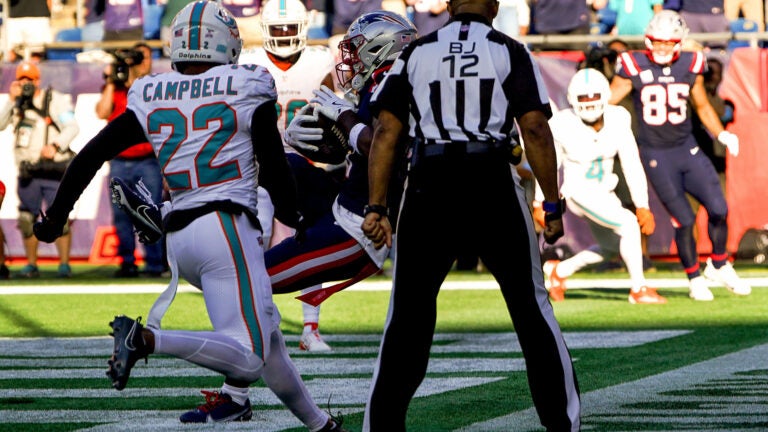
With just over a minute remaining in Sunday’s Week 5 home game against the Dolphins, Patriots quarterback Jacoby Brissett appeared to have given his team a dramatic late lead after completing a 12-yard touchdown pass to rookie wide receiver Ja’Lynn Polk in the back of the endzone.
Yet the touchdown did not stand, called back by officials after it was recognized that — by the specific definition of NFL law — Polk’s foot had not completely come down in-bounds. The Patriots would up losing the game in the end, 15-10.
The exact definition relates to a new aspect of NFL rules in 2024. Article 7 in the rulebook, labeled “Player Possession” — dealing with the NFL definition of a catch — has a new “note” added to it this season.
It reads:
“If any part of the foot hits out of bounds during the normal continuous motion of taking a step (heel-toe or toe-heel), then the foot is out of bounds. A player is inbounds if he drags his foot, or if there is a delay between the heel-toe or toe heel touching the ground.”
In practice, this means that had Polk “dragged” his toes as happens frequently with sideline catches, or had “toe-tapped,” it would have counted. Yet because his toe hit first in the midst of what officials judged was a “normal continuous motion of taking a step,” he was ruled to be out of bounds.
Update: The Patriots provided a transcript of the brief question-and-answer discussion of the incident between PFWA pool reporter Mike Reiss (of ESPN) and NFL vice president of officiating George Stewart. Here’s the back-and-forth:
Question: What was the rule applied in the decision to overturn the touchdown catch by Ja’Lynn Polk?
Stewart: “The rule that was applied was the toe-heel rule. What happened was he did have one foot down in the field of play and at the completion of the second step, he had his toe in the field of play, but his heel came down on the white line out of bounds. So, he did not have two feet in bounds at the conclusion of the catch.”
Question: What were the elements of the play that were essential to the decision to overturn?
Stewart: “Just like I said, he did not have two feet in the field of play. It was a toe-heel, it wasn’t a drag. It was a toe-heel that caused this to be an incomplete pass.”
Question: For Ja’Lynn Polk to have that be a touchdown catch, he needed to have the heel come down in the field of play and not on the white?
Stewart: “Correct.”
This has been a subject of discussion in the league for several years. Alex Barth of 98.5 The Sports Hub pointed out in the aftermath of Sunday’s controversy that there have been previous examples of the toe-touch interpretation of a catch in past years.
In 2024, as noted by the red text in the official league rulebook (indicating that it is new this season), the league “finally codified” the toe-touch rule, as NFL commentator Mike Florio noted prior to the start of the season.
Get everything you need to know to start your day, delivered right to your inbox every morning.



To comment, please create a screen name in your profile
To comment, please verify your email address
Conversation
This discussion has ended. Please join elsewhere on Boston.com