
In 1994, Robert Kraft bought the Patriots and faced problems that seem outlandish 30 years later
"The New England Patriots aren't going anywhere, and the new owner can carry on a conversation about Dapper O'Neil, Revere Beach, the Beanpot, Lou Gorman, Heartbreak Hill, and Eddie Andelman. This is good."
It can be hard for younger Patriots fans in 2024 to imagine a time before the local football team was one of the undisputed main characters of the New England sports universe.
The most recent evidence of the Patriots’ enduring appeal came in the form of Bill Belichick’s departure as head coach and Jerod Mayo’s installation as successor. Despite the team making the playoffs just once in the last four years — and suffering its worst season in decades in 2023 — both events reflexively received widesweeping coverage.
It was, in a distant way, evidence of just how successful Robert Kraft’s tenure as Patriots owner has been.
In the past week, the Patriots marked the 30th anniversary of Kraft buying the team in January 1994 for a then NFL record price of $172 million. Since then, New England has enjoyed a remarkable level of success on the field: 19 division titles, 10 AFC championships, and six Super Bowl wins.
The results off the field — though understandably not as celebrated — have also been hugely important for the team. For starters, questions about the Patriots’ future have settled into more familiar patterns of roster decisions and other football-specific subplots.
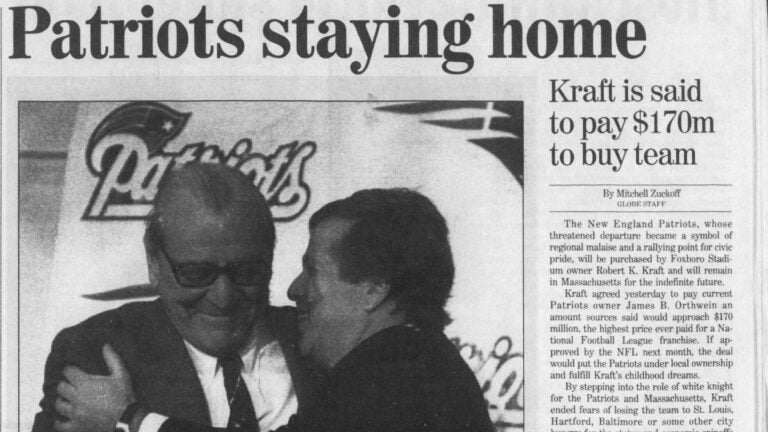
The dark clouds of a potential move to another city have dissolved. Though it’s now an afterthought, the possibility of New England losing its professional football team was very real in the ’90s. The urgency of this threat was underscored by the lede in Boston Globe reporter Micthell Zuckoff’s story on Kraft’s introduction in 1994.
“The New England Patriots, whose threatened departure became a symbol of regional malaise and a rallying point for civic pride, will be purchased by Foxboro Stadium owner Robert K. Kraft and will remain in Massachusetts for the indefinite future,” wrote Zuckoff in the story that appeared on the Globe‘s front page the day after Kraft’s press conference.
Previous Patriots owner James Orthwein was a St. Louis native, and the team was rumored to be a candidate for relocation.
Yet Kraft intelligently used his preexisting ownership of Foxboro Stadium — with its “operating covenant,” which contractually mandated the Patriots to remain there until 2002 — to outmaneuver his out-of-town counterparts. Any attempt to move the team would’ve run into a legal fight in which Kraft likely would’ve held the higher ground.
Kraft was also willing to simply outspend the competition. Even as bidding for the Patriots went well beyond what he’d originally anticipated (Kraft has often recalled that his late wife, Myra, only ever opposed his business sense regarding the Patriots’ price tag), the future owner kept negotiations moving forward.
That he paid a record sum for a team in the midst of four consecutive losing seasons appeared to be a poor business decision at the time. But as Kraft could easily point out, the Patriots’ modern valuation ($7 billion per Forbes in 2023) demonstrates the laughable degree to which his apparently risky financial bet has paid off.
In the moment, Kraft was praised for his commitment to saving the hometown team from a possible departure.
“The New England Patriots aren’t going anywhere, and the new owner can carry on a conversation about Dapper O’Neil, Revere Beach, the Beanpot, Lou Gorman, Heartbreak Hill, and Eddie Andelman,” wrote Globe columnist Dan Shaughnessy. “This is good.”

Of course, Kraft’s commitment to staying in Foxborough would be repeatedly tested (and questioned) in the ensuing years, as multiple stadium proposals in the Boston area were considered and, ultimately, rejected. There was also the period of time in which the team appeared to be headed for a new location in downtown Hartford.
Yet the larger question of whether or not New England would continue to have an NFL team was largely answered that day in 1994.
The other issue which beset Patriots leadership in that era was relevance. In the constellation of New England sports stars during the 20th century, the football team had rarely shined brightest.
“We have an opportunity to do things in this region. Football has never been primary,” Kraft explained in an interview after taking over as owner. “In most areas of the country, it’s the number one sport. We probably have been fourth here of the four major sports.”
Looking back now after three decades, questions about the Patriots’ popularity appear almost as ridiculous as the notion of relocation.
Granted, there was a degree of luck involved (most notably personified in the form of a sixth-round draft pick named Tom Brady), but Kraft’s commitment to winning had already been established.
Having only made three trips to the playoffs in the 15 years prior to becoming owner, the Patriots made the postseason four times in the first five years of Kraft’s tenure during the Bill Parcells and Pete Carroll eras. A “new normal” had already been set even before Brady and Belichick were a partnership.
In 2024, Kraft faces arguably the biggest challenges he’s had to confront in decades. With a new coach, a roster in need of massive upgrades, and ongoing uncertainty at the quarterback position, the future is far from assured.
But however difficult the road ahead might appear, Kraft can reassuringly reflect on two bedrock realities he’s helped create over the last 30 years: That the Patriots are likely to be a leading story, and one that’s taking place in New England, not St. Louis.




To comment, please create a screen name in your profile
To comment, please verify your email address
Conversation
This discussion has ended. Please join elsewhere on Boston.com