
‘The substandards of yesteryear’: The suddenly relevant story of the 1992 Patriots
The distant history of an earlier era Patriots disaster offers fans the most recent example of a truly down season, and what might come afterward.
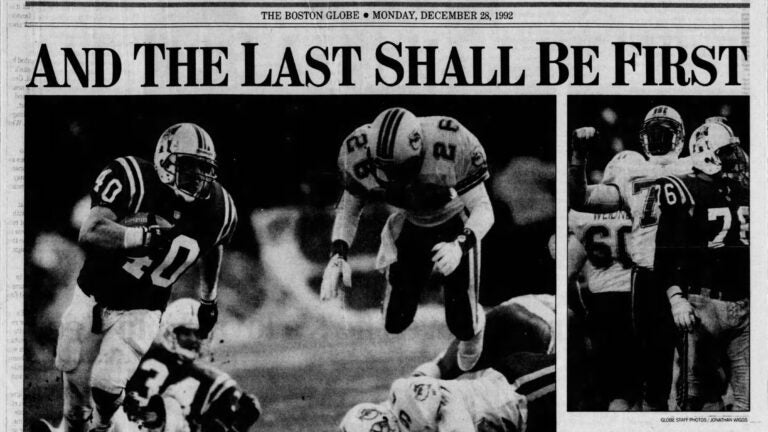
Possessing a roster lacking in offensive talent, a collection of inconsistent quarterbacks, and coaching decisions that increasingly came under criticism, it was no surprise that the Patriots crossed the ignominious threshold of double-digit defeats in a season.
No, that’s not a description of the 2023 Patriots, though it may sound similar to the current debacle.
It’s actually a summary — albeit an admittedly simplistic one — of the 1992 Patriots. That year, New England slumped to 2-14. Until this fall, it was the last Patriots team to amass a truly terrible record.
Granted, the jury is still at least partly out on the current iteration. New England has a few games remaining to try and avoid ending up with the league’s worst record.
Yet for fans who feel unmoored by the unrecognizable experience of a genuine down season, it’s worth revisiting the 1992 slog to 14 losses, if only to provide a reminder of what might come next.
“We are going to be very good.”
The Patriots were in the second year of the Dick MacPherson era in 1992. An energetic 61-year-old Maine native, his head coaching background included successful stops at UMass and Syracuse (including guiding the Orange to an undefeated 11-0-1 season in 1987).
Hired by the Patriots following the abysmal 1-15 campaign in 1990, MacPherson managed to restore a level of respectability to the team in his first season.
“Coach Mac’s enthusiasm was a burst of sunlight in ’91, and New England responded by stealing a few games and winning some others on pure intensity,” wrote Sports Illustrated‘s Paul Zimmerman in an AFC East preview piece prior to the ’92 season.
The Patriots finished 6-10 in 1991, a measurable improvement, though as Zimmerman noted, “talent is thin.”
One bright spot was supposed to be running back Leonard Russell, who the team had picked 14th overall in 1991. As a rookie, Russell rushed for 959 yards and was named NFL Offensive Rookie of the Year. In a preseason poll of general managers taken by “Street & Smith” in the buildup to the 1992 season, Russell was placed in a category of players who were potential “superstars.”
Examining his uneven roster, MacPherson concluded that New England would likely end up in the middle of the pack.
“We won’t be one of the lower-echelon teams and we won’t be one of the top-echelon teams,” he told reporters during training camp, “but we are going to be very good.”
Experts disagreed, listing the Patriots at +10000 to win the Super Bowl, with an over/under of five wins. In fairness, it was far from the worst Super Bowl odds in the NFL: The Colts were listed at +30000.
“A team that invents new ways to lose each week.”
The season was originally scheduled to begin on Sept. 6 in Miami against the Dolphins, but Hurricane Andrew — a deadly Category 5 storm that made landfall in South Florida in late August (along with the Bahamas and Louisiana) — forced the game to be postponed.
Before even playing a down of regular season football, the Patriots had already been shifted from the team’s original plan. Instead of having a midseason bye week (like every other team), New England now had to play 16 consecutive weeks.
When the games finally did get underway, the preseason concerns about the offensive line were quickly confirmed. Facing the Rams, the Patriots surrendered seven sacks and proved utterly unable to move the ball. Quarterback Hugh Millen, a journeyman who started a career-high 13 games for the Patriots in 1991, tossed four interceptions in a 14-0 loss.
The second game proved a worrying continuation of the first, with the Patriots’ offensive line yielding six sacks in a 10-6 loss to the Seahawks. The sour tone was set.
Results didn’t improve in the ensuing weeks. If anything, the team’s performance deteriorated. The Bills — in the midst of four consecutive Super Bowl appearances — flattened the Patriots 41-7 in Week 3. The following week, facing a seemingly even opponent (the 0-4 Jets), the Patriots still engineered a 17-0 halftime deficit en route to a 30-21 loss. Having allowed seven sacks for the second time in the young season, the narrative was already calcifying.
Describing why there was “no hurry” by reporters to seek out player interviews after the Jets game, Boston Globe columnist Michael Madden quipped, “There’s nothing to ask the dead, is there?”
Even by the first week of October, the season was seen as over. Yet a month later, the Patriots were still seeking a first win. Discussion of the team transitioned away from any short-term relevance to its place in history.
A marked difference between the 1992 team and 2023 was the historical baggage the earlier Patriots had to carry. Where their modern counterparts face a very different challenge — living up to the impossible standards of Tom Brady — the 1992 Patriots were simply an extension of a franchise that had struggled for large stretches of its existence.
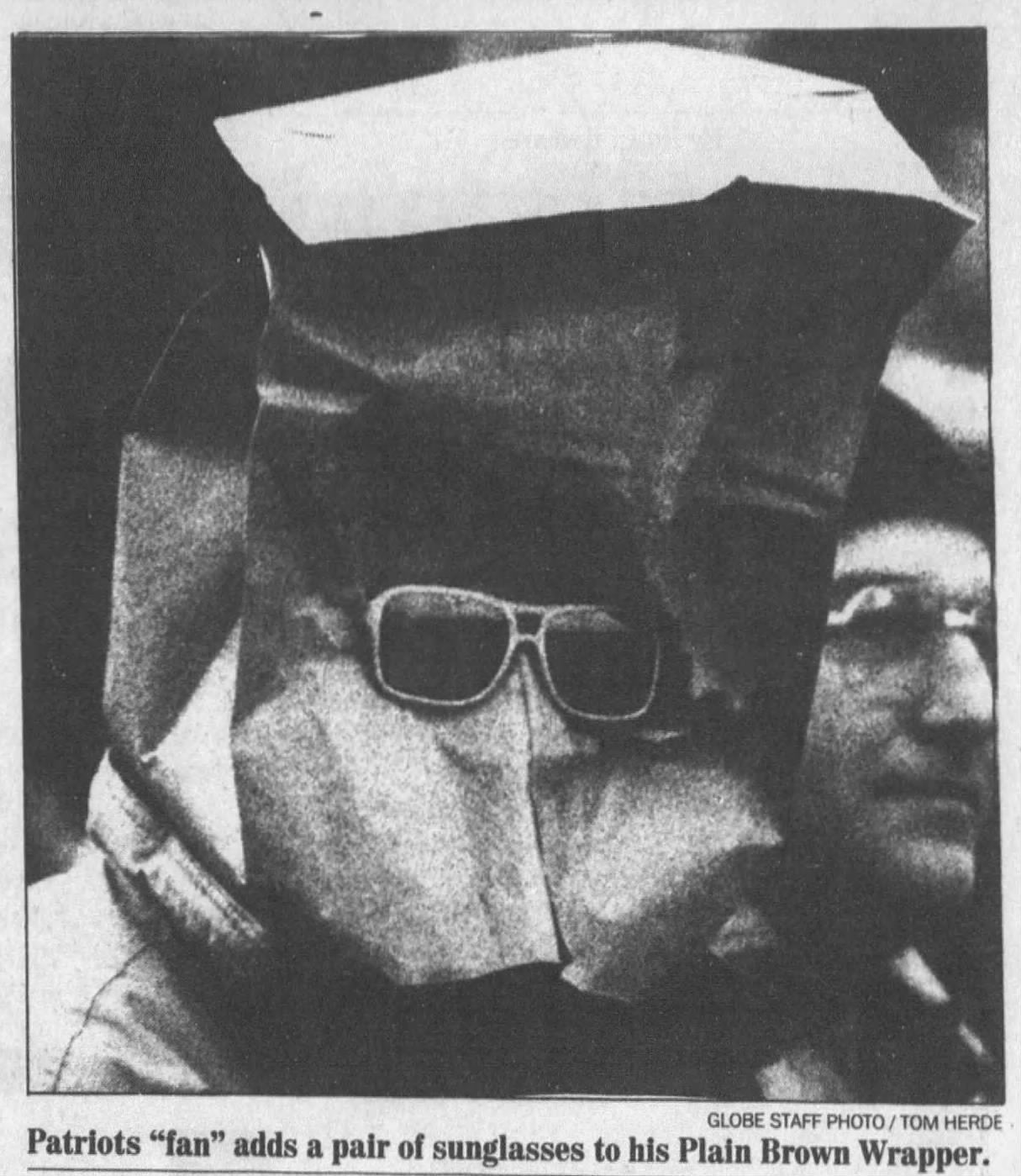
“This year’s team is bad. It is a team that invents new ways to lose each week. But it is not the worst of them all,” wrote Dan Shaughnessy of the Globe after a Week 10 loss to the Saints. “That’s a lofty burden for any Patriot team.
“When the Patriots are the yardstick,” Shaughnessy added, “it’s never easy to measure up to the substandards of yesteryear.”
Still, at 0-9 following the 31-19 defeat to New Orleans, it was officially the worst start in franchise history.
A Globe graphic identified the best sign spotted in the crowd that day. It read: “John 3:16, Pats 0:16.”
Brutal stats bubbled to the surface. Starting at the end of the 1991 season, MacPherson’s team went 41 quarters without scoring a rushing touchdown, broken up only in the eventual loss to the Saints.
Linebacker Vincent Brown was one of the team leaders in touchdowns (with two), finishing the year tied with Russell, the player NFL GMs had pegged in preseason as a potential superstar.
“I don’t know what it is about this organization, but it’s in disarray right now.”
MacPherson’s season was interrupted on his 62nd birthday when he abruptly developed an intestinal disorder (acute diverticulitis) and was hospitalized. Assistant coach Dante Scarnecchia — already in his 10th season and second stint with the Patriots — took over MacPheron’s responsibilities while he was gone.
Scarnecchia and another recognizable name, Scott Zolak, played important roles in what proved to be one of the only fun days for Patriots fans that year. In a Week 10 shootout with the Colts, Zolak (a rookie making his first career start) helped the Patriots finally get a win: 37-34 in overtime.
But after a second win the following week against the Jets, the brief reprieve ended. New England was shut out in back-to-back games — including a 6-0 loss to the Colts in which Indianapolis gained a measure of revenge, notching eight sacks — and finished the season on a five-game losing streak.
“There were a lot of people saying that once the Sullivans left, things were going to get better,” wide receiver Irving Fryar said the day after the last game, referencing original Patriots owner Billy Sullivan and his family. “But it has gotten worse. I don’t know what it is about this organization, but it’s in disarray right now. And that’s why changes are going to be made.”
Fryar’s prediction proved to be accurate, though he wouldn’t be in New England to experience the result as he was traded that offseason to Miami.
Out went MacPherson, who had returned to the sidelines in late December. One day later, Patriots CEO Sam Jankovich resigned.
“We can only wonder what’s next for the cursed House of Patriots,” wrote Shaughnessy.

Though it was impossible to have predicted at the time, what came next was essentially the foundation of the team’s modern success story. Less than two weeks after Jankovich unceremoniously left his post, Bill Parcells arrived amid an unusual amount of fanfare to lead the organization back from the depths.
Handed the No. 1 overall pick (from which Drew Bledsoe would eventually be selected after a classic Parcells-level of mystery), and access to the NFL’s inaugural unrestricted free agent class, Parcells would reshape the Patriots into a Super Bowl-caliber team over the course of four seasons. And within a year, Robert Kraft took over as owner.
Having watched their team get shut out three times in 1992, chalking up a plethora of ignominious stats amid a disastrous season, Patriots fans somehow emerged from it with a renewed sense of hope. The sheer scale of the debacle, though painful in the moment, had forced sweeping changes.
“Within hours, fans rushed to Foxborough to buy 260 season tickets for the 1993 season,” wrote Madden in his column the day after Parcells’ first press conference. “And for the first time in years, they may get their money’s worth.”




To comment, please create a screen name in your profile
To comment, please verify your email address
Conversation
This discussion has ended. Please join elsewhere on Boston.com