
Devin and Jason McCourty are helping kids fight a familiar off-field battle
“There’s so much fear that goes around with dealing with a disease like this," Jason McCourty says of sickle cell disease.
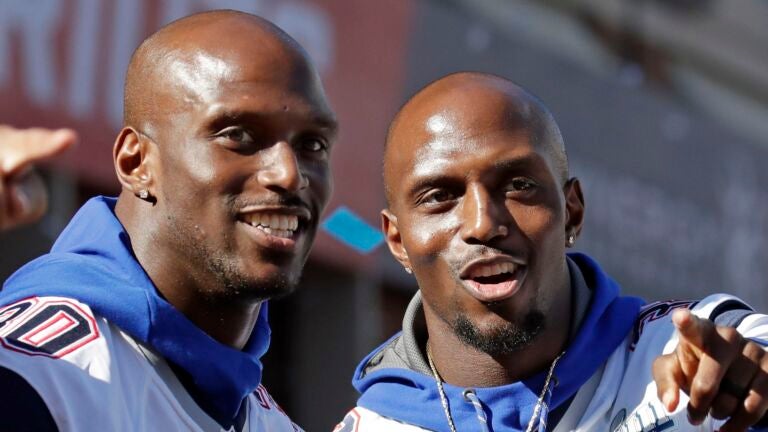
Devin and Jason McCourty knew when they entered the NFL that they wanted to be were advocates for sickle cell disease, an illness that disproportionally affects Black Americans.
The twin brothers and former Patriots players have been personally affected by the disease. They had an aunt and uncle who had it, while their father held the trait and passed away when they were 3 years old.
The McCourtys created Tackle Sickle Cell, a campaign to bring awareness to the disease that causes red blood cell disorders, not long after they began their NFL careers in 2009 (Jason, Titans) and 2010 (Devin, Patriots) respectively. Through the campaign, the twins have met many people who have sickle cell disease.
Recently, Devin and Jason met with siblings Dontrell and Ashanti Pickens from South Carolina over Zoom, pairing with the young sickle cell disease patients through Be The Match, a national bone marrow transplant program.
Dontrell, 13, has faced major health problems stemming from the disease in recent years. He’s suffered three strokes, with the first occurring in December 2020. After his third stroke, Dontrell underwent brain surgery in October 2021, undergoing an indirect bypass to help fix the blockage in one of the arteries in his brain.
“He has experienced TIAs (transient ischaemic attacks), which are very scary because you never know when it’s going to happen,” Dontrell’s mother, Toni Yates, told Boston.com. “Like, the last three times he woke up from his sleep and he couldn’t feel half of his body or his face. So, it’s very scary.”
Ashanti, who turned 12 on Friday, has dealt with more pain-related issues than her brother has, dealing with “very, very horrible crises over the last two years,” according to her mother.
“One of her most recent crises happened about a year and a half ago,” Yates said. “She actually told me she ‘wanted to go to heaven.’ She was in that much pain and was in the hospital for about seven days. She doesn’t have strokes or TIAs like Dontrell, but she’s been sick, sick to where she thought she was going to die.”

Yates said she learned that her kids both had sickle cell disease when they were both two weeks old. When she was seven weeks pregnant with Dontrell at 19 years old, Yates actually learned that she carried the trait, but didn’t want to find out if her son had it, saying the doctors told her that he would eventually die of sickle cell and saying his life expectancy would be around 40 or so.
Yet, Yates has pushed through. In fact, when she spoke with Boston.com last week, she shared that Dontrell was going through another pain crisis.
“We battle sickle cell every day,” Yates said.
The McCourty twins were both inspired by Dontrell and Ashanti as they’ve juggled the struggles of growing up with sickle cell disease while trying to have a normal childhood. But what particularly drew them into their story was their mother, relating it back to their own story.
“We grew up with a single mom, and mom did everything,” Jason McCourty told Boston.com. “The strength of Toni and seeing her sit side-by-side with her children and talking about some of the challenges and how they’ve worked together as a family and how they’ve figured things out no matter what the obstacle is or what the challenge is was very inspiring to us.
“We knew how much our mom meant to us growing up and how much she continues to mean to us as adults and as a grandparent to our six kids, total. I think that’s what stuck out. Getting to hear and listen to their story was very empowering.”
Devin agreed with his brother, saying how the parents of kids with sickle cell are their “No. 1 advocate” as they make sure everything is going right.
When Dontrell underwent brain surgery in October 2021, Yates was right by his side. Not long after his surgery though, Dontrell was acting like a kid again. He was riding a bicycle in his first full day in the ICU and was discharged three days sooner than expected, saying that the early recovery process was nothing compared to sickle cell, his mom recalled.
“[That] made me cry because for him to go through a whole brain surgery and be like, ‘It didn’t hurt as much as when I was in pain.’ That, as a mother, is very hurtful,” Yates remembered.
Yates commends her son on his strength though.
“Dontrell is very strong,” Yates said. “ … He doesn’t let anything hold him back. He’s definitely a go-getter. He’s definitely fearless. He’s so fearless. He’s so not scared by normal things because he’s faced so much in the 14 years he’s been here.”
However, that fearlessness wasn’t immediately on display when the family met the McCourtys on the Zoom call.
“He was very nervous when he met the McCourty twins because he loves football and he always wanted to play football,” Yates said. “But with sickle cell, you can’t play contact sports. So, he’s never been able to play. … He was really nervous when he met them but he was really excited to meet them.”

Devin enjoyed the moment.
“Them sitting side-by-side was probably the coolest moment as we were asking them questions and they were getting shy,” Devin told Boston.com. “Toni would tell them, ‘Oh, now you’re acting shy.’ They slowly got out of their shell.
“It was just cool to see, like me and Jason know in that background, seeing the kids slowly coming out of their shells and opening up and smiling and laughing was really cool to see at their age and knowing how much they’ve gone through with strokes and different things like that,” McCourty added. “It’s not always easy. Us being random two guys that want to help out on a Zoom call and to see them come out of their shells was a fun experience for both of us.”
The McCourty twins said that in most of their conversations, the parents typically know who they are while most of the kids don’t necessarily have a full realization of who they’re talking to. Yates falls in the same category as most parents. A Newport, Rhode Island, native, she roots for the Patriots and all Boston sports.
Yates wasn’t able to pass on her Patriots fandom to her son though. Dontrell is a big Eagles fan and even had a chance to potentially meet the Eagles through Make-A-Wish. He opted to go to Disney World instead.
Dontrell made the McCourtys aware of his Eagles fandom.
“They actually said, ‘Oh man Dontrell, we actually lost in 2018 to them,’” Yates said as Devin recalled the Patriots’ Super Bowl LII loss to the Eagles. “And he said, ‘I know. I was so happy!’”
Other than talking about football, the McCourtys used their conversation with Dontrell and Ashanti to give them hope and share stories of other people they know or have met who have been able to live somewhat normal lives with sickle cell.
For instance, the McCourtys met a child named Jimmy from New Jersey a little more than five years ago. He just finished his freshman year at the University of Albany as a straight-A student. In addition, Devin recalled how he met Brunel Ettiene “seven or eight years ago” at Boston Children’s Hospital and just found out he was able to go on his second cruise.
And then there’s their aunt, Winfred, who is the main inspiration behind the twins’ mission to bring awareness to sickle cell disease. She was told at 10 years old that she wouldn’t make it past 35. She ended up living to be 69 years old and “did things doctors told her she would never be able to do” before passing away in 2019.
“When we tell them the story of our aunt, it adds inspiration,” Jason said. “I remember about six or seven years ago, talking to a mom who wanted us to talk to her son because he was living in a way that he thought he was on borrowed time and he was doing as many things as possible at such a young age because he was looking at an expiration date and didn’t think he was going to be able to live past it.
“There’s so much fear that goes around with dealing with a disease like this, so I think continuing to tell other people’s stories like this continues to help.”

Dontrell, however, is already hopeful. Yates is also hopeful for her son and daughter to get a bone marrow transplant, which is the only known cure for sickle cell disease.
Dontrell and Ashanti’s doctors are planning for them to receive a bone marrow transplant sometime next year. The doctors want “to move forward as quickly” as possible with Dontrell’s transplant due to his prior health issues. They’re also urgent with Ashanti because there aren’t any more treatments and medicines they can give for her pain, with a cure being the next step.
Unfortunately for Dontrell and Ashanti, they’re facing the same problem many have faced. Only 30 percent of patients seeking a bone marrow transplant are able to find a match within their family. Dontrell and Ashanti are only half matches with their parents, which allows them to undergo a haploidentical transplant. But it’s preferred for them to undergo a transplant with someone who is a full match, as doctors told Yates that they would have an 85 percent chance of being cured with someone that’s a full match and a 70 percent chance of being cured if they underwent a haploidentical transplant.
So, like many sickle cell patients seeking a bone marrow transplant, Yates and her family turned to Be The Match, a registry that helps patients find matches for marrow transplants.
Like many African-Americans though, Dontrell and Ashanti have struggled to find a full match so far. Just 29 percent of African-Americans are able to find a match for a bone marrow transplant within Be The Match’s registry, which pales in comparison to the 79 percent success rate that white people within the registry are able to find a match.
That’s why the McCourtys are pleading with those who are able to possibly be a bone marrow donor.
“I think it was a cool thing to team up with Be The Match because it’s so simple,” Devin said. “You just decide you want to do it and swab the inside of your cheek and you’re off to the races. It doesn’t promise anything, but I think the more people that you get involved and what they’re doing on college campuses at some point can be huge.”
“We need people to get involved and swab their cheeks to see if they’re going to be a donor,” Jason added. “But we also need a wide variety of different ethnic backgrounds and races and people joining in to be able to spread that out and bring those numbers up for everybody.”
Anyone can become a donor through Be The Match, who also provides virtual kits to willing donors to see if they’re a match for anyone within their registry. Testing is free and if you are a match with someone seeking a bone marrow transplant, and Be The Match will also cover the costs needed to help set up the transplant. (Willing donors can visit My.bethematch.org/CureForSCD or text “CureForSCD” to 61474 for more information.)

Yates is also hoping to spread awareness. She said she’s already gotten 15 diverse people to join the registry.
One way she’s helped spread awareness is through social media. She created a Facebook group for moms of kids with sickle cell called “Sickle Cell is Curable.” It only has 23 members so far, most of which are located in the South Carolina area, but she said she knows it’ll blow up someday.
Yates also helped her daughter create an Instagram account as she’s doing pageantry, using the account to make constant posts dedicated to spreading sickle cell awareness as well. They documented a snippet of their call with the McCourty twins on the page, too.
Whenever her kids get transplants, Yates’s ultimate goal after that is to get them to college. And whatever happens next for Yates and her family though, the McCourty twins wanted her to know one thing when they spoke with her: that she’s “a rockstar.”
“I think the guilt and the shame and all of that, you throw it to the wayside and you figure out a way,” Jason said on the message he tells parents who have kids with sickle cell disease. “If you’re a parent and you’re talking about it, you’re already figuring out a way. It’s not easy. Nothing about it.”
Yates appreciated their message.
“They told me to just keep doing what I’m doing. To be a mom and hang in there. Keep being strong, which is very motivating,” Yates said. “As a parent with kids who have sickle cell, you have to be very strong.”




To comment, please create a screen name in your profile
To comment, please verify your email address
Conversation
This discussion has ended. Please join elsewhere on Boston.com