
10 things we learned from Ernie Adams’s in-depth podcast interview
"We've been having a football conversation for 50 years," Adams said of his friendship with Bill Belichick.
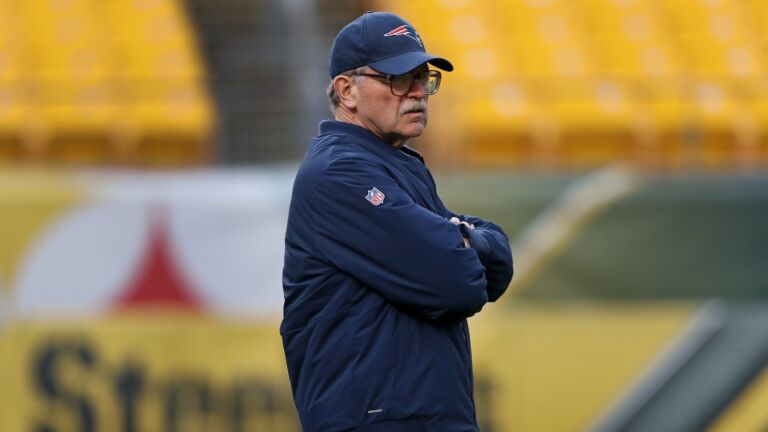
There are few people in the football world Bill Belichick trusts more than Ernie Adams.
Adams, 69, first met Belichick in 1970 when the two were in high school. Then seniors on an undefeated football team at Phillips Academy, they formed a friendship and found a mutual passion for football that has spanned decades, taking them to several NFL teams and (eventually) an unprecedented run of Super Bowl wins.
In 2021, Adams retired from the Patriots after two decades as the team’s football research director.
Though his role was nebulously defined — a fact that once caused Cleveland Browns owner Art Modell to quip that he would “pay anyone here $10,000 if they can tell me what Ernie Adams does” — Adams was very much in Belichick’s inner circle.
And since he rarely spoke publicly during the years before he retired, Adams’s recent interview on the “Pats from the Past” podcast presented a chance to hear from one of the more mysterious figures of the Patriots’ dynasty.
Here are a few observations from the interview:
He’s not obsessively watching every football game in retirement.
Despite his reputation as an intense football researcher, Adams said he’s had no problem stepping away from the game.
“I knew it was going to come,” he said of retirement. “Dying at the office was never part of the plan. It felt like the right time.”
Does he watch NFL RedZone from start to finish each Sunday?
“I certainly watched the Patriots’ games, and if there were teams that were interesting to me, then I would watch them,” Adams said of the 2021 season. “I did not sit there glued watching every game that came on.”
How did he originally get interested in the sport?
Adams offered a rare glimpse into his background, discussing his football origins.
“It was when I was an eighth grader at Dexter School in Brookline,” Adams recalled. “Football was mandatory, intramural. So there was no choice if [you] wanted to play football or didn’t. At Dexter School, you’re going to play football.”
After badgering a coach for long enough, Adams was given his chance.
“He finally said, ‘Look, you’re so smart, why don’t you coach the team and we’ll see how you do,’” Adams remembered. “And that’s where it started.”
The connection with Belichick happened quickly.
Asked how long it took him to figure out that Belichick was similarly obsessed with football after the two first met, Adams noted that it was “probably about a minute.”
“We had a great time together,” he added. “It basically started a 50-plus year conversation about football.”
Still, Adams admitted he had no idea that their mutual interest would amount to anything special.
“We both knew that we really enjoyed football. I can’t say that we had every step of the way mapped out. Things went from there.”
He holds two of the Patriots teams of the ’70s in high regard.
Unlike Belichick, Adams worked for the Patriots in his first NFL job as an offensive assistant.
During his time (from 1975 through 1978), Adams got to witness two of the better Patriots teams from that era.
“In ’76 we were a championship-caliber team,” he said. “Even though we didn’t win it, most seasons still end up being two or three teams playing at the end that have a legitimate chance to win and we were one of them.”
New England went 11-3 that season, but lost to the eventual Super Bowl champion Raiders in the playoffs thanks partly to a controversial roughing the passer penalty called against Patriots defensive lineman Ray Hamilton.
“The two best teams in the league that year were the Patriots and the Raiders and they came out on the long end of the score,” said Adams. “You hate seeing a game really come down to a call, but it did.”
In 1978, New England once again assembled a talented team. But as had happened in 1976, the Patriots exited the playoffs without a Super Bowl win.
Put to a comparison between the two teams, Adams sided with the latter.
“I must say probably the ’78 team because instead of Steve Grogan being a rookie quarterback, he was in his third year,” he explained. “We had Stanley Morgan and Harold Jackson at receiver and we were more explosive on offense in 78. In the end though the ’76 team was the one that came closest to winning the championship.”
His opinion on the Russ Francis vs. Rob Gronkowski discussion.
During the course of the interview, Adams was asked about Patriots from his time with the team during the 1970s. One name that was mentioned was tight end Russ Francis, who made the Pro Bowl in three consecutive years while Adams was in his first stint with New England.
Considering Francis’s skill both as a pass catcher and a blocker, Adams was asked to compare him to Rob Gronkowski.
“The biggest difference between Russ Francis and Rob Gronkowski is that Rob played on a passing team with a Hall of Fame quarterback,” said Adams. “I mean [with] Russ we were more of a running team and, like Rob, was a devastating blocker on the edge. Russ had great athletic ability, great hands, when you talk what do you want in a tight end, you think of Russ Francis and Rob Gronkowski. I have no problem putting them in the same [category].”
How he viewed the Patriots’ expectations heading into the 2001 season.
Few teams in NFL history have experienced a more unexpected run to a Super Bowl championship than the Patriots did in the 2001 season.
For Adams, the goal heading into Belichick’s second season as head coach was fairly basic.
“I just wanted to see us make some progress,” he said, noting that the team had blown multiple late leads in the 5-11 season in 2000.
Looking back, Adams views New England’s first Super Bowl winner differently than the others.
“We weren’t really a juggernaut at that stage,” Adams explained. “I mean I tell people the 2001 team, we were just the little engine that could. This was 15 years before we became the evil empire.”
A view into the conversations with Belichick.
At a pure football level, the meeting of minds between Adams and Belichick became legendary in New England.
Adams gave some context around how he would discuss the game.
“We’ve been having a football conversation for 50 years. At the Giants, we’d go for long runs together. We can do a lot of things very quickly because we have some common reference points,” said Adams. “Something that happened in Cleveland in 1993, nobody else on the face of planet earth will remember but, [I’ll say] ‘Hey Bill, remember what we did in Cleveland, this really worked in this situation.'”
“We can make big changes in a hurry because we’ve spent so much time talking, we know what each other are talking about.”
The evolution of Tom Brady.
Like anyone else who was with the Patriots in the 2000s, Adams had a front row seat for the rise of Tom Brady. Asked if he could identify one moment when he knew Brady would be a special player, Adams took a longer view.
“I don’t know if that it was one specific play but as we started playing in 2001, Tom just got better every week,” he said. “The team responded well. He was doing well. I think it was more of a process than one play.”
And after Brady led New England to the Super Bowl XXXVI win, the quarterback competition with Drew Bledsoe was decisively ended.
“Being realistic about it we knew after the 2001 season that Tom was going to be our quarterback,” said Adams. “We weren’t going to have Drew here as our backup. That realistically was not going to happen.”
Looking back at the Patriots’ dynasty is easier now that he’s retired.
Though the Patriots are known for the Belichick principle of never looking back at what the team has already accomplished, Adams says that he’s able to enjoy the past success now that he’s retired.
“You win the Super Bowl, they do a special issue of Sports Illustrated. I mean I’ve got all the issues from when we won,” Adams proudly described. “I’ve got them all signed by everybody who [was on the team]. I’ve got them all on my wall, sure. I know that even though when you’re in it, it’s ‘Let’s get ready for the next practice. Let’s run the ball off-tackle better.’ You sit back and say hey, we had maybe the greatest run in the history of the National Football League. That’s a big deal.
“Winning it once is really hard. Doing it repeatedly is a phenomenal accomplishment,” Adams added. “But again, the biggest thing was when you’re doing it, you’re just thinking next play, next game. It’s one game at a time. I know people say, ‘That’s coach talk, one game at a time,’ but it’s the key to success. Getting people to believe is the key to success.”
He offered his take on Pat Patriot vs. “The Flying Elvis.”
One of the final questions Adams was asked was which of the team’s logos he prefers.
After decades of using “Pat Patriot,” the team — which had also by then changed its official location from Boston to New England — adopted an updated logo in the 1993 that’s become known as “The Flying Elvis.”
For Adams, who recalls seeing Patriots games at Fenway Park decades ago, it was no contest.
“Pat Patriot,” he said. “That’s Boston. That’s New England. For me, every time.”




To comment, please create a screen name in your profile
To comment, please verify your email address
Conversation
This discussion has ended. Please join elsewhere on Boston.com