
Why the Patriots shouldn’t draft Tua Tagovailoa
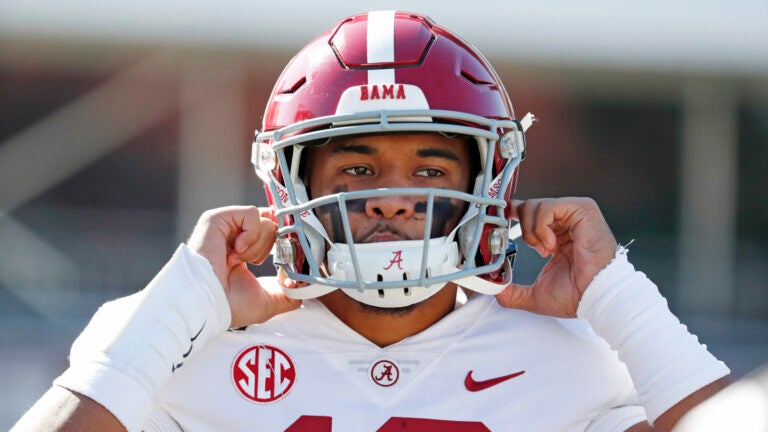
It would be unlike Bill Belichick to trade up for Alabama quarterback Tua Tagovailoa.
Related Links
COMMENTARY
The fit between New England and the talented Alabama quarterback is an uneven one, and brings risk.
Until the Patriots find their next franchise quarterback of the future, rumors will fly every spring attempting to connect the franchise to top quarterbacks in the NFL Draft. This year, it’s Tua Tagovailoa.
With a clean bill of health, Tagovailoa would give Joe Burrow a run for his money as the best quarterback prospect in the 2020 draft. But what makes Tagovailoa perhaps the most polarizing prospect in this year’s draft is the serious hip injury that ended his junior year in November 2019, and raised questions about his long-term durability.
Those questions about his ability to stay on the field could lead to every NFL fan’s worst nightmare: the Patriots replacing their legendary franchise quarterback with a young, elite quarterback prospect who fell to them because of injury concerns.
The chances of Tua Time coming to New England are slim, because it would take a drastic nosedive — he would have to be passed over 22 times — before the Patriots could have their chance at scooping him up with the 23rd overall pick. With the likelihood of this happening being slim to none, the question is: Does it make sense for New England trade up for Tua?
In a vacuum, drafting Tua is a no-brainer. Despite the promise that second-year quarterback Jarrett Stidham has shown, Tagovailoa would likely project to be the team’s starting quarterback as a rookie right away. He is that good, when healthy.
But there are three things that make Tua becoming a Patriot unlikely.
The Patriots typically target bigger guys.
Historically, Bill Belichick does not draft quarterbacks like Tagovailoa. At 6-feet 217 pounds, Tagovailoa is a smaller, more mobile quarterback prospect than the 11 passers Belichick has drafted with the Patriots.
The shortest quarterbacks Belichick has drafted for the Patriots were Rohan Davey (2002) and Jimmy Garopolo (2014), who were both 6-foot-2.
Typically, Belichick has shown an affinity for quarterbacks with more compact releases and prototypical size — players with more NFL-ready frames. Tagovailoa has the vision, the accuracy, and the pocket awareness, but he lacks the physical profile.
His durability is a concern.
On top of his uneven fit from a size standpoint, Tagovailoa’s struggles with staying on the field are sure to be an issue for Belichick, who often preaches that “the greatest ability is availability.”
In Tagovailoa’s three-year career at Alabama, he has suffered a broken left index finger, a sprained right knee, high ankle sprains on both ankles, and most recently, a dislocated right hip. He underwent three surgeries in an 11-month span, which is especially concerning.
Part of what makes Tua such a tantalizing prospect is his playmaking ability, but it’s his desire to make plays no matter the cost that increases his exposure to hits and thus, to injury. His inability to protect himself is a red flag, one that will surely hurt his draft evaluation with New England.
It would be a major shift in the Patriots’ philosophy.
Trading up for Tagovailoa would also go against Belichick’s emphasis on team-building that he has stuck to since day one of his coaching career. New England has far too many glaring holes on their roster to sacrifice so much draft capital in order to select one player, even if that player is a potential franchise quarterback.
Using the trade value chart developed by Rich Hill of Pats Pulpit, we can illustrate just how costly it would be to move up to select Tagovailoa.
To jump ahead of Miami and the Los Angeles Chargers, New England could trade with the Giants, who have been rumored to consider trading out of the fourth overall pick (491 points). To do so, that would cost New England at least pick Nos. 23, 87, 98, 100, and 125 (350 points). That still would not equal the point value of the fourth overall pick, meaning they would need to part with next year’s first-rounder too, or include a starting-caliber player currently on the roster.
Now let’s say Tagovailoa slides. Things get a little more manageable, right?
Not really. Let’s say you trade for San Francisco’s 13th overall pick, valued at 336 points. You would still have to give up pick Nos. 23, 87, 98, 100, and 125.
New England does not have the draft capital to swing a trade for Tagovailoa without giving up an exorbitant number of draft picks, unless he falls into the late teens or early twenties. Belichick has never been one to give up so much compensation for one player, and it would be surprising to see him do that now.
With the talent in this year’s draft expected to last well into the middle rounds — where New England has three third-rounders, two fourth-rounders, and one fifth-rounder — the Patriots can improve its depth and get younger at several positions. Belichick isn’t afraid of taking risks, but trading up to draft Tagovailoa is too great a risk, even for him.




To comment, please create a screen name in your profile
To comment, please verify your email address
Conversation
This discussion has ended. Please join elsewhere on Boston.com